
There are moments when hunger arrives softly—your stomach whispers, your energy dips, and food feels like a clear, loving answer.
And then there are the other moments.
The ones where you’re standing in front of the fridge, door open, light spilling out, and something inside you feels restless. You ate not long ago. Your body isn’t asking. But something is.
If you’ve ever wondered why this happens—why food becomes magnetic when life feels heavy, lonely, or overwhelming—I want you to know this first:
Nothing is wrong with you.
You’re not weak.
And you’re not lacking discipline.
You’re responding to a very human need.
As a WildFit coach and functional medicine practitioner, I’ve watched this pattern emerge again and again. When we stop reducing eating to calories and willpower, and instead view it through the lens of Maslow’s Hierarchy of Needs, a gentler truth reveals itself:
We don’t just eat to survive.
We eat to feel safe.
We eat to belong.
We eat to feel worthy.
And sometimes, we eat because it’s the only place we’ve learned to go when something inside us is unmet.
The Hidden Conversation Between Your Nervous System and Your Plate
Maslow’s hierarchy is often taught as a pyramid—basic needs at the bottom, self-actualization at the top. But in real life, it’s less of a ladder and more of a tide. We move up and down throughout the day, depending on stress, sleep, relationships, finances, and the stories our nervous system is telling us.
Each level whispers something different into our food choices.
When we learn to listen, eating stops feeling like a battleground—and starts becoming information.

1️⃣ Level One: Survival Needs
When Stress Makes Food Feel Urgent
At the foundation are our most primal needs: food, water, rest, shelter.
When these feel threatened—even subtly—the body tightens. Cortisol rises. The nervous system shifts into protection.
This can look like:
- Cravings that feel urgent or panicked
- Overeating during financial stress
- Reaching for sugar or caffeine when exhausted
- An inability to waste food, even when you’re full
Often, this isn’t hunger at all.
It’s the body saying, “Am I safe?”
A gentle inquiry:
Am I actually hungry—or am I tired, thirsty, overwhelmed, or afraid of scarcity?

2️⃣ Level Two: Safety Needs
Why Familiar Foods Feel So Comforting
Once survival is met, the body longs for predictability. Stability. Order.
In uncertain seasons, food often becomes a stand-in for safety. The same meals. The same snacks. The same rituals. Not because they’re optimal—but because they’re known.
You might notice:
- A pull toward childhood comfort foods
- Rigid food rules that create a sense of control
- Anxiety when routines are disrupted
- Eating “safe foods” on repeat
This is where emotional eating quietly roots itself—not as a flaw, but as a coping strategy.
A gentle inquiry:
What does this food give me emotionally that my life feels short on right now?
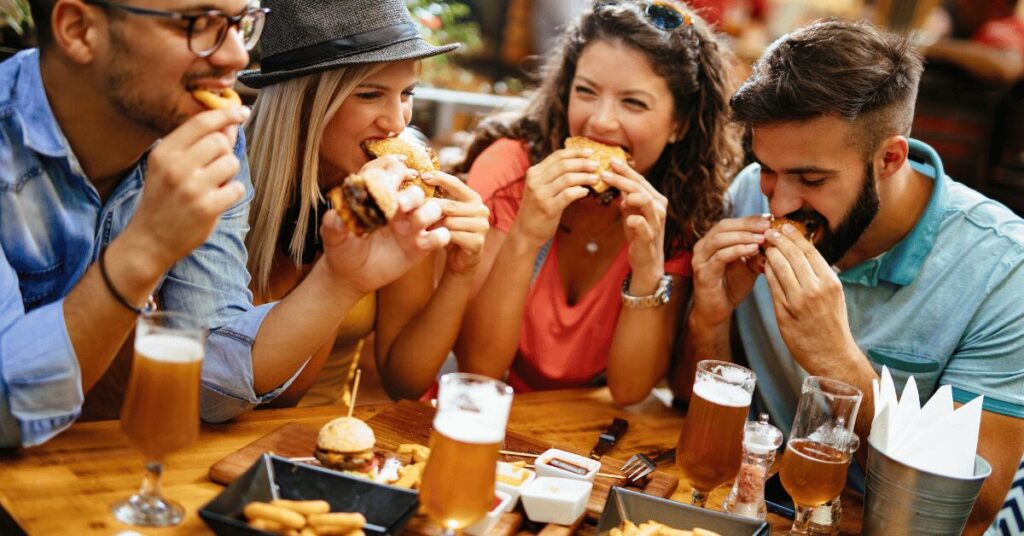
3️⃣ Level Three: Love and Belonging
Food as a Language of Connection
Long before food was fuel, it was relationship.
We were fed while being held. Celebrated with meals. Comforted with treats. So it makes sense that when connection feels thin, food becomes louder.
This can show up as:
- Eating to fit in
- Guilt for eating differently than loved ones
- Fear of missing out at social events
- Using food to soothe loneliness
- Sacrificing your needs to preserve belonging
Sometimes the craving isn’t for food at all.
It’s for closeness.
A gentle inquiry:
Am I feeding myself because I’m hungry—or because I feel alone?

4️⃣ Level Four: Esteem Needs
When Food Becomes a Measure of Worth
This is where diet culture does its deepest harm.
At this level, food is no longer just food—it becomes morality. Identity. Proof that you’re “good enough.”
You might recognize:
- “Good” and “bad” foods becoming “good” and “bad” days
- Shame after eating
- Restriction as a form of self-control
- Rewarding success with food, punishing yourself without it
- Comparing your eating to others
Here, eating isn’t about nourishment.
It’s about earning approval—often from yourself.
A gentle inquiry:
Who would I be if my worth wasn’t tied to what I ate today?

5️⃣ Level Five: Self-Actualization
Eating as an Expression of Self-Trust
At the highest level, food softens.
Choices come from alignment, not fear. Curiosity replaces judgment. Nourishment becomes a way of supporting the life you want to live—not fixing yourself.
This looks like:
- Flexibility without chaos
- Intuition without rigidity
- Enjoyment without guilt
- Food as fuel for purpose, creativity, and presence
This isn’t perfection.
It’s relationship.
A gentle inquiry:
If I trusted myself fully, how would I eat today?
You Don’t Live on One Level—You Move Between Them
You might eat intuitively on a calm Sunday morning…
Then find yourself stress-snacking by Tuesday afternoon.
That’s not failure.
That’s being human.
Different moments activate different needs. Food simply follows.
A Simple Practice: The PAUSE Method
The next time you reach for food when hunger feels unclear, try this—softly, without pressure:
P — Pause. Take three slow breaths.
A — Acknowledge. Name the emotion present.
U — Understand. Which need is asking to be met?
S — Seek. What would actually support that need right now?
E — Engage. Eat if you choose—slowly, without guilt—or meet the need another way.
There is no wrong outcome here. Only information.

Compassion Changes Everything
When you see your eating through this lens, the shame begins to loosen.
The night binge isn’t a lack of discipline—it’s often a search for safety.
The struggle while traveling isn’t weakness—it’s a pull toward belonging.
Your patterns make sense when you listen to what they’re trying to protect.
And when you ask, “What do I really need right now?” instead of “What’s wrong with me?”—everything shifts.
A Few Gentle Invitations This Week
- Notice your emotional state before eating—not to control it, just to witness
- Identify which level shows up most often for you
- Create non-food ways to meet that need
- Practice kindness when old patterns appear
Healing isn’t about eating perfectly.
It’s about understanding yourself deeply enough that food no longer has to carry the weight of unmet needs.
Ready to Go Deeper?
If this resonates, and you’re ready to untangle your food story with support, I’d love to walk with you.
✨ Join the WildFit Food Freedom Challenge here.
Classes are starting soon, and this work changes everything.