

Clinical Insights • Stress & Recovery

Why Am I So Easily Overwhelmed Lately? When Stress Overflows, Small Things Feel So Big

If little things are hitting harder than they used to, you’re not getting weaker. Your load and your recovery are out of balance. Here’s how to see both sides, and where to start.


Quick Capacity Check

Which of These Looks Most Like Your Week?

  • Work messages before breakfast
  • Caregiving logistics running in the background all day
  • Lunch at 2:36 p.m. because the calendar won
  • Awake at 3:18 a.m., then expected to perform at 8
  • Pain, illness, or hormone symptoms taking their own share of your energy

If you nodded at more than one, it makes sense that a mildly annoying email suddenly feels like too much. That isn’t a character flaw, and you’re not “bad at stress.” You’re carrying a lot, and you probably haven’t had much chance to refill.

You’re not getting weaker. You’re carrying a lot, with nothing draining back out.

I use a simple picture to help people see that: the stress overflow model.

Woman feeling overwhelmed by a busy week
A Simple Picture

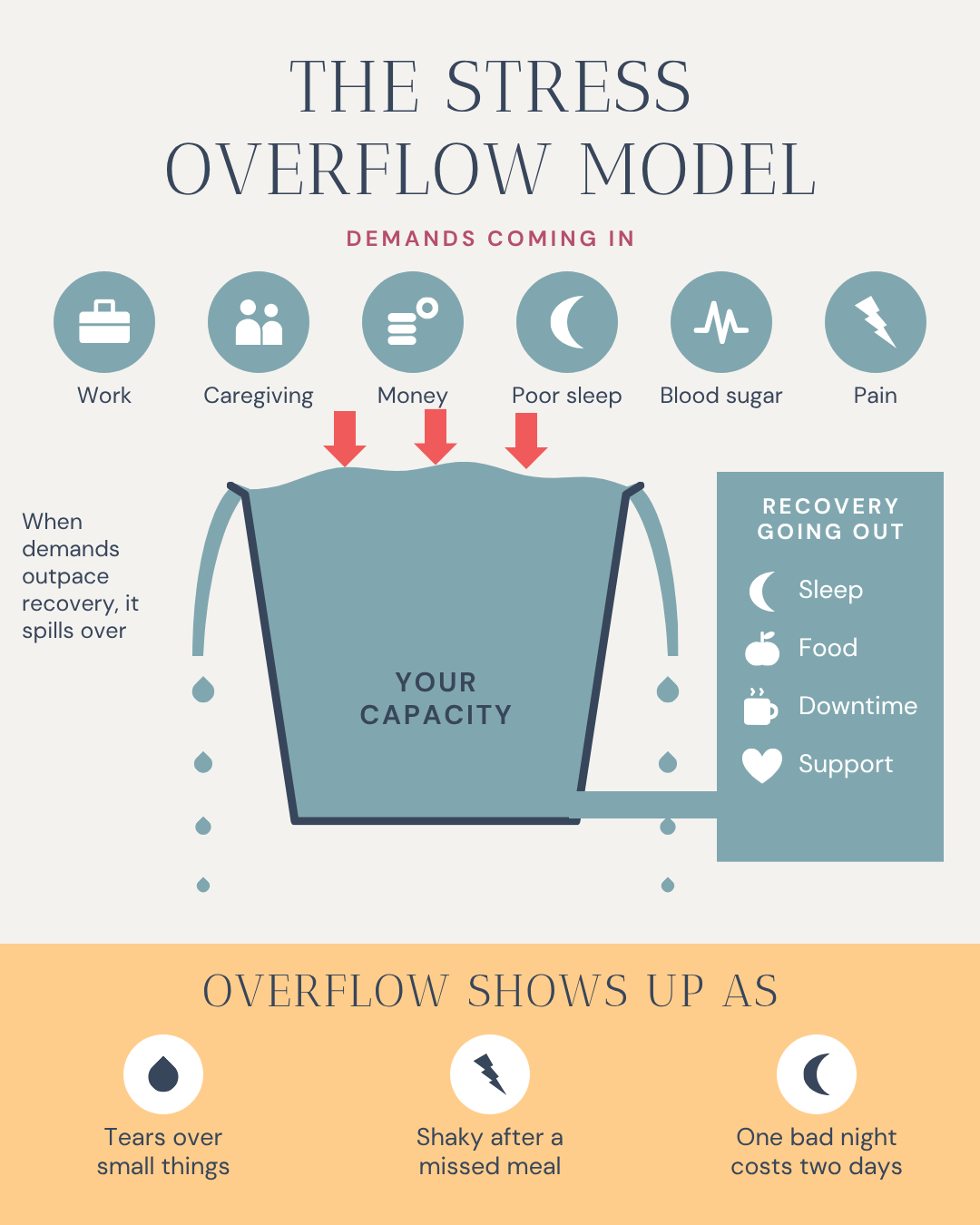
The Stress Overflow Model

A container labeled your capacity with demands like work, caregiving, money, poor sleep, blood sugar, and pain pouring in, and sleep, food, downtime, and support as recovery. When demands outpace recovery, it spills over.

Picture your capacity as a container. Demands pour in from the top, and recovery drains them back out.

Demands coming in

  • Work and deadlines
  • Relationships and caregiving
  • Money worries
  • Poor sleep
  • Blood sugar swings and under-eating
  • Pain, illness, or infection

Recovery going out

  • Sleep
  • Food, eaten on time
  • Downtime
  • Support from other people
One Quick Note

This is a way to picture it, not a literal tank of cortisol running dry. Your adrenal glands aren’t “empty.” What runs low is your margin, the space between what’s being asked of you and what you’re able to recover from.

Researchers have a name for this. They call the wear and tear of adapting over and over again “allostatic load.”[1] Your stress response is built to switch on for a challenge, then switch back off. When challenges keep coming without enough recovery in between, the system stays switched on longer than it should, and the cost adds up.[2]

That’s why a week that looks manageable on paper can still leave you completely wrung out. It’s not one thing. It’s everything at once, with nothing draining back out. (If you’ve been told it’s “just stress,” this is why that answer never feels complete.)
The Signs

What Overflow Looks Like

When your margin shrinks, the signs are usually small and very human. These are the three I hear most.

  1. Tears over small things

    The email that would normally get an eye-roll now brings tears. Poor sleep is often part of the story. After a short night, the brain’s alarm center reacts more strongly, and the parts that usually calm it down have a harder time doing their job.[3] You’re not overreacting. You’re running without a buffer.

  2. Shaky after a missed meal

    Lunch slips to 3 p.m. and suddenly you’re shaky, foggy, and getting a headache. When food doesn’t come on time, your body leans harder on stress hormones to keep blood sugar steady. If this sounds familiar, your anxiety might be a blood sugar event.

  3. One bad night costs two days

    One rough night used to mean one tired day. Now it lingers. Sleep loss can keep cortisol higher the following evening, right when it should be winding down, which makes the next night harder, too.[4] That’s how one bad night turns into a cycle. If your energy has been all over the place, read why your energy feels so unpredictable.

Cover of The Cortisol Rhythm Decoder, a free guide from Farmacy Counter
Free Guide • Find Your Pattern

See Where Your Overflow Shows Up

Overflow doesn’t look the same for everyone. For some people it shows up as wired mornings and a 3 p.m. slump. For others it’s a flat, heavy tiredness all day, or a second wind right at bedtime. The Cortisol Rhythm Decoder helps you find your pattern in about five minutes: spiking, flat, running late, or stuck on at night. It also explains why a single morning blood test can’t see it, and which testing actually shows your rhythm.

A Different Approach

Why “Just Reduce Stress” Doesn’t Help

You can’t resign from parenting. You can’t stop caring for a parent who’s sick. Some demands are simply part of your life right now, and caregiving in particular takes a real toll on the body.[5]

So instead of “reduce stress,” I look at both sides of the container and ask two questions:

Which demands can actually change?

Not all of them, just one or two.

Is any recovery being blocked by something treatable?

This is where a lot of the relief usually is.

Where the Relief Is

Finding Your Bottleneck

When I map someone’s week, these are some of the things I look for:

  • Is your sleep broken up by snoring? Sleep apnea is common, and most moderate to severe cases go undiagnosed.[6] You can spend eight hours in bed and still wake up without having recovered.
  • Is your schedule pushing lunch to 3 p.m.? Moving one meal earlier is often easier than “managing stress,” and it can take a surprising amount of load off your afternoon.
  • Is daily pain going untreated? Pain and poor sleep feed each other. Pain breaks up sleep, and short sleep makes pain feel worse.[7]
  • Are you eating enough? Under-eating, whether from dieting or just forgetting, is a demand your body feels even when you don’t. More on that in what years of dieting does to your metabolism.
  • Are hormones taking their share? Perimenopause, low thyroid, and other shifts can quietly use up your capacity. Here’s more on the stress-thyroid pattern.
The Takeaway

Fixing one blocked recovery channel often does more than adding three new self-care habits.

Try This Today

Your Turn: List Your Inflows

Save this post and grab a piece of paper. Make two columns.

  1. What’s coming in this week?

    Write down every demand, even the ones that feel too small to count.

  2. What’s going out?

    How much sleep, real meals, downtime, and support did you actually get?

  3. Circle one thing.

    Pick one demand that could shrink, or one recovery channel that’s blocked. That’s your starting point.

You don’t have to fix everything. You just have to find the bottleneck.

Pharmacist Checklist

A Functional Medicine Pharmacist’s Note

Sometimes the bottleneck is sitting right in your medicine cabinet. When I look at someone’s recovery side, I always check the medication list:

  • Some medications can break up sleep. Steroids like prednisone, decongestants, some asthma inhalers, and certain antidepressants can make it harder to fall or stay asleep, especially when taken later in the day.
  • Timing can cost you sleep. A water pill taken in the evening can mean extra trips to the bathroom overnight. Sometimes moving a dose earlier, with your prescriber’s okay, gives you back hours of sleep.
  • Some medications can make a missed meal hit harder. Certain diabetes medications can drop blood sugar when a meal is late or skipped. If you get shaky between meals and take one, talk to your provider.
  • Alcohol and sleep aids can make snoring worse. They relax the airway, so if you snore, they may be working against your recovery. (More on why alcohol hits harder after 40.)
Pharmacist Note

Never stop or change a medication on your own. But it’s always worth asking your pharmacist or provider, “Could any of my medications be affecting my sleep or energy?”

Targeted Support, With Your Provider

Support for your recovery side

If you’d like extra support while you work on your recovery side, these are the options I trust for supporting restful sleep and a steadier stress response. Check with your pharmacist or provider first, especially if you take other medications.

Available through my Fullscript dispensary. Farmacy Counter may earn a commission on purchases.

Know When to Look Closer

When to Get Help

It’s worth checking in with your provider if:

  • You snore loudly, gasp or stop breathing in your sleep, or wake up unrefreshed no matter how long you sleep.
  • Feeling overwhelmed has lasted more than a few weeks, or it’s affecting your work, relationships, or sleep.
  • You get shaky, sweaty, or lightheaded between meals often.
  • Daily pain is going untreated or under-treated.
  • You’re exhausted, wired at night, or waking at 3 a.m. most nights.
Your Next Step

Let’s Find Your Bottleneck

You don’t need another list of self-care tips. You need someone to look at both sides of your container with you. On a free discovery call, we’ll map out what’s coming in and what’s going out, look at any labs you’ve had in context, and figure out which recovery channel to open up first. If you haven’t yet, grab the free Cortisol Rhythm Decoder first.

Book Your Free Discovery Call →

To your health and vitality, Dr. Ryan

Common Questions

Frequently Asked Questions

Why am I so easily overwhelmed lately?

Usually it’s because demands like work, caregiving, poor sleep, or skipped meals have been outpacing recovery for a while. When your margin shrinks, small things that used to roll off start to feel like too much.

Why do I cry over small things when I’m stressed?

Poor sleep and ongoing stress make the brain’s alarm system more reactive. A small frustration can land like a big one when you’re running without a buffer.

What is allostatic load?

It’s the term researchers use for the cumulative wear and tear of adapting to stress over and over. Think of it as the cost of your stress response staying switched on without enough recovery in between.

Is feeling overwhelmed the same as adrenal fatigue?

No. Your adrenal glands aren’t running out of cortisol. What shrinks is your margin, the balance between what’s asked of you and how much you’re able to recover.

How do I get my capacity back?

Look at both sides. Find one demand that can shrink and one recovery channel that’s blocked, like snoring, late meals, or untreated pain. Fixing one bottleneck often helps more than adding new habits.

For educational purposes only. Not a diagnosis, and not a substitute for care from your healthcare provider. Do not start, stop, or change any medication or supplement without talking with your provider or pharmacist.

References
  1. McEwen BS, Stellar E. Stress and the individual: mechanisms leading to disease. Arch Intern Med. 1993;153(18):2093–2101.
  2. McEwen BS. Protective and damaging effects of stress mediators. N Engl J Med. 1998;338(3):171–179.
  3. Yoo SS, Gujar N, Hu P, Jolesz FA, Walker MP. The human emotional brain without sleep: a prefrontal amygdala disconnect. Curr Biol. 2007;17(20):R877–R878.
  4. Leproult R, Copinschi G, Buxton O, Van Cauter E. Sleep loss results in an elevation of cortisol levels the next evening. Sleep. 1997;20(10):865–870.
  5. Vitaliano PP, Zhang J, Scanlan JM. Is caregiving hazardous to one’s physical health? A meta-analysis. Psychol Bull. 2003;129(6):946–972.
  6. Young T, Evans L, Finn L, Palta M. Estimation of the clinically diagnosed proportion of sleep apnea syndrome in middle-aged men and women. Sleep. 1997;20(9):705–706.
  7. Finan PH, Goodin BR, Smith MT. The association of sleep and pain: an update and a path forward. J Pain. 2013;14(12):1539–1552.