

Most people who are trying to feel better focus on reducing inflammation. Cut this food, add that supplement, avoid this trigger.
That’s not the wrong idea. But it’s aiming at the wrong target.
The real goal isn’t just less inflammation. It’s more repair capacity, enough that your body can actually catch up on the maintenance it’s been putting off.
Your body runs like a bank account
Every single day, you’re making withdrawals and deposits without necessarily noticing either one.
Withdrawals look like stress, poor sleep, processed food, toxin exposure, and illness. Deposits look like sleep, nutrition, movement, and genuine recovery.
As long as withdrawals stay ahead of deposits, your body stays in survival mode. It has to. There’s no surplus to spend on repair when it’s still trying to keep up with what’s coming in. This is the same dynamic behind repair debt: your body borrowing from tomorrow’s maintenance budget to fund today’s survival demands.
The shift happens when deposits consistently outweigh withdrawals. That’s the point where your body finally has enough left over to shift into active repair, clearing damaged cells, resolving inflammation, regenerating tissue, instead of just holding the line.
You don’t need a perfect life to get there. You need adequate inputs across the right areas, often enough that repair starts outpacing wear instead of falling further behind it.
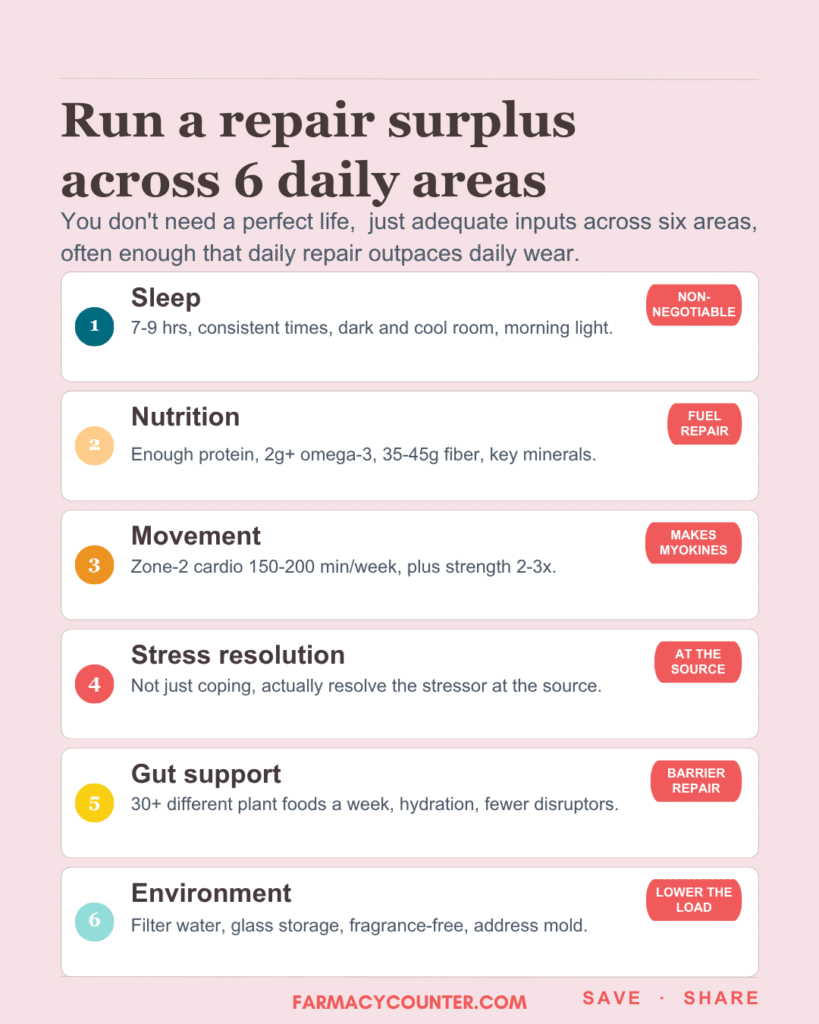
The six biggest repair deposits
Sleep — non-negotiable. This is the deposit everything else depends on. Aim for 7 to 9 hours on a consistent schedule, in a room that’s dark and cool. Morning sunlight and limiting screens before bed both help signal to your body that it’s safe to shift into repair overnight. Skimp here and the other five areas have to work much harder to compensate, if they can compensate at all.
Nutrition — fuels repair. Repair isn’t free. It requires raw materials: enough protein to rebuild tissue, at least 2 grams of omega-3s to support inflammation resolution, 35 to 45 grams of fiber, and key minerals your cells need to run their maintenance systems. Without these building blocks, your body can want to repair and simply not have what it needs to do it.
Movement — makes myokines. Movement isn’t just about calories or cardiovascular health. Muscle tissue releases signaling molecules called myokines during activity, and those molecules have direct anti-inflammatory and repair-promoting effects elsewhere in the body. Zone 2 cardio for 150 to 200 minutes a week, plus strength training 2 to 3 times a week, covers the bases. Consistent moderate movement beats being sedentary all day, even if you occasionally push harder.
Stress resolution — at the source. Managing stress in the moment helps, but it isn’t the same as resolving it. Your nervous system can’t fully commit to repair while it’s still reading your environment as unsafe. That means the goal isn’t just coping techniques for when stress hits, it’s actually addressing the source of chronic stress wherever that’s possible.
Gut support — barrier repair. Your gut lining is one of the most metabolically demanding tissues in your body to maintain, and it’s also one of the most common places repair falls behind. Supporting it means eating 30 or more different plant foods a week for microbial diversity, staying hydrated, and addressing actual gut imbalances instead of just managing the symptoms they cause.
Environment — lowers the load. You don’t need to eliminate every possible toxin to make progress here. Filtering your water, storing food in glass instead of plastic, choosing fragrance-free products, and addressing mold exposure if it’s present cover the highest-impact changes without requiring perfection.

It’s not about finding one magic input
Notice that no single item on this list does the whole job on its own. Perfect sleep doesn’t compensate for a nutrient-poor diet. Great nutrition doesn’t offset a nervous system stuck in chronic stress. Each of these six areas is a separate deposit, and they add up together, not individually.
This is also why chasing one supplement or one protocol so often falls short. Healing isn’t about finding the one thing that fixes everything. It’s about consistently making enough deposits, across enough of these six areas, that your body finally has a surplus to work with instead of a deficit to manage.
Where to start
You don’t need to overhaul all six areas at once. Start by noticing which of these deposits is currently the thinnest for you, that’s usually where the fastest gains are available.
If you’re not sure where your biggest gaps actually are, the Inflammation Threshold Test is a good place to start. It’s a free, 9-question self-assessment that maps your current inflammatory load and points to what’s most likely driving it.
Take the Inflammation Threshold Test →