

Not all bloating is the same.
Most people treat bloating as one problem with one solution. They eliminate gluten. They try a probiotic. They cut dairy. And when none of it works — or it works for a few weeks and then stops — they assume something is uniquely wrong with them.
It isn’t. The problem is that they’ve been trying to solve the wrong thing.
Before I look at anyone’s diet, I want to know two things: where does the bloat hit, and when does it start. Those two answers tell me more than any food diary, because where you bloat is diagnostic. It points directly to which part of your digestive system is breaking down — and that’s the information you need before any intervention makes sense.
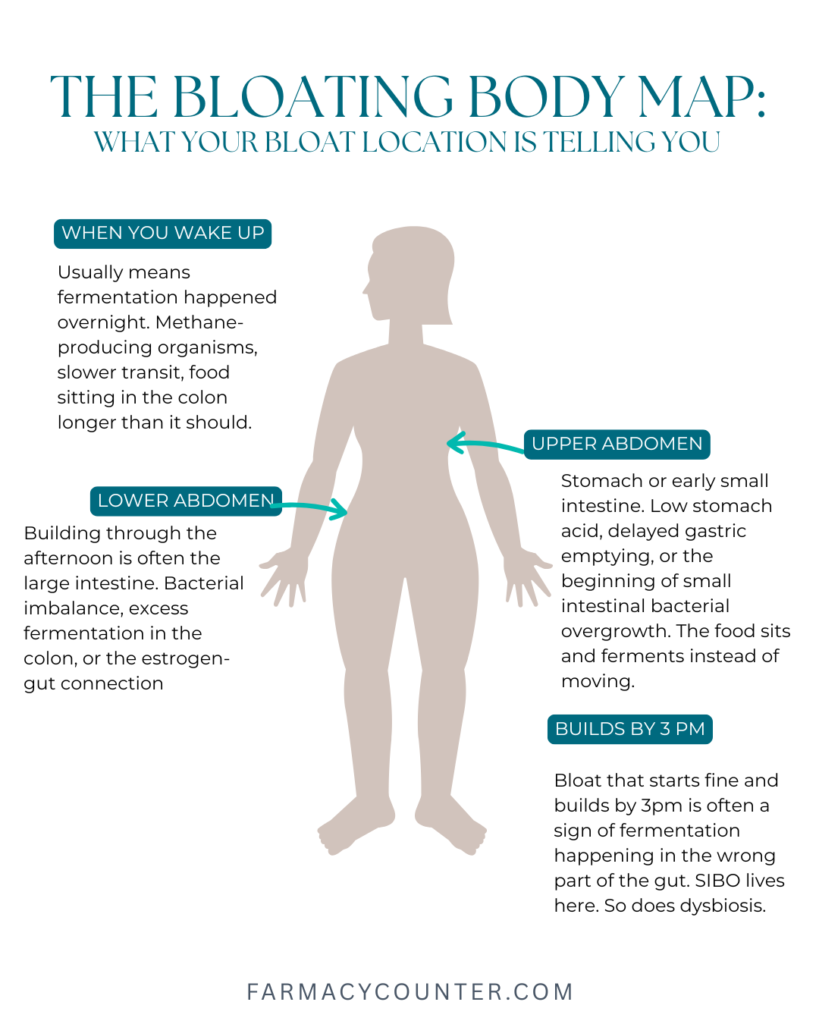
Upper Abdomen: The Stomach and Early Small Intestine
If your bloating shows up in your upper abdomen right after eating — that full, tight, uncomfortable feeling that sets in within 30 to 60 minutes of a meal — your stomach or early small intestine is the likely origin point.
The most common drivers here are low stomach acid (hypochlorhydria), delayed gastric emptying, or the early stages of small intestinal bacterial overgrowth.
Here’s what’s happening: when stomach acid is insufficient, food isn’t properly broken down before it moves into the small intestine. Larger, incompletely digested particles sit and ferment instead of moving efficiently through. You feel it as pressure, fullness, and bloating that settles in the upper belly — often accompanied by belching, nausea, or a sensation that food is just sitting there.
Delayed gastric emptying takes this further. The stomach’s motility is impaired — often from vagus nerve dysfunction, previous viral infection, or blood sugar dysregulation — and food literally doesn’t empty into the small intestine at a normal rate. The fermentation that results creates upper abdominal bloating and distension that starts with eating and can linger for hours.
Low stomach acid is also one of the primary setup conditions for SIBO. When the stomach isn’t producing enough acid, its antimicrobial defense drops. Bacteria that should be killed on contact survive and migrate upstream into the small intestine. And that leads to the next pattern.
Lower Abdomen: The Large Intestine and the Estrogen Connection
Lower abdominal bloating that builds through the afternoon is a different signal entirely. This pattern points to the large intestine — specifically to bacterial imbalance, excess fermentation in the colon, or what I call the estrogen-gut connection.
When the colon microbiome is imbalanced, fermentation becomes excessive. Gas accumulates. The lower belly distends progressively as the day goes on. It’s not one meal triggering it. It’s the accumulation of fermentation across multiple meals on top of a dysbiotic bacterial environment.
The estrogen piece is something most people have never been told about. Estrogen receptors line the gut wall. When estrogen clearance is sluggish — either because the liver isn’t conjugating it efficiently or because the estrobolome (the community of gut bacteria that metabolize estrogen) is disrupted — motility slows. Slow motility means food and waste sit longer, fermentation increases, and lower abdominal bloating becomes a daily pattern.
This is why so many women notice their bloating is worse in the week before their period. It’s not random. It’s a direct hormonal-gut connection that almost nobody explains.

Waking Up Already Bloated: The Overnight Fermentation Signal
If your stomach is already distended when you wake up — before you’ve eaten a single thing — that’s one of the most specific signals your gut can send.
Overnight bloating almost always means fermentation happened while you were asleep. The most common culprits are methane-producing organisms, slower intestinal transit, and food that’s sitting in the colon far longer than it should be.
Methane-producing archaea — specifically Methanobrevibacter smithii — are a distinct type of overgrowth from hydrogen-producing SIBO. Methane actually slows gut motility. It has a direct constipating effect on the intestinal wall. So you get a double problem: organisms producing gas overnight, and motility slow enough that the gas isn’t clearing normally. You wake up bloated and often stay that way until things start moving.
This pattern is also associated with transit times that are significantly longer than normal. When food spends too much time in the colon, bacterial fermentation is prolonged. The gas produced overnight has nowhere efficient to go, and you feel it the moment you become aware of your body in the morning.
Builds to 3pm: The SIBO and Dysbiosis Pattern
Bloat that starts fine in the morning and progressively builds until it peaks in the mid-to-late afternoon is one of the most recognizable patterns I see — and one of the most commonly misunderstood.
This is a fermentation accumulation pattern. Your small intestine isn’t clearing food and bacteria efficiently between meals. As you layer breakfast on top of incompletely cleared prior content, then lunch on top of that, bacterial fermentation accumulates. The gas builds. By 3pm, you look and feel significantly more distended than you did in the morning, even if you ate relatively normally.
SIBO lives in this pattern. So does dysbiosis. The migrating motor complex — the “housekeeper” wave that’s supposed to sweep through your small intestine between meals and clear residual bacteria and debris — isn’t firing properly. Stress, blood sugar dysregulation, and previous gut infections that damaged the enteric nervous system are common reasons it breaks down. When the MMC is disrupted, bacteria accumulate upstream in the small intestine, ferment carbohydrates aggressively, and produce the gas that creates that building, progressive bloat that defines the 3pm pattern.
Your Bloat Has a Pattern. That Pattern Is Data.
The point of all of this isn’t to give you a new way to worry about your symptoms. It’s to reframe what those symptoms actually are.
Your bloating isn’t random. It isn’t your body being difficult or sensitive. It’s a very specific signal about which part of your digestive system is breaking down — and that signal is actionable.
Upper belly bloating after eating points to stomach acid, gastric motility, and early SIBO. Lower belly bloating building through the day points to the colon, dysbiosis, and estrogen-gut dynamics. Morning bloating points to methane overgrowth and slow transit. Progressive afternoon bloating points to MMC dysfunction and bacterial fermentation in the wrong place.
Each of these has a mechanism. Each mechanism has a testing pathway. And each testing pathway leads to a protocol that’s actually designed for what’s breaking down in your body — not a generic approach that worked for someone with a completely different pattern.
The first step is identifying your pattern. The Bloating Body Map was designed to help you do exactly that.
→ Download the free Bloating Body Map below
Once you know your zone, you know where to look. And when you know where to look, you stop guessing.
Ready to find out what your pattern is actually telling you? Complete our Digestive Health Assessment and our team will review your full symptom profile to determine your most strategic next step.
→ Start Your Digestive Health Assessment here
After reviewing your responses, we’ll recommend the right path forward — whether that includes functional gut testing, a targeted protocol, or a personalized strategy session.
Your bloat has a pattern. That pattern is data. And data can be worked with.