

You already know sleep is important.
You’ve heard it a hundred times. Sleep more. Prioritize rest. Seven to eight hours.
But knowing something and truly understanding the mechanism behind it are different things. And when it comes to sleep and metabolism, most people have no idea how fast, how dramatically, and how specifically sleep deprivation dismantles metabolic function.
This isn’t about feeling groggy. This is about measurable, quantifiable changes to the hormones and cellular machinery that control your weight, your energy, and your body’s ability to respond to food and exercise.
One bad night changes your metabolism. And chronic sleep restriction — the kind most driven, high-achieving adults are living with — systematically destroys it.
What Happens to Your Metabolism After Just One Night of Poor Sleep
This isn’t theoretical. These are documented, measurable changes that occur after a single night of disrupted or insufficient sleep:
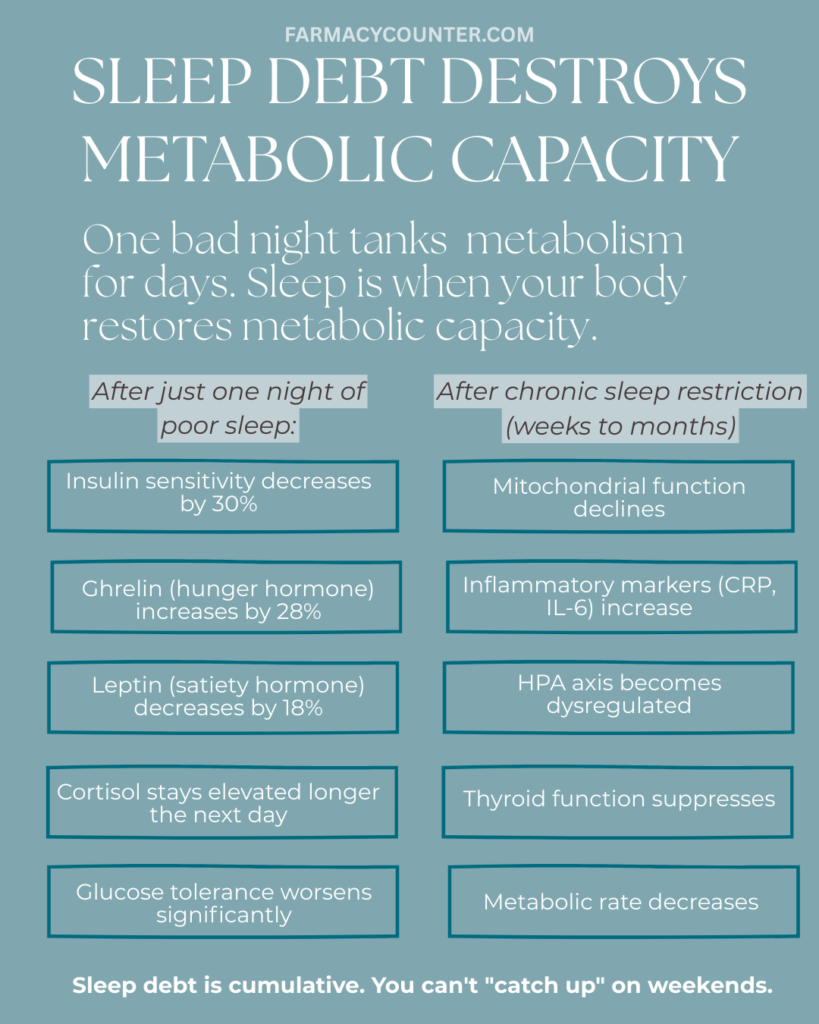
Insulin sensitivity decreases by 30%
Thirty percent. After one night. This means your cells become significantly less responsive to insulin’s signal to absorb glucose — the same mechanism seen in pre-diabetes and type 2 diabetes. Your body has to produce more insulin to do the same job, and excess insulin is one of the primary drivers of fat storage and weight resistance.
Ghrelin (your hunger hormone) increases by 28%
Ghrelin is the hormone that signals hunger and drives you to eat. A 28% increase means you wake up significantly hungrier than you would after a good night’s sleep — and you’ll stay hungrier throughout the day. This isn’t a willpower failure. It’s a hormonal reality.
Leptin (your satiety hormone) decreases by 18%
Leptin is the hormone that tells your brain you’ve had enough to eat. When leptin drops, your brain doesn’t receive adequate satiety signals — meaning you can eat a full meal and still feel unsatisfied. Combined with elevated ghrelin, this creates a hormonal environment that makes overeating nearly inevitable.
Cortisol stays elevated longer the next day
Your cortisol rhythm is supposed to peak in the morning and taper throughout the day. Poor sleep disrupts this rhythm, keeping cortisol elevated well into the afternoon and evening. Chronically elevated cortisol drives visceral fat storage, increases blood sugar, and creates the “wired but tired” state that becomes so familiar to sleep-deprived high achievers.
Glucose tolerance worsens significantly
Even without the insulin sensitivity change, sleep deprivation directly impairs your body’s ability to manage blood sugar. Foods that your body would normally handle without issue cause larger glucose spikes and more pronounced crashes — driving energy instability, cravings, and fat storage throughout the day.
All of that. From one night.
What Chronic Sleep Restriction Does Over Weeks and Months
If one bad night produces those acute changes, chronic sleep restriction — consistently getting five to six hours when your body needs seven to eight — produces something far more serious:
Mitochondrial function declines
Your mitochondria are the energy-producing organelles in every cell. Chronic sleep deprivation directly impairs their function, reducing your cells’ capacity to produce ATP. This is cellular energy production — and when it declines, no amount of caffeine, clean eating, or willpower compensates for it.
Inflammatory markers increase
CRP and IL-6 — markers of systemic inflammation — rise with chronic sleep restriction. Inflammation is a metabolic burden that drives insulin resistance, suppresses thyroid hormone conversion, and depletes antioxidant reserves. Sleep deprivation and inflammation create a self-reinforcing cycle that’s extremely difficult to break without addressing the sleep piece first.
HPA axis becomes dysregulated
The HPA axis — your hypothalamic-pituitary-adrenal stress response system — depends on adequate sleep to reset and recalibrate. Chronic deprivation dysregulates the entire axis, leading to abnormal cortisol rhythms, impaired stress recovery, and the adrenal dysfunction pattern that drives so much of the fatigue and weight resistance seen in driven adults.
Thyroid function suppresses
Sleep is when your body produces and regulates thyroid hormone. Chronic restriction suppresses thyroid output, slowing metabolic rate, reducing fat burning capacity, and contributing to the constellation of symptoms — fatigue, cold intolerance, weight resistance, brain fog — that leads many people to suspect thyroid disease even when their TSH looks “normal.”
Metabolic rate decreases
Your resting metabolic rate — the calories your body burns at rest — measurably decreases with chronic sleep deprivation. You are literally burning fewer calories doing nothing, while simultaneously being hungrier, less insulin sensitive, and more inflamed.

The Cruel Irony of “Catching Up” on Weekends
Sleep debt is cumulative. And despite what feels intuitive, you cannot meaningfully catch up on weekends.
Sleeping in on Saturday and Sunday may partially restore some acute deficits — mood, reaction time, subjective fatigue. But the metabolic consequences of chronic weekday restriction don’t fully reverse with two nights of recovery sleep. The insulin resistance, the HPA dysregulation, the mitochondrial decline — these require consistent, sustained sleep restoration over weeks.
This is particularly relevant for the driven, high-achieving patient who runs on six hours Monday through Friday and sleeps nine hours on weekends, believing they’re breaking even. They’re not.
Sleep Is When Your Body Restores Metabolic Capacity
Here’s the reframe that changes how most people think about sleep:
Sleep isn’t rest from life. It’s when the work of metabolic restoration actually happens.
During sleep your body:
- Resets cortisol rhythm for the following day
- Restores insulin sensitivity
- Regulates hunger and satiety hormones
- Repairs mitochondrial membranes
- Clears inflammatory byproducts
- Produces and regulates thyroid hormone
- Consolidates blood sugar regulation
When you cut sleep to squeeze more into your day, you’re not just tired the next morning. You’re borrowing against every metabolic system in your body — and the interest compounds.
What Actually Disrupts Sleep (Beyond “Just Go to Bed Earlier”)
For many people with metabolic dysfunction, the sleep problem isn’t just a scheduling problem. There are physiological reasons sleep is disrupted that need to be addressed at the root:
Blood sugar crashes at night — If blood sugar drops during the night, your body releases cortisol to raise it, waking you between 2-4am. This is one of the most common and most missed causes of non-restorative sleep.
Elevated evening cortisol — HPA axis dysregulation keeps cortisol high when it should be low, making it physically difficult to fall asleep despite exhaustion. This is the “wired but tired” pattern.
Sleep apnea — Frequently undiagnosed, particularly in women. Fragmented sleep from apnea destroys sleep quality regardless of how many hours are spent in bed.
Nutrient deficiencies — Low magnesium directly impairs sleep quality. Low iron causes restless legs syndrome in many people. These are addressable root causes, not character flaws.
Addressing these underlying drivers — rather than just trying harder to sleep — is how functional medicine approaches the sleep-metabolism connection.
The Bottom Line
If you’re eating well, exercising, managing stress, and still struggling with weight resistance, fatigue, and metabolic dysfunction — ask yourself honestly: how much are you actually sleeping?
Not how much you think you should be sleeping. How much are you actually sleeping, consistently, through the night?
Because you can optimize every other variable perfectly and still not make meaningful progress if your body never gets the overnight window it needs to restore the capacity to respond.
Sleep isn’t a luxury. It’s metabolic infrastructure.
Find Out What’s Driving Your Metabolic Resistance
Sleep is one piece of the metabolic puzzle. The free Weight Resistance Decoder Guide walks you through the four hidden patterns driving stubborn weight resistance — including how to identify which combination of factors is keeping your specific body stuck.