

If little things are hitting harder than they used to, you’re not getting weaker. Your load and your recovery are out of balance. Here’s how to see both sides, and where to start.
If you nodded at more than one, it makes sense that a mildly annoying email suddenly feels like too much. That isn’t a character flaw, and you’re not “bad at stress.” You’re carrying a lot, and you probably haven’t had much chance to refill.
You’re not getting weaker. You’re carrying a lot, with nothing draining back out.
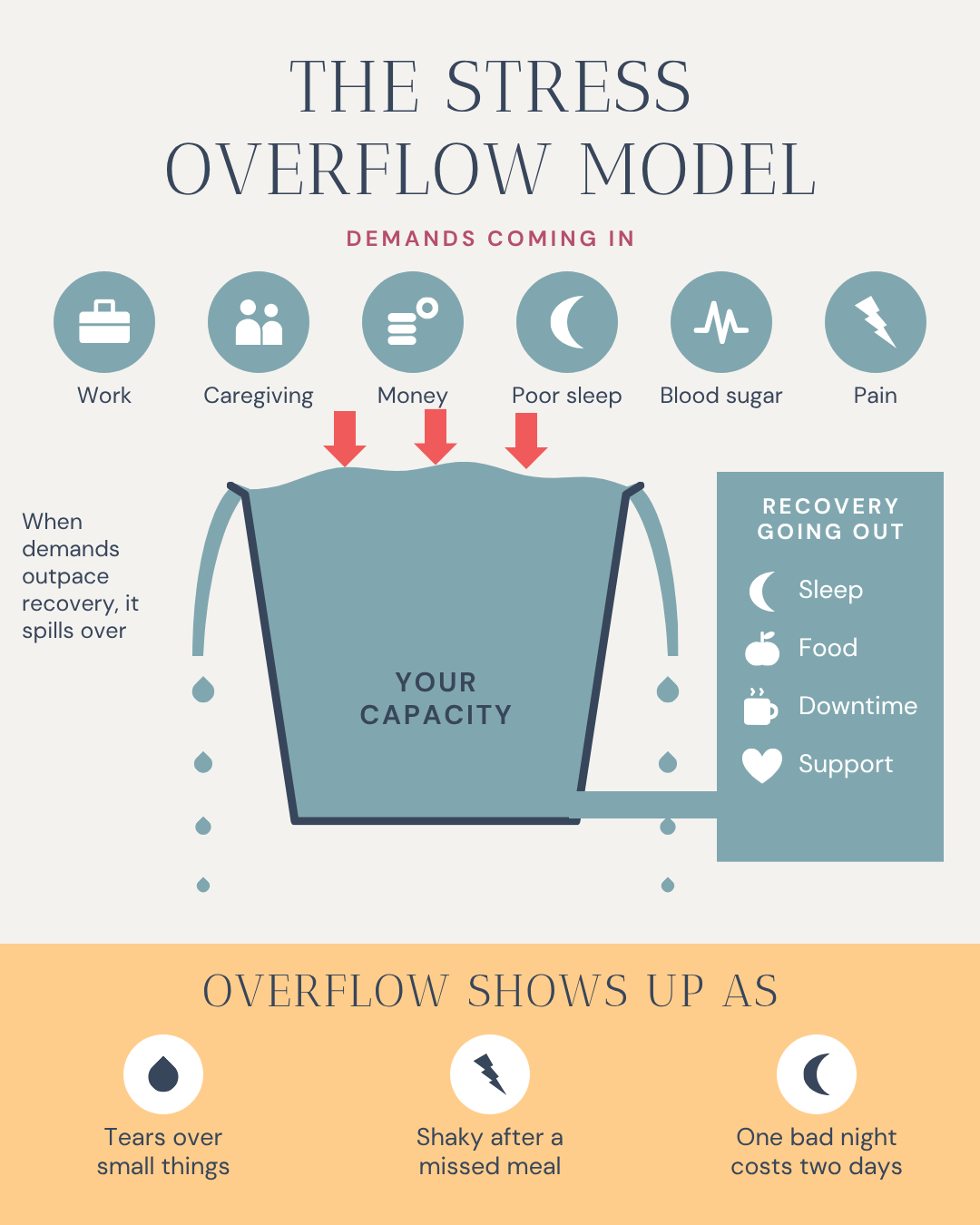
I use a simple picture to help people see that: the stress overflow model.
Picture your capacity as a container. Demands pour in from the top, and recovery drains them back out.
This is a way to picture it, not a literal tank of cortisol running dry. Your adrenal glands aren’t “empty.” What runs low is your margin, the space between what’s being asked of you and what you’re able to recover from.
Researchers have a name for this. They call the wear and tear of adapting over and over again “allostatic load.”[1] Your stress response is built to switch on for a challenge, then switch back off. When challenges keep coming without enough recovery in between, the system stays switched on longer than it should, and the cost adds up.[2]
That’s why a week that looks manageable on paper can still leave you completely wrung out. It’s not one thing. It’s everything at once, with nothing draining back out. (If you’ve been told it’s “just stress,” this is why that answer never feels complete.)
When your margin shrinks, the signs are usually small and very human. These are the three I hear most.
The email that would normally get an eye-roll now brings tears. Poor sleep is often part of the story. After a short night, the brain’s alarm center reacts more strongly, and the parts that usually calm it down have a harder time doing their job.[3] You’re not overreacting. You’re running without a buffer.
Lunch slips to 3 p.m. and suddenly you’re shaky, foggy, and getting a headache. When food doesn’t come on time, your body leans harder on stress hormones to keep blood sugar steady. If this sounds familiar, your anxiety might be a blood sugar event.
One rough night used to mean one tired day. Now it lingers. Sleep loss can keep cortisol higher the following evening, right when it should be winding down, which makes the next night harder, too.[4] That’s how one bad night turns into a cycle. If your energy has been all over the place, read why your energy feels so unpredictable.
Overflow doesn’t look the same for everyone. For some people it shows up as wired mornings and a 3 p.m. slump. For others it’s a flat, heavy tiredness all day, or a second wind right at bedtime. The Cortisol Rhythm Decoder helps you find your pattern in about five minutes: spiking, flat, running late, or stuck on at night. It also explains why a single morning blood test can’t see it, and which testing actually shows your rhythm.
You can’t resign from parenting. You can’t stop caring for a parent who’s sick. Some demands are simply part of your life right now, and caregiving in particular takes a real toll on the body.[5]
So instead of “reduce stress,” I look at both sides of the container and ask two questions:
Not all of them, just one or two.
This is where a lot of the relief usually is.
When I map someone’s week, these are some of the things I look for:
Fixing one blocked recovery channel often does more than adding three new self-care habits.
Save this post and grab a piece of paper. Make two columns.
Write down every demand, even the ones that feel too small to count.
How much sleep, real meals, downtime, and support did you actually get?
Pick one demand that could shrink, or one recovery channel that’s blocked. That’s your starting point.
You don’t have to fix everything. You just have to find the bottleneck.
Sometimes the bottleneck is sitting right in your medicine cabinet. When I look at someone’s recovery side, I always check the medication list:
Never stop or change a medication on your own. But it’s always worth asking your pharmacist or provider, “Could any of my medications be affecting my sleep or energy?”
If you’d like extra support while you work on your recovery side, these are the options I trust for supporting restful sleep and a steadier stress response. Check with your pharmacist or provider first, especially if you take other medications.
Available through my Fullscript dispensary. Farmacy Counter may earn a commission on purchases.
It’s worth checking in with your provider if:
You don’t need another list of self-care tips. You need someone to look at both sides of your container with you. On a free discovery call, we’ll map out what’s coming in and what’s going out, look at any labs you’ve had in context, and figure out which recovery channel to open up first. If you haven’t yet, grab the free Cortisol Rhythm Decoder first.
Book Your Free Discovery Call →To your health and vitality, Dr. Ryan
Usually it’s because demands like work, caregiving, poor sleep, or skipped meals have been outpacing recovery for a while. When your margin shrinks, small things that used to roll off start to feel like too much.
Poor sleep and ongoing stress make the brain’s alarm system more reactive. A small frustration can land like a big one when you’re running without a buffer.
It’s the term researchers use for the cumulative wear and tear of adapting to stress over and over. Think of it as the cost of your stress response staying switched on without enough recovery in between.
No. Your adrenal glands aren’t running out of cortisol. What shrinks is your margin, the balance between what’s asked of you and how much you’re able to recover.
Look at both sides. Find one demand that can shrink and one recovery channel that’s blocked, like snoring, late meals, or untreated pain. Fixing one bottleneck often helps more than adding new habits.
For educational purposes only. Not a diagnosis, and not a substitute for care from your healthcare provider. Do not start, stop, or change any medication or supplement without talking with your provider or pharmacist.