
In large studies, grip strength predicts mortality and cardiovascular risk better than blood pressure. Here’s what it measures, and why it matters.
Every year, millions of people get their cholesterol checked. The numbers come back, a provider reviews them, and a decision is made about whether medication or lifestyle changes are needed. This is standard practice, and it has real value.
But there is a marker that large studies show to be a strong, independent predictor of all-cause mortality, cardiovascular events, and functional decline. It takes less than sixty seconds to measure, requires no lab draw, and is almost never included in a standard physical.
Grip strength.
The link between grip strength and health outcomes isn’t a niche finding. It’s one of the most replicated associations in longevity and cardiovascular research, across populations, age groups, and regions.
Following nearly 140,000 adults across 17 countries, the PURE study found grip strength was a stronger predictor of cardiovascular and all-cause mortality than systolic blood pressure.[1] Every 5-kilogram drop in grip strength was associated with:
death risk
death risk
stroke risk
In more than 500,000 UK adults, lower grip strength was tied to higher risk of death from cardiovascular disease, respiratory disease, and cancer, independent of age, smoking, BMI, and other risk factors. Adding grip strength to a standard office risk score (age, blood pressure, BMI, smoking, diabetes) improved its ability to predict mortality.[2]
Grip strength also looks forward. In a study that followed middle-aged men for 25 years, those with the weakest grip in midlife were significantly more likely to develop disability in old age.[3]
The consistency of these findings across very different populations is striking. Grip strength isn’t a curiosity. It’s a clinically meaningful measurement that standard care largely ignores.
Grip strength isn’t really a measure of hand strength. It’s a stand-in for whole-body muscle quality.
Skeletal muscle is the largest metabolic organ in the body. It’s the main place your body clears glucose after a meal, a major contributor to your daily energy expenditure, and the system that keeps you balanced, upright, and independent.
When grip strength is low for your age and sex, it usually signals that muscle quality throughout the body (not just mass, but strength, coordination, and metabolic activity) is compromised.
From a functional medicine perspective, low grip strength isn’t just a fitness issue. It’s a metabolic signal.
Skeletal muscle is where most insulin-driven glucose uptake happens. Muscle insulin resistance is both a cause and a consequence of declining muscle quality: when muscle mass and function drop, glucose disposal suffers, fasting insulin rises, and the metabolic dysfunction behind weight gain, inflammation, and cardiovascular risk is amplified. Low grip strength can be an early, measurable sign of this process.
Chronic low-grade inflammation, driven by visceral fat, poor sleep, gut dysbiosis, and metabolic dysfunction, speeds muscle breakdown and blunts muscle building. The resulting loss of muscle mass and function, called sarcopenia, is linked to the same markers that predict cardiovascular risk: IL-6, TNF-alpha, and hs-CRP.[5] Low grip strength and elevated inflammatory markers often show up together.
Testosterone, growth hormone, IGF-1, DHEA, and estrogen all help maintain muscle. In women, the hormonal shifts of perimenopause and menopause can change body composition and muscle function quickly, often before anyone addresses it. In men, the gradual decline of testosterone through the 40s and 50s produces similar, slower shifts. Grip strength that’s low for your age is a reason to look more carefully at the hormonal environment.
Sarcopenia, the progressive loss of muscle mass and function with age, is one of the most consequential and least-discussed health trajectories.[4]
Muscle mass lost per decade without deliberate intervention
The rate of loss accelerates, and strength falls even faster than mass
This decline isn’t inevitable. But it’s the default trajectory without resistance training, enough protein, and hormonal support when indicated. And it stays largely invisible until it crosses a clinical threshold, which usually means a fall or losing the ability to manage daily tasks independently.
That’s why tools that protect muscle matter so much at midlife, from creatine for women over 35 to protecting muscle on GLP-1 medications.
The best window to intervene isn’t at seventy. It’s now.

The Metabolic Makeover guide walks through the key markers, lifestyle drivers, and nutrition strategies that support long-term metabolic health, including muscle quality, hormonal balance, and the assessments standard care leaves out.
Free instant download. No spam, unsubscribe anytime.
Standard markers aren’t useless. But they look at risk through a mostly biochemical, mostly reactive lens, waiting for numbers that have already crossed into the abnormal range.
Grip strength isn’t routine because care systems are slow to change, preventive checks without a clear billing pathway get deprioritized, and most exam rooms don’t keep a dynamometer on hand. That’s exactly the gap functional medicine is designed to fill: tools that are cheap, quick, and clinically meaningful belong in the evaluation.
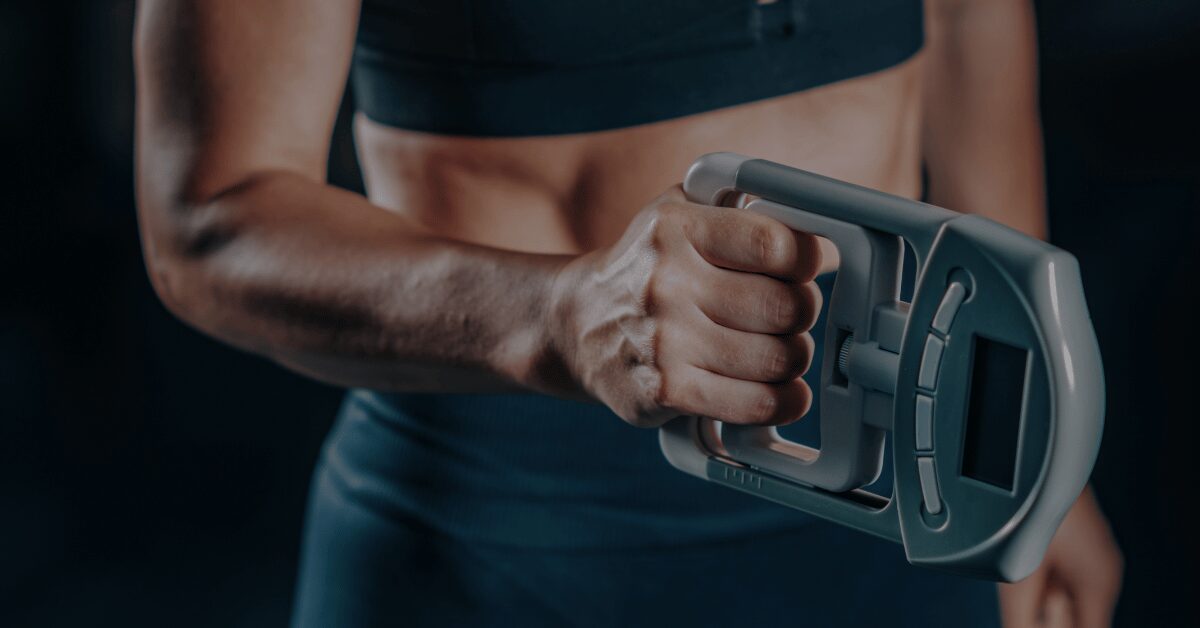
Grip strength is measured with a handheld dynamometer, which records the force of a maximal squeeze. The standard protocol is two to three attempts per hand, recording the best or the average. It takes under a minute.
Current sarcopenia definitions flag grip strength as low below roughly:[4]
About 60 lb of force
About 35 lb of force
These are cutoffs for clear weakness, not targets. The more useful question is where you sit compared with others your age and sex, and which way your number is trending.
A single low reading is a signal worth investigating. A number that keeps dropping across serial measurements is a more urgent one.
In a functional medicine evaluation, low grip strength prompts a closer look at what’s driving it:
Because grip strength reflects whole-body muscle quality, improving it means addressing the same inputs that support muscle health broadly.
Progressive resistance training (compound movements with increasing load over time) is the most effective way to build and preserve muscle at any age. Three whole-body sessions a week is a meaningful stimulus. Grip-specific work like farmer’s carries, dead hangs, and thick-bar pulling improves the number directly, but the bigger win is whole-body muscle quality.
Building muscle requires enough amino acids. Evidence supports about 1.2 to 1.6 grams of protein per kilogram of body weight daily for muscle preservation, with some research suggesting more for older adults. Leucine is the amino acid most tied to switching on muscle building, and it’s highest in animal proteins, eggs, and whey.
When low grip strength comes with hormonal deficiency (low testosterone, declining estradiol and progesterone in perimenopause or menopause, low DHEA, or suboptimal thyroid function), addressing the hormonal environment is part of the strategy, not an optional add-on.
Growth hormone, the main overnight repair signal, is released in pulses during deep sleep. Chronic sleep disruption suppresses it and impairs muscle building, even with good training and nutrition.
Chronic inflammation suppresses muscle building and speeds breakdown, and insulin resistance reduces muscle’s ability to use fuel and adapt. Treating grip strength as an isolated fitness number misses the metabolic context that decides how well any intervention works.
Grip strength testing needs no preparation, no fasting, no blood draw, and no radiation. It takes about thirty seconds, and it tells you a lot about long-term health.
If you’ve never had yours measured, ask about it at your next visit. If it comes back low for your age, it’s worth understanding why: not as an isolated fitness concern, but as a metabolic signal pointing to a system worth evaluating more carefully.
The fact that most providers don’t measure it isn’t a reason to overlook it. It’s a reason to ask.
If you want a functional medicine evaluation that looks beyond the standard panel, including the markers that predict how you’ll age, a discovery call is the place to start.
Book a Discovery Call →Grip strength reflects whole-body muscle quality. In large studies like PURE and UK Biobank, lower grip strength was linked to higher risk of cardiovascular death, all-cause death, and other outcomes, independent of age, smoking, and other risk factors.
Current sarcopenia definitions flag grip strength below about 27 kg (60 lb) in men and 16 kg (35 lb) in women as low. Those are cutoffs for clear weakness, so the more useful question is how you compare with people your age and sex and whether your number is changing over time.
With a handheld dynamometer. You squeeze as hard as you can two to three times per hand, and the best or average reading is recorded. It takes under a minute and needs no preparation.
Yes. Progressive resistance training, adequate protein, good sleep, and addressing inflammation, insulin resistance, and hormonal deficiencies all support muscle quality. Grip-specific exercises like farmer’s carries and dead hangs improve the number directly.
They measure different things. In the PURE study, grip strength predicted cardiovascular and all-cause death better than systolic blood pressure. Grip strength doesn’t replace lab work; it adds a functional measure that standard checkups usually skip.
For educational purposes only. Not a diagnosis, and not a substitute for care from your healthcare provider. Talk with your provider before starting a new exercise program or hormone therapy, especially if you have a medical condition.