

You’ve been doing everything right.
Eating less. Exercising more. Tracking every calorie. Pushing through exhaustion because somewhere along the way, you started believing that if you just had more discipline, your body would finally cooperate.
And yet — the weight won’t move. Your energy is gone. You need three coffees to get through the afternoon. Your workouts feel harder than they should. And you’ve started to wonder if something is fundamentally wrong with you.
Here’s what’s actually happening: your metabolic capacity is smaller than the demands you’re placing on it.
And adding more demand — more restriction, more exercise, more effort — is making it worse.
The Framework That Changes Everything: Capacity vs. Demand
Most people think of metabolism as a speed. Fast metabolism = thin. Slow metabolism = struggling.
That’s not how it works.
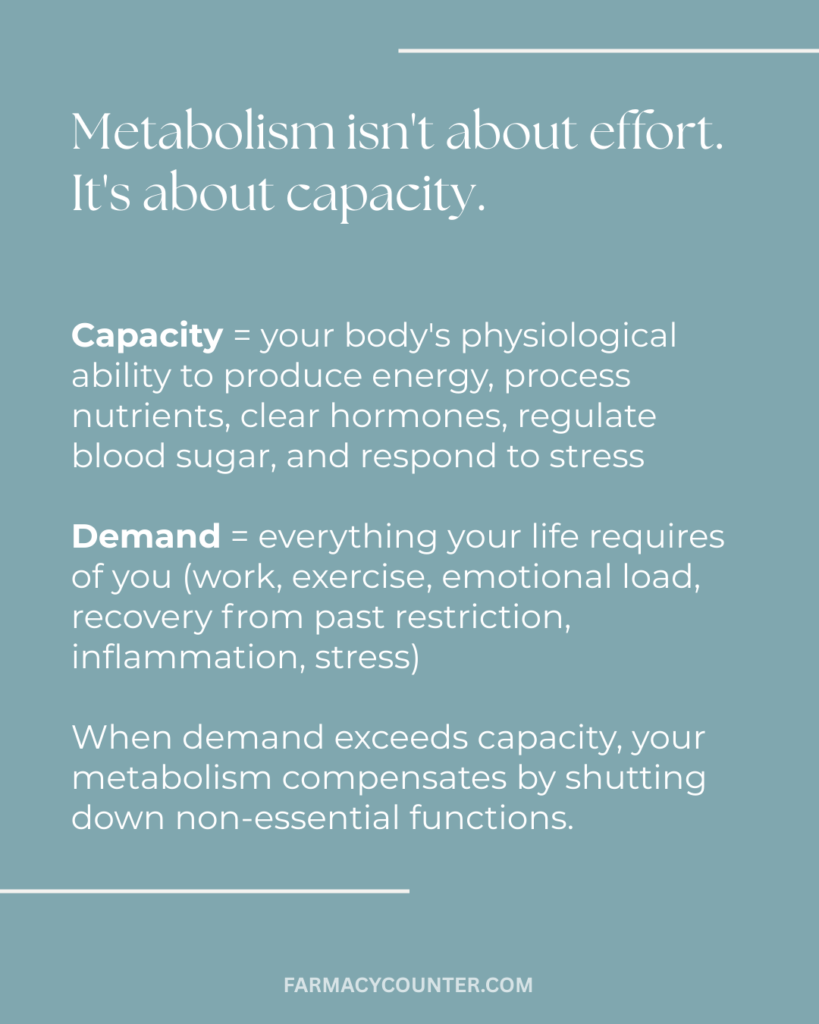
Metabolism is better understood as a capacity — your body’s physiological ability to produce energy, process nutrients, clear hormones, regulate blood sugar, and respond to stress.
On the other side of that equation is demand — everything your life requires of you. Work stress. Exercise load. Emotional burden. Recovery from past restriction. Chronic inflammation. Ongoing stress.
Here’s the key principle:
When demand exceeds capacity, your metabolism compensates by shutting down non-essential functions.
It doesn’t matter how motivated you are. You can’t willpower your way past a cellular energy deficit. You can’t mindset your way past mitochondrial dysfunction.
And that’s exactly why trying harder is not working.
What “Low Metabolic Capacity” Actually Looks Like
This isn’t abstract. There’s a real, measurable difference between a body where capacity matches demand and one where demand has overtaken capacity.
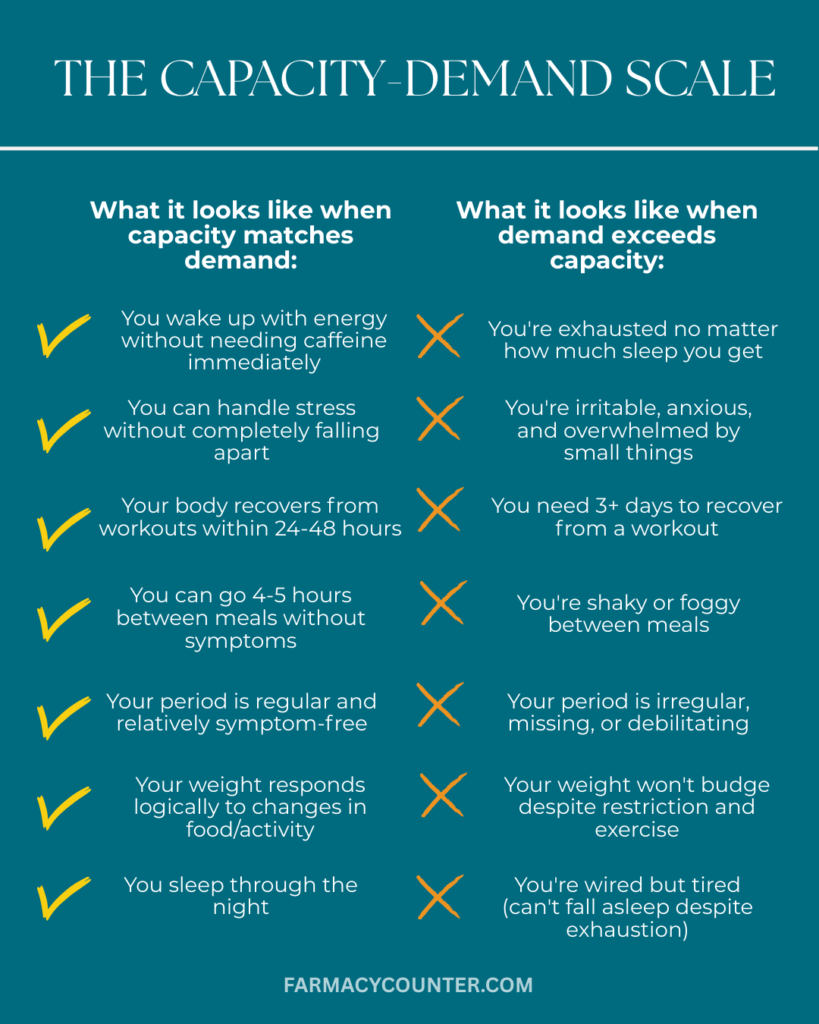
If the right column describes your life right now — exhausted no matter how much you sleep, weight that won’t budge despite restriction, wired but tired at night, needing 3+ days to recover from a workout — you’re not lazy. You’re not broken. Your body is doing exactly what it’s designed to do when capacity runs low.
It’s conserving.
Why “Eat Less, Move More” Fails When Capacity Is Depleted
The standard advice — eat less and move more — is based on one critical assumption: that your body has the capacity to respond to those inputs.
Most people with stubborn metabolic dysfunction don’t.
When your ferritin sits at 18, your mitochondria physically cannot produce ATP efficiently, regardless of how clean you’re eating. When magnesium is depleted, over 300 enzymatic reactions slow down throughout your body. When you’ve been running on 5 hours of sleep for months, insulin sensitivity tanks and hunger hormones dysregulate in ways that no amount of willpower can override.
Cutting calories or adding more exercise in this state doesn’t signal your body to burn more fat. It signals your body that resources are even scarcer than it thought — and it shuts down further to protect itself.
This is why some people can eat 1,200 calories and lose weight while you eat 1,200 calories and gain. It’s not fairness. It’s not genetics being cruel. Their metabolic capacity matched the demand. Yours didn’t.
The Approach That Actually Works
Practitioners who consistently get results with complex metabolic cases aren’t prescribing more restriction. They’re doing something fundamentally different.
They’re assessing capacity first — and expanding it before adding demand.
That means looking at:
- Nutrient status — not just whether levels are “in range,” but whether they’re optimal for metabolic function
- Sleep quality and consistency — because sleep is when your body restores metabolic capacity
- Inflammatory burden — chronic low-grade inflammation is a metabolic drain that most standard panels miss
- Mitochondrial function — the actual machinery your cells use to convert food into energy
- HPA axis regulation — how your stress response system is either supporting or sabotaging everything else
Once capacity is restored, the body can actually respond to inputs the way it’s supposed to. Food becomes fuel again. Exercise becomes productive instead of depleting. The weight starts to move — not because you tried harder, but because your body finally can.
What This Means for You
If you’ve been stuck — if you’ve done everything “right” and still feel exhausted, inflamed, and metabolically frustrated — the answer isn’t more discipline.
The answer is finding out where your capacity has been depleted and addressing it at the root.
The first step is understanding which metabolic pattern is driving your resistance.
It walks you through the four hidden metabolic patterns that cause stubborn weight resistance — including which symptoms point to which pattern, and what functional testing actually reveals the root cause.
Your body isn’t working against you. It’s trying to keep you alive with the resources it has. Give it what it actually needs, and it will respond.