

Your hands are always cold.
Your body temperature reads 97.2°F every morning — below normal, even though you feel fine-ish.
You sleep eight hours and wake up exhausted anyway.
And despite eating clean, working out consistently, and doing everything the wellness industry has told you to do, your body won’t budge.
If this sounds familiar, I want you to know something important: this is not a motivation problem. This is not a discipline problem. This is not you.
This is low energy availability — and it has a very specific, very logical explanation rooted in how your metabolism responds to sustained demand.
What Is Low Energy Availability?
Low energy availability (LEA) occurs when your body doesn’t have enough energy left over after exercise and daily activity to support normal physiological functions. But here’s what most people miss: you don’t have to be an elite athlete or severely restricting calories to experience it.
LEA can develop gradually — over months or years — in people who are:
- Eating “healthy” but chronically under-fueling relative to their actual output
- Exercising consistently without adequate recovery
- Managing high stress loads alongside demanding work and family schedules
- Sleeping poorly, even if the hours look fine on paper
- Dealing with chronic blood sugar instability that keeps the nervous system in low-grade alarm
The common thread? Your body has been operating under sustained demand for so long that it has started shutting down everything it considers non-essential for survival.
This is not dysfunction. This is your body doing exactly what it was designed to do. The problem is that what keeps you alive in a genuine survival situation is precisely what makes you feel terrible — and plateau — in your everyday life.
The 4-Part Metabolic Shutdown Cascade
When your body perceives that energy is chronically scarce or that demands consistently outpace resources, it initiates a cascade of protective responses. Understanding each one helps explain why the symptoms you’re experiencing aren’t random — they’re connected.
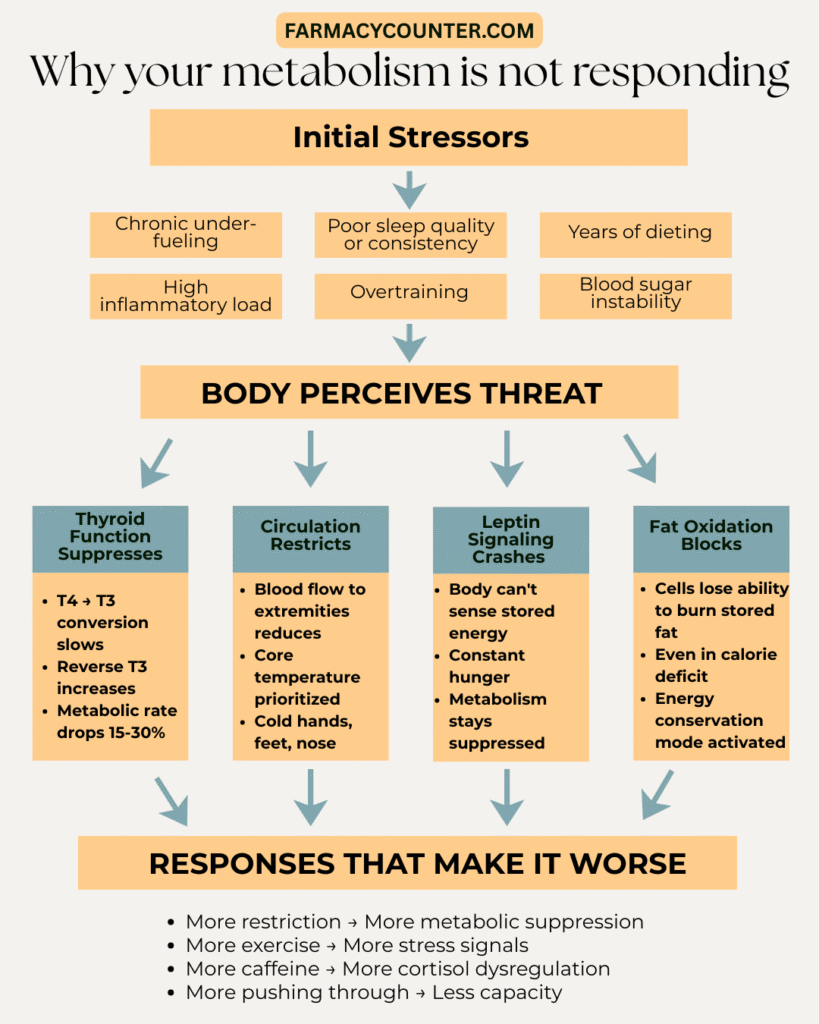
1. Thyroid Conversion Slows (Metabolic Rate Drops 15–30%)
Your thyroid gland produces mostly T4, an inactive form of thyroid hormone. For T4 to actually do anything useful in your body, it has to be converted into T3 — the active form that drives metabolic rate, temperature regulation, energy production, and dozens of other functions.
Under conditions of low energy availability, your body strategically slows this conversion. It also increases production of reverse T3 (rT3) — essentially a “blocking” molecule that occupies T3 receptor sites without activating them.
The result: your metabolism drops by 15 to 30 percent, even if your TSH (the standard thyroid test most doctors run) looks completely normal. This is why so many people are told their thyroid is “fine” while experiencing every classic symptom of thyroid dysfunction.
Cold hands and feet? Low body temperature every morning? Exhaustion despite sleep? These are thyroid symptoms. Specifically, they’re low T3 symptoms — and they will not resolve until the underlying low energy availability is addressed.
2. Circulation Restricts
When energy is scarce, your body becomes very strategic about where it sends blood flow. Circulation to the extremities — hands, feet, the tip of your nose — gets deprioritized so that core temperature and vital organ function can be maintained.
This is why cold extremities are such a consistent finding in people with LEA. It’s not poor circulation in the traditional sense. It’s your body making a very deliberate choice about resource allocation.
3. Leptin Signaling Crashes
Leptin is the hormone produced by your fat cells that tells your brain “we have enough stored energy, you don’t need to eat.” When leptin is functioning properly, you can go several hours between meals without feeling desperate, your hunger is proportionate to your actual needs, and your body readily accesses stored fat for fuel.
When leptin crashes — as it does in response to chronic low energy availability — your brain loses its ability to accurately assess how much energy you have stored. Despite having body fat (often substantial amounts), your brain essentially thinks you’re starving. The result is constant hunger, relentless cravings, and a metabolism that refuses to tap into fat stores because it genuinely believes it needs to conserve them.
This is why you can be eating a calorie deficit and still not losing weight. Your leptin signaling is disrupted, and no amount of further restriction will fix it — it will only make it worse.
4. Fat Oxidation Shuts Down
Fat burning — technically called fat oxidation — requires your body to be in a state of relative metabolic safety. When your nervous system is in a chronic stress response, when cortisol is elevated, when blood sugar is unstable, when your cells are depleted of the nutrients required for mitochondrial function, fat burning is one of the first things to go.
Your body shifts almost entirely into sugar-burning mode, which means you’re dependent on frequent meals and snacks just to maintain stable energy. Any gap between eating feels catastrophic because your cells genuinely cannot access the stored fuel sitting right there in your adipose tissue.

Why Everything You’re Trying Makes It Worse
Here’s the part that is both the most important and the most frustrating: the standard responses to a stalled metabolism — eat less, exercise more, push through, add caffeine — are the exact interventions that deepen the low energy availability cascade.
Every additional restriction adds another signal to your nervous system that resources are scarce. Every additional cardio session adds more demand to a system that is already maxed out. Every cup of coffee spikes cortisol, which drives more glucose production, which triggers more insulin release, which keeps your body locked in sugar-burning mode.
You’re not lazy. You’re not weak. You’re not “cheating” without realizing it. You are doing exactly what you’ve been told to do — and every one of those interventions is making your metabolic situation measurably worse.
Most people add MORE demand when the scale won’t move. Eat less. More cardio. More coffee. More pushing. Every intervention adds stress without addressing the actual problem.
This is not a willpower problem. This is a physiology problem.
What Actually Restores Metabolic Function
Reversing low energy availability requires a fundamentally different approach. Instead of adding more demand to a depleted system, the goal is to restore capacity — to convince your body that the threat is over and that it’s safe to resume normal metabolic function.
In practice, that looks like:
Eating enough consistently. Your body needs to stop perceiving food scarcity as a real threat. That means regular meals, adequate protein at every meal, and enough total calories to support your actual output — not the output you think you should have, but the output you actually have given your current health status. When your body has consistent evidence that food is coming, it stops hoarding.
Stabilizing blood sugar. Every blood sugar spike is a cortisol spike. Multiple cortisol spikes per day keep your HPA axis in a chronic stress response, which perpetuates every downstream symptom in this cascade. Protein, fat, and fiber at every meal — in the right ratios for your individual physiology — is the foundation of metabolic repair.
Actually recovering between workouts. For people in LEA, more exercise is almost always the wrong answer. Your body needs to experience that the demand is decreasing before it will release its protective responses. This often means temporarily reducing exercise intensity — something that feels completely counterintuitive but is physiologically essential.
Addressing underlying inflammation. Chronic inflammation drives cortisol dysregulation, impairs thyroid conversion, and disrupts insulin signaling. Identifying and addressing the sources of inflammation — whether that’s gut dysfunction, poor sleep, toxic load, food sensitivities, or chronic infection — is a critical part of metabolic restoration that generic protocols entirely miss.

Why Testing Matters More Than Guessing
The four patterns described above — thyroid conversion failure, circulation restriction, leptin dysregulation, and fat oxidation shutdown — can look similar on the surface but have very different root causes and require very different interventions.
Standard lab work almost never catches this. A normal TSH doesn’t tell you anything about T3, reverse T3, or thyroid receptor sensitivity. A basic metabolic panel doesn’t reveal fasting insulin, cortisol curve, ferritin, RBC magnesium, or the nutrient status that determines whether your mitochondria can actually produce ATP.
This is why people with low energy availability so often fall through the cracks of conventional medicine. Their basic labs look normal. But when you run the right tests — comprehensive thyroid panels, fasting insulin, 4-point cortisol, organic acids for mitochondrial function, micronutrient status — the picture becomes very clear very quickly.
Your metabolism isn’t broken. It’s protecting you. And once you understand what it’s protecting you from, you can actually start to fix it.
Let’s Figure Out Which Pattern Is Keeping You Stuck
If you’re recognizing this cascade — the cold hands, the exhaustion despite sleep, the weight that won’t move no matter what you restrict — you need specific identification, not general advice.
The Weight Resistance Decoder is designed to bring clarity to that confusion.
It’s a 33-page self-assessment guide that walks you through the four hidden metabolic patterns most commonly driving weight resistance and metabolic dysfunction — stress and cortisol-driven, blood sugar and insulin-driven, thyroid and hormone-driven, and gut and liver detox-driven.
Most people discover they have a primary pattern they didn’t know to look for, and often a secondary one compounding it. That overlap is exactly why generic approaches — eat less, move more, try this supplement — consistently fail.
Understanding your pattern is the first step toward restoring function instead of just adding more demand to a system that’s already maxed out.
Download the free Weight Resistance Decoder below.
Your body isn’t broken. It’s been trying to tell you something. Let’s find out what.