

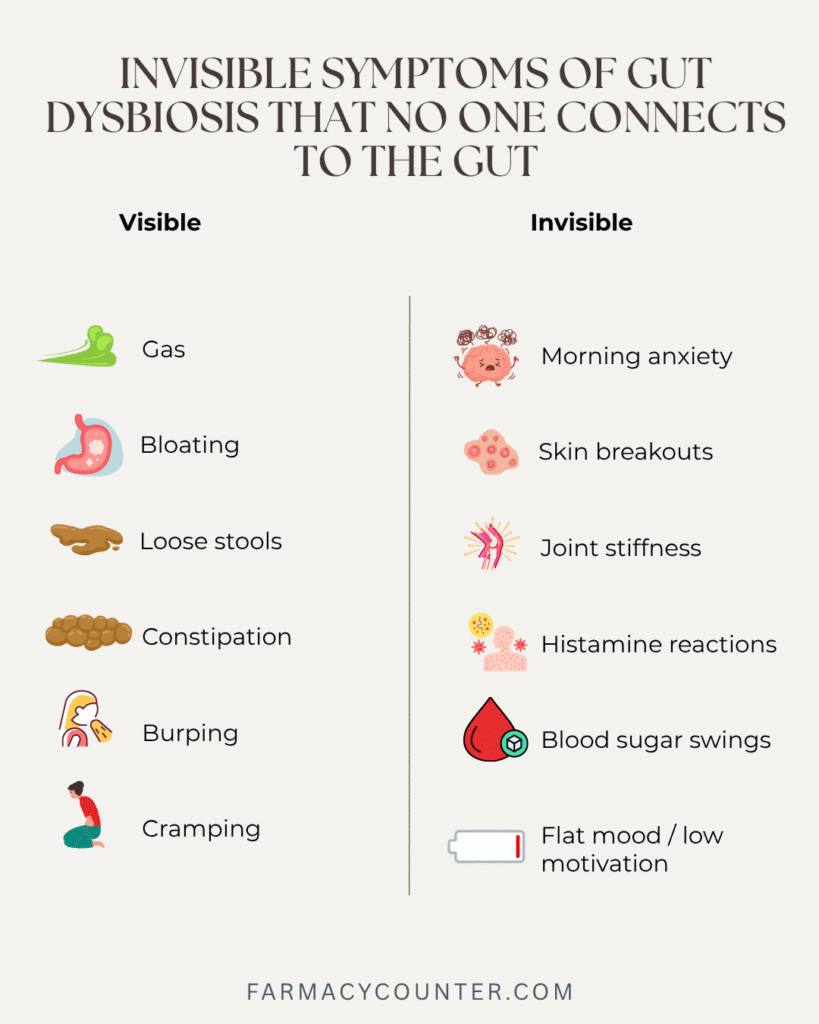
Acne. Anxiety. Achy joints. Afternoon crashes.
Most people treat these as four separate problems. They see a dermatologist for the skin, a therapist for the anxiety, a rheumatologist for the joints, and blame their diet for the afternoon energy collapse.
Nobody asks about the gut microbiome. And that’s the common thread running through all of them.
When gut dysbiosis is present — when the balance of bacteria in your microbiome shifts away from health-supporting species toward inflammatory or overgrown ones — the consequences don’t stay in your digestive tract. They travel through your bloodstream, your nervous system, your hormone pathways, and your immune system, creating symptoms that look completely unrelated to digestion.
None of this is mysterious. Every single symptom has a mechanism. And the mechanism starts in the gut.
What Gut Dysbiosis Actually Means
Dysbiosis isn’t a single condition. It’s a state of microbial imbalance — too much of the wrong bacteria, not enough of the right ones, or both simultaneously.
Your gut microbiome contains trillions of microorganisms. Under healthy conditions, beneficial species like Akkermansia muciniphila, Faecalibacterium prausnitzii, and diverse Bifidobacterium and Lactobacillus populations keep pathogenic and opportunistic bacteria in check, produce compounds that support gut lining integrity, regulate immune function, and produce metabolites that affect everything from mood chemistry to blood sugar signaling.
When that balance shifts — from antibiotic exposure, chronic stress, dietary changes, infections, medications, or any combination of the above — the metabolic output of the microbiome changes. Beneficial metabolites drop. Inflammatory metabolites increase. And the downstream consequences show up in places that have nothing obvious to do with your gut.
The visible symptoms of dysbiosis — bloating, gas, constipation, diarrhea — are the ones most people recognize. They’re the ones that eventually prompt a GI referral.
The invisible ones are the ones that get missed.
Morning Anxiety That Fades by Noon
If you wake up anxious — heart slightly racing, thoughts already moving too fast, a low-level dread that doesn’t have a clear object — and then notice that it gradually eases through the morning without you doing anything particular, that pattern has a gut origin.
Here’s the mechanism: your gut microbiome is most metabolically active overnight, when digestion has slowed and bacterial populations cycle through their own activity rhythms. When dysbiosis is present, certain bacteria overproduce metabolites overnight that dysregulate the hypothalamic-pituitary-adrenal axis — the HPA axis that governs your cortisol and stress response.
Specifically, dysbiotic bacteria produce short-chain fatty acids and other metabolites in imbalanced ratios that affect corticotropin-releasing hormone (CRH) signaling. This creates an exaggerated cortisol response in the early morning hours. You wake up with cortisol already elevated — not from stress, not from a threat, but from bacterial metabolites produced while you slept.
By late morning, as you eat and move and your cortisol naturally begins its daily descent, the anxiety eases. It feels like anxiety. It has the texture of anxiety. But it has a gut origin, not a psychological one.
This is why some people describe anxiety that seems to have no cause — it doesn’t correlate with what’s happening in their life, it doesn’t respond reliably to therapy or medication, and it has that specific morning-heaviest quality that doesn’t match typical anxiety patterns. The HPA axis dysregulation that gut dysbiosis produces creates a biological state that mimics anxiety at the neurochemical level.

Skin That Breaks Out in Hormonal Patterns
Hormonal acne — the deep, cystic kind that clusters along the jawline, chin, and lower cheeks, that worsens before your period, that doesn’t respond to topical treatments — is one of the most consistent presentations of estrobolome disruption.
The estrobolome is the community of gut bacteria that metabolizes estrogen. Specifically, these bacteria produce an enzyme called beta-glucuronidase that deconjugates estrogen in the gut, allowing it to be reabsorbed into circulation rather than excreted. When the estrobolome is functioning properly, estrogen recirculation is appropriately regulated. When dysbiosis disrupts estrobolome composition, beta-glucuronidase activity becomes imbalanced — either too high, driving estrogen dominance, or too low, affecting estrogen availability.
Elevated beta-glucuronidase activity from dysbiosis means more estrogen gets deconjugated and reabsorbed. Higher circulating estrogen relative to progesterone affects androgen metabolism through its influence on sex hormone-binding globulin (SHBG). Lower SHBG means more free testosterone available to drive sebaceous gland activity and inflammatory skin responses.
The result: hormonal acne that tracks your cycle, that worsens with certain foods that feed dysbiotic bacteria, and that doesn’t respond to topical retinoids or antibiotics because the driver is internal and hormonal, not topical.
This is why people with persistent hormonal acne who address their gut dysbiosis and estrobolome function often see skin changes that years of dermatology appointments never produced. The treatment wasn’t wrong. It was addressing the wrong address.
Joint Stiffness, Especially in the Morning
Morning joint stiffness without a clear diagnosis — that creaky, slow-to-warm-up quality that improves as you move through the morning — is a consistent presentation of LPS-mediated systemic inflammation with a gut origin.
When dysbiosis is present, gram-negative bacterial species produce lipopolysaccharide (LPS) as a component of their cell walls. In a healthy gut with intact barrier function, LPS stays in the gut. When dysbiosis is accompanied by any degree of intestinal permeability — which it frequently is, since the two conditions drive each other — LPS crosses into systemic circulation.
Once in circulation, LPS binds to TLR4 receptors on immune cells and triggers the release of inflammatory cytokines: IL-1β, IL-6, TNF-alpha. These cytokines drive inflammation throughout the body, and connective tissue is a common landing place. Joint lining — synovial tissue — is rich in immune cells and particularly responsive to circulating inflammatory signals.
The morning pattern is explained by overnight bacterial metabolite production. LPS levels in circulation tend to peak in the morning, correlating with the overnight activity of dysbiotic gut bacteria. You wake up with the highest inflammatory load of the day. As you move, eat, and your immune system processes the load, stiffness improves.
Rheumatology workup comes back negative because this isn’t autoimmune joint disease. There’s no antibody driving it. There’s no structural damage. It’s functional inflammation from a gut source — and it won’t resolve until the source is addressed.
Histamine Reactions After Wine, Leftovers, Aged Cheese, or Fermented Foods
If you reliably feel worse after high-histamine foods — wine, leftover meat, aged cheese, fermented foods like kimchi or sauerkraut — and the response looks like flushing, headache, bloating, racing heart, nasal congestion, or anxiety that arrives within an hour of eating, that’s not an allergy. It’s a bacterial balance problem.
Two things drive histamine intolerance from gut dysbiosis.
First, certain bacteria — particularly species like Morganella morganii, Klebsiella pneumoniae, and some Lactobacillus species — directly produce histamine as a metabolic byproduct. When these bacteria are overgrown due to dysbiosis, histamine production in the gut exceeds normal levels before you’ve even eaten a high-histamine food.
Second, and more importantly, dysbiosis depletes DAO — diamine oxidase — the enzyme produced by intestinal cells that breaks down histamine. DAO is the primary mechanism for histamine degradation in the gut. When the gut lining is damaged by dysbiosis or when the bacterial populations that support DAO-producing enterocytes are depleted, DAO activity drops. Histamine accumulates because the system designed to clear it isn’t functioning.
The result: you add any amount of dietary histamine to a system that’s already histamine-loaded and DAO-deficient, and you tip into symptoms. You’re not reacting to the wine. You’re reacting to your gut’s inability to process histamine, which is a bacterial balance and gut lining problem.
This is why antihistamines provide temporary relief but don’t solve the underlying pattern. And why people with histamine intolerance who address their dysbiosis and support DAO function can often reintroduce high-histamine foods without reaction once the gut environment is restored.

Flat Mood and Low Motivation Through the Day
The connection between gut dysbiosis and mood is one of the most extensively researched areas in microbiome science, with contributions from researchers including Dr. John Cryan and Dr. Ted Dinan at University College Cork and Dr. Emeran Mayer at UCLA.
The mechanism is specific. Approximately 90 to 95% of the body’s serotonin is produced in the gut — by enterochromaffin cells in the intestinal lining — not in the brain. Serotonin production requires tryptophan, and the availability of tryptophan for serotonin synthesis is directly regulated by gut bacterial balance.
Beneficial bacteria — particularly certain Bifidobacterium species — support the tryptophan pathway toward serotonin production. When these bacteria are depleted by dysbiosis, tryptophan metabolism shifts. Under inflammatory conditions created by dysbiosis, an enzyme called IDO (indoleamine 2,3-dioxygenase) is activated, which shunts tryptophan away from serotonin and toward kynurenine pathway metabolites — some of which are neurotoxic and anxiety-producing.
The result: lower serotonin availability, higher levels of neurologically active kynurenine metabolites, and the specific pattern of flat mood, low motivation, and emotional blunting that doesn’t track with external circumstances. You have no obvious reason to feel flat. Your life is objectively fine. But your neurochemistry is being shaped by a dysbiotic gut.
GABA production follows a similar pattern. Certain gut bacteria produce GABA directly, and when those populations are disrupted by dysbiosis, GABA availability drops. Low GABA means difficulty calming down, poor stress resilience, and the exhausted-but-wired quality that makes rest feel impossible.
This is not the same as clinical depression requiring antidepressant treatment. It’s a functional neurochemistry shift driven by a microbiome that’s not producing the precursors mood chemistry depends on.
Blood Sugar Crashes 2 to 3 Hours After Eating
The afternoon energy crash — the 2 to 3pm wall that sends people to the coffee machine or the snack drawer — is widely assumed to be a carbohydrate problem or a sleep debt problem. Often, it’s a gut bacteria problem.
Here’s the mechanism: healthy gut bacteria, specifically Akkermansia muciniphila, Faecalibacterium prausnitzii, and specific Bifidobacterium strains, produce short-chain fatty acids (SCFAs) — butyrate, propionate, and acetate — during the fermentation of dietary fiber. These SCFAs are not just local gut nutrients. They regulate GLP-1 secretion, improve insulin sensitivity, and smooth the post-meal blood sugar curve.
When these bacteria are depleted by dysbiosis, SCFA production drops. The blood sugar regulation mechanism that SCFAs support becomes impaired. Insulin response to meals becomes less efficient. Blood sugar rises more sharply after eating and crashes harder 2 to 3 hours later.
Simultaneously, dysbiosis-driven inflammation dysregulates the HPA axis and cortisol rhythm. Cortisol naturally dips in the mid-afternoon — a normal physiological pattern. But when chronic gut inflammation has dysregulated the HPA axis, that dip becomes a cliff. The afternoon cortisol drop, combined with the blood sugar crash from impaired SCFA production, creates the 2 to 3pm collapse that feels like it should be fixable with better sleep or fewer carbohydrates.
It isn’t fixed by those things because those aren’t the primary drivers. The primary driver is a microbiome that’s not producing the molecules that regulate blood sugar and cortisol rhythm.

Why These Symptoms Go Undiagnosed
The reason these symptoms rarely get connected to the gut is structural. Medicine is organized by organ system. You take your skin to a dermatologist. Your joints to a rheumatologist. Your mood to a psychiatrist. Your blood sugar to an endocrinologist.
Nobody sits across from all of these symptoms at once and asks what they have in common.
And even when a practitioner suspects a gut component, standard GI testing — colonoscopy, standard bloodwork, basic stool culture — isn’t designed to measure what’s actually happening in the microbiome. It looks for structural disease and pathogenic infection. It doesn’t measure dysbiosis, SCFA production, beta-glucuronidase activity, estrobolome composition, or DAO levels.
The testing that would find the gut origin of these symptoms exists. It’s just rarely ordered.
A comprehensive stool analysis like the GI-MAP shows bacterial diversity, pathogenic and opportunistic species, markers of dysbiosis, inflammatory markers, and digestive function. Organic acids testing shows metabolic byproducts that indicate specific bacterial imbalances and their downstream effects on neurotransmitter metabolism and cellular energy. Targeted markers for DAO, histamine, and estrogen metabolism fill in the picture.
When someone comes to me with this cluster of symptoms — morning anxiety, hormonal acne, joint stiffness, histamine reactions, flat mood, and afternoon crashes — these are the tests that tell us which dysbiosis patterns are present and what the protocol needs to address first.
What Changes When Dysbiosis Is Addressed
When the actual microbiome imbalance is identified and treated — not with a generic probiotic, but with a protocol built from what the testing shows — these invisible symptoms often resolve in ways that years of treating them separately never achieved.
The morning anxiety fades as HPA axis dysregulation resolves. The hormonal acne clears as estrobolome function is restored. Joint stiffness improves as LPS-mediated inflammation drops. Histamine reactions calm as DAO production recovers and dysbiotic histamine-producing bacteria are reduced. Mood stabilizes as serotonin precursors become available again. Afternoon energy normalizes as SCFA production is restored and blood sugar regulation improves.
These aren’t separate outcomes from separate treatments. They’re parallel consequences of the same intervention: restoring microbial balance so the gut can produce the molecules the rest of the body depends on.
If you have a cluster of these symptoms and nobody has ever looked at your gut microbiome, that’s the missing piece.
→ Download the free Bloating Body Map to start identifying which gut pattern is most likely driving your symptoms — even if the symptoms you’re most concerned about aren’t digestive.
Ready to find out what’s actually happening in your gut? Complete our Digestive Health Assessment and our team will review your full symptom profile to determine your most strategic next step.
→ Start Your Digestive Health Assessment here
After reviewing your responses, we’ll recommend the right path forward — whether that includes functional gut testing, a targeted protocol, or a personalized strategy session.
None of these symptoms are mysterious. Every single one has a mechanism. And the mechanism is findable.