

You’ve cleaned up your diet. You don’t have joint pain. You don’t feel “inflamed.”
So inflammation probably isn’t your problem, right?
Not necessarily.
The kind of inflammation that silently derails metabolism isn’t the acute kind — the redness, swelling, and pain you associate with an injury or infection. It’s chronic low-grade inflammation: a sustained, below-the-threshold immune activation that produces no obvious symptoms while systematically dismantling your body’s ability to produce energy, regulate hormones, manage blood sugar, and burn fat.
You can’t feel it. But your metabolism absolutely can.
Inflammation Isn’t Just About Pain. It’s a Metabolic Burden.
When most people hear “inflammation,” they think about arthritis, injury, or autoimmune disease. Visible, painful, obvious.
Chronic low-grade inflammation is none of those things. It’s measured in lab markers — CRP, IL-6, TNF-alpha — that most standard annual panels don’t include. And it operates quietly in the background, consuming metabolic resources and disrupting every system your body uses to regulate weight and energy.
Here’s what chronic low-grade inflammation actually does to your metabolism:
It leads to insulin resistance. Inflammatory cytokines directly interfere with insulin signaling at the cellular level, making your cells less responsive to insulin’s message to absorb glucose. The result is higher circulating insulin, more fat storage — particularly around the abdomen — and progressively worsening blood sugar regulation.
It suppresses thyroid hormone conversion. Your thyroid produces mostly T4 — an inactive precursor hormone. Converting T4 into the active T3 your cells actually use requires a conversion process that happens primarily in the liver and gut. Chronic inflammation suppresses this conversion, leaving you with low active thyroid hormone even when your TSH looks completely normal.
It increases cortisol demand. Cortisol is one of your body’s primary anti-inflammatory agents. When inflammation is chronically elevated, your adrenal glands have to produce more cortisol just to manage the inflammatory load — leaving less cortisol available for its other jobs: blood sugar regulation, energy mobilization, immune modulation, and stress response. This is one of the primary drivers of HPA axis dysfunction in people who have never experienced an obvious traumatic stressor.
It damages mitochondrial membranes. Inflammatory processes generate reactive oxygen species that directly damage mitochondrial membranes — the structures your cells depend on to produce ATP efficiently. Damaged mitochondria produce less energy and more oxidative stress, creating a self-reinforcing cycle of cellular dysfunction and fatigue.
It depletes antioxidant reserves. Your body uses antioxidants — glutathione, vitamin C, vitamin E, and others — to neutralize the oxidative damage generated by inflammation. Chronic inflammation exhausts these reserves faster than most diets can replenish them, leaving cells increasingly vulnerable to further damage.
This is why you can eat a perfectly clean diet, exercise consistently, and still feel terrible if underlying inflammation isn’t addressed. The inflammation is consuming your metabolic capacity faster than your healthy habits can restore it.
Where Chronic Inflammation Actually Comes From
This is where functional medicine diverges most sharply from conventional care. Standard medicine treats inflammation with anti-inflammatory medications — suppressing the symptom without identifying the source.
Functional medicine asks: why is the immune system activated in the first place?
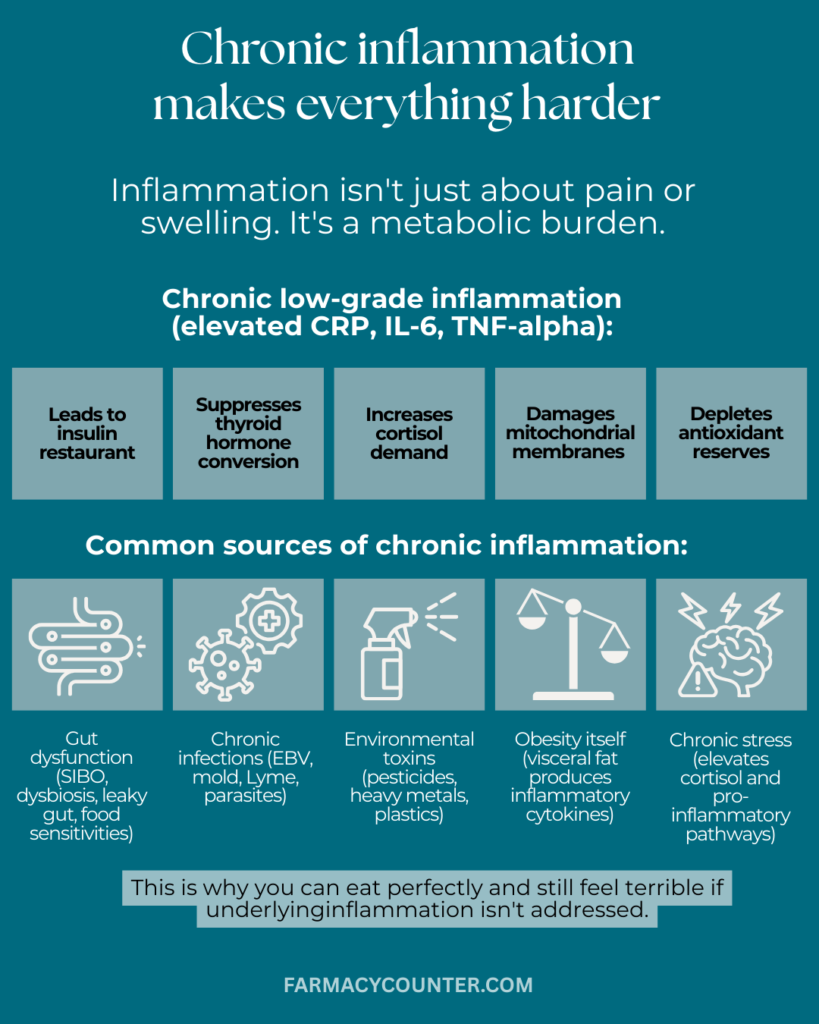
The most common sources of chronic low-grade inflammation that drive metabolic dysfunction:
Gut dysfunction — SIBO, dysbiosis, leaky gut, food sensitivities
The gut lining is a single cell layer thick. When that barrier is compromised — by antibiotic use, chronic stress, poor diet, or infection — partially digested food particles and bacterial endotoxins enter the bloodstream, triggering a sustained immune response. This is one of the most common and most underdiagnosed drivers of systemic inflammation.
Food sensitivities (distinct from true allergies) operate through a similar mechanism — triggering low-grade immune activation every time you eat a reactive food, with no obvious immediate symptoms to connect cause and effect.
Chronic infections — EBV, mold, Lyme, parasites
Reactivated Epstein-Barr virus, mold toxicity, chronic Lyme disease, and parasitic infections all generate persistent immune activation. These are frequently missed because standard testing either doesn’t look for them or uses reference ranges that miss subclinical activation. Many patients with unexplained fatigue and weight resistance have one or more of these as a contributing factor.
Environmental toxins — pesticides, heavy metals, plastics
Heavy metals (mercury, lead, arsenic) and persistent organic pollutants accumulate in fat tissue and organs, generating ongoing oxidative stress and immune activation. They also directly impair detoxification pathways, creating a toxic burden that compounds over time. BPA and other plasticizers are endocrine disruptors that additionally interfere with hormone signaling.
Visceral fat itself
This one surprises people: excess abdominal fat isn’t just a consequence of inflammation — it’s also a source of it. Visceral fat cells actively produce inflammatory cytokines (adiponectin, TNF-alpha, IL-6), creating a feedback loop where inflammation drives fat storage, and fat storage drives more inflammation. This is one of the reasons metabolic dysfunction can become self-perpetuating and resistant to standard interventions.
Chronic stress
Chronic psychological stress elevates cortisol and activates pro-inflammatory pathways simultaneously. Over time, cells become resistant to cortisol’s anti-inflammatory signal — a phenomenon called glucocorticoid resistance — leaving inflammatory pathways unchecked even when cortisol is being produced. The result is the combination of high inflammation and high cortisol that characterizes so much of the metabolic dysfunction seen in driven, high-achieving adults.

Why “Eating Anti-Inflammatory Foods” Often Isn’t Enough
Turmeric lattes and omega-3s are a start. But when chronic inflammation has identifiable root causes — gut infections, mold exposure, food sensitivities, heavy metal accumulation — dietary anti-inflammatory strategies alone are unlikely to resolve it.
The functional medicine approach to chronic inflammation:
- Identify the source through comprehensive testing, not just symptom management
- Address gut integrity — healing the gut lining removes one of the most common drivers of systemic immune activation
- Remove or reduce toxin exposure where possible, and support detoxification pathways so the body can clear what it’s already accumulated
- Increase antioxidant capacity through targeted nutrient repletion, not just supplementation guesswork
- Address chronic infections if present — something standard care almost never investigates in the context of fatigue and weight resistance
The goal isn’t to suppress inflammation indefinitely. It’s to remove the triggers so the immune system can stand down.

The Labs That Reveal Hidden Inflammation
If you’ve never had these markers tested, you don’t actually know whether inflammation is a factor in your metabolic dysfunction:
- High-sensitivity CRP (hsCRP) — the most accessible marker of systemic inflammation; optimal is below 1.0 mg/L
- IL-6 — a pro-inflammatory cytokine that drives insulin resistance and thyroid suppression
- Homocysteine — elevated levels indicate both inflammatory burden and methylation dysfunction
- ESR (erythrocyte sedimentation rate) — a broad marker of immune activation
- Fasting insulin — elevated fasting insulin is both a marker of insulin resistance and a downstream consequence of inflammation
These are not exotic tests. They’re available through standard labs. They’re just not included in routine annual panels — which means most people with chronic low-grade inflammation have never been told they have it.
Your Body Is Trying to Tell You Something
Chronic inflammation is your immune system signaling that something in its environment needs to change. It’s not a character flaw. It’s not inevitable aging. And it’s not something you manage forever with medication.
It’s a message — and functional medicine is designed to decode it.
When the inflammatory burden is identified and addressed at the root, the downstream effects — insulin resistance, thyroid suppression, HPA dysfunction, mitochondrial damage — begin to resolve. Metabolism restores. Energy returns. Weight starts to respond.
Not because anything magical happened. Because the thing that was blocking all of it was finally removed.
Find Out What’s Driving Your Metabolic Resistance
Chronic inflammation is one of four overlapping patterns that drive stubborn weight resistance and fatigue. The free Weight Resistance Decoder Guide walks you through all four — including the symptoms that point to each pattern and what functional testing reveals the root cause.