

You can eat clean, sleep well, manage your stress, and still have estrogen dominance symptoms that will not budge.
Bloating that will not resolve. Breast tenderness every luteal phase. Heavy, clot-filled periods. Mood swings that arrive like clockwork. You have done the things you were told to do, and the needle has not moved.
Here is what almost never gets mentioned: the reason might not be your liver, your stress, or your diet at all. It might be your gut.
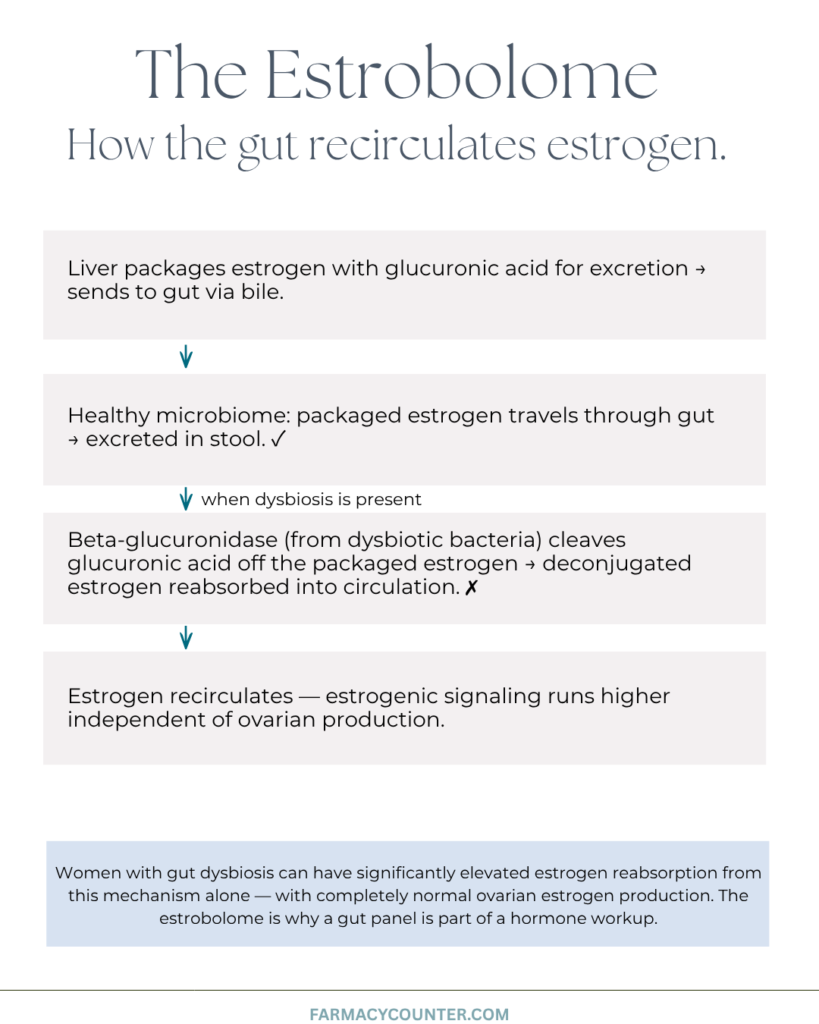
What’s Actually Happening
Here is the process, step by step.
Step 1: Your liver packages estrogen for removal by attaching it to glucuronic acid, a process called conjugation. This tagged, “packaged” estrogen is sent to the gut through bile.
Step 2: In a healthy microbiome, that packaged estrogen travels through the gut and is excreted in stool. Done. Gone. That is the system working as designed.
Step 3: But when dysbiosis is present, certain gut bacteria produce an enzyme called beta-glucuronidase, which cleaves the glucuronic acid tag back off. The estrogen is deconjugated, right there in your gut, before it can leave.
Step 4: That deconjugated estrogen does not exit in your stool. It gets reabsorbed into circulation instead, as if your liver had never processed it at all.
This bacterial collection, and its collective effect on your estrogen levels, is called the estrobolome. It is one of the most overlooked drivers of estrogen dominance I see in clinical practice.
Here is the detail that changes how most women think about their own labs: this recirculation happens independent of ovarian estrogen production. A woman with gut dysbiosis can have significantly elevated estrogen reabsorption from this mechanism alone, with completely normal ovarian estrogen output. Her ovaries are doing exactly what they should. Her gut is putting estrogen back into rotation anyway.
This is exactly why a hormone panel showing “normal” estrogen does not rule out estrogen dominance, and why a gut panel belongs in a real hormone workup, not just a digestive one.
Why This Matters More Than Most People Realize
Estrogen dominance is rarely about having objectively high estrogen on a lab test. More often, it is about estrogen being high relative to progesterone, or estrogen not clearing efficiently once your body has tried to get rid of it.
The estrobolome sits at exactly that second point, and it can do so even when everything upstream is working correctly. You could have a well-functioning liver, sufficient methylation cofactors, and a clean phase I and phase II detox pathway, and still end up with elevated circulating estrogen if your gut keeps sending it back into rotation after your liver already did its job.
This is also why “just take DIM” so often falls short. DIM supports phase I liver metabolism, shifting how estrogen gets broken down. It does nothing to address an estrobolome that is recirculating estrogen after your liver has already finished its job. If the gut is the bottleneck, phase I support alone will not move the needle, and may leave you wondering why a supplement that is supposed to help estrogen dominance is not helping yours.

What Drives an Overactive Estrobolome
A handful of things reliably push beta-glucuronidase activity higher and shift the gut microbiome toward more estrogen recirculation:
- Dysbiosis. An imbalanced gut microbiome, from antibiotic use, chronic stress, low fiber intake, or an underlying infection, tends to favor the bacterial strains that produce more beta-glucuronidase.
- Low fiber intake. Fiber binds conjugated estrogen in the gut and helps escort it out through stool. Without enough of it, conjugated estrogen has more time and opportunity to be deconjugated before it exits.
- Constipation and slow motility. The longer conjugated estrogen sits in the colon, the more exposure it has to beta-glucuronidase-producing bacteria, and the higher the odds it gets reabsorbed instead of excreted.
- Chronic gut inflammation. Inflammatory conditions in the GI tract, including food sensitivities and low-grade chronic inflammation, shift the microbial environment in ways that tend to favor higher beta-glucuronidase activity.
None of these are exotic. They are common, everyday gut patterns that most women have never connected to their hormonal symptoms, because almost no one asks about digestion during a hormone workup.

What’s Possible
This is one of the more addressable pieces of estrogen dominance once it is identified, because the mechanism is specific and the gut is investigable.
In a real protocol, we are not guessing. We look directly at what the gut is doing to estrogen, and we build the intervention around that data rather than a generic “detox” approach.
In a functional medicine protocol, I’d start with:
- Comprehensive stool analysis, including a direct beta-glucuronidase measurement, dysbiosis markers, and inflammatory markers like calprotectin
- DUTCH Complete, to see how estrogen is being metabolized and whether the recirculation shows up in the metabolite pattern
- A fiber and prebiotic strategy targeted to reduce the substrate available for recirculation, not just “eat more fiber” in the abstract
- Calcium-d-glucarate, timed appropriately, which directly inhibits beta-glucuronidase activity and supports estrogen staying conjugated on its way out
- Gut-specific work to shift the microbial balance itself, addressing the dysbiosis rather than only managing its downstream effect
Most women in my practice who have an estrobolome-driven component to their estrogen dominance notice a real shift in their luteal phase within one to two cycles of addressing the gut piece directly, often faster than any liver-support protocol alone produced.
Your Next Step
If you have been doing “all the right things” for estrogen dominance and still feel stuck, this is usually why. The piece that is missing is not more effort. It is the right investigation.
A good place to start is figuring out which PMS pattern actually matches your symptoms. Estrogen dominance, the one the estrobolome feeds into, is one of four distinct patterns I see in practice, and each one points toward a different set of labs and a different protocol.
Take the Free PMS Pattern Decoder → A quick self-assessment to find out which pattern is driving your symptoms, and what it means.
If you already have a good sense of your pattern and want to talk through your specific picture, I also offer a free discovery call. No pressure, just a conversation about whether functional medicine is the right next step for you.
→Book Your Free Discovery Call Here