

When practitioners run a workup for inflammation, they usually ask about diet. Sometimes stress. Rarely do they ask how you’re actually sleeping, and how consistently.
That’s a significant blind spot. Sleep deprivation is one of the most reliable experimental methods researchers use to elevate inflammatory markers in otherwise healthy people. Take away someone’s sleep in a lab setting, and inflammation goes up in predictable, measurable ways. If it’s that reliable in a controlled study, it’s very likely doing the same thing quietly in your own life.
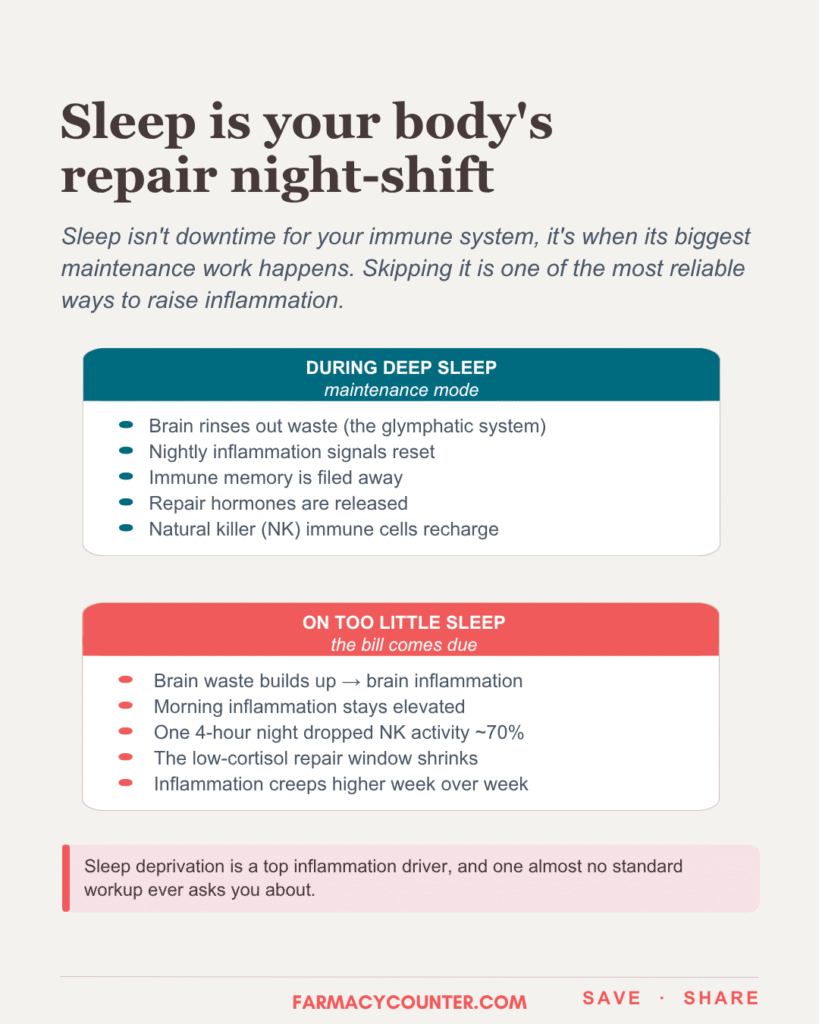
What’s actually happening during deep sleep
Sleep isn’t simply the absence of activity. It’s an active maintenance shift, and several distinct repair processes are only able to run properly while you’re asleep.
Your brain rinses out its own waste. Your brain has a waste clearance system called the glymphatic system, driven by cerebrospinal fluid, that operates primarily during slow-wave sleep. During deep sleep, brain cells actually shrink by roughly 60%, which expands the space between them and dramatically increases how much cerebrospinal fluid can flow through brain tissue. That flow clears out metabolic waste and neurotoxic byproducts left over from a full day of neural activity. When sleep is chronically cut short, that waste doesn’t get cleared as effectively. It accumulates in brain tissue instead, and that accumulation directly drives neuroinflammation.
Inflammatory signals get their nightly reset. Pro-inflammatory cytokines follow their own circadian rhythm, with a peak that normally happens early in the sleep cycle. In the context of adequate sleep, that peak is a completely normal part of nightly immune maintenance, and it resolves by morning. But when sleep is shortened or fragmented, that nocturnal peak still happens, it just doesn’t get the resolution phase it needs. Morning cytokine levels stay elevated instead of resetting, and over weeks of insufficient sleep, that unresolved elevation accumulates into a sustained, chronically higher inflammatory baseline.
Your immune system’s cancer and infection surveillance recharges. Natural killer (NK) cells are part of your innate immune system, and their job is to survey the body for virally infected and cancerous cells. They need sleep to recharge, and the drop-off when they don’t get it is dramatic: a landmark 2019 study out of UC Berkeley found that a single night of just four hours of sleep reduced NK cell activity by roughly 70% compared to well-rested controls. That’s not a gradual decline from chronic sleep debt. That’s one bad night.
Cortisol steps aside so repair can happen. Cortisol and cellular repair are, in a sense, competing for the same resources. Cortisol’s job is to support acute stress response, and while it’s active, it actively suppresses the protein synthesis and cellular repair processes your body would otherwise be running. Normal sleep is when cortisol reaches its lowest point of the day, and that low-cortisol window is exactly when anabolic repair, growth hormone secretion, and immune maintenance are able to operate at their best. When chronic stress keeps cortisol elevated into the sleep period, it compresses or eliminates that repair window entirely, even if you’re technically getting hours of sleep.

What happens when the bill comes due
Cut any of these processes short consistently, and the downstream effects compound quickly:
- Brain waste that isn’t cleared builds up, contributing directly to brain inflammation
- Morning inflammation stays elevated instead of resetting overnight
- A single 4-hour night can drop NK cell activity by roughly 70%
- Chronic cortisol elevation shrinks or eliminates your low-cortisol repair window
- Inflammation creeps higher week over week as these effects stack
None of this requires a dramatic, obvious sleep problem to start happening. Consistently shaving an hour or two off your sleep, or sleeping through a chronically stressful season with cortisol staying elevated overnight, is enough to keep this cycle running in the background.
Why this gets missed so often
Sleep is one of the few inflammation drivers that’s almost entirely within your control, and it’s also one of the most commonly overlooked in a standard workup. Most people get asked about their diet. Far fewer get asked how many hours they’re actually sleeping, how consistent their schedule is, or whether their stress is bleeding into their sleep window.
That’s a real gap, because sleep isn’t a minor lifestyle factor sitting alongside inflammation. It’s one of the most powerful levers available for addressing it, precisely because so much of your body’s repair work is scheduled to happen during those hours and nowhere else.
Where to start
If you’ve been addressing diet, stress, and gut health but never really looked at your sleep as an inflammation driver in its own right, that’s often the missing piece. The Inflammation Threshold Test is a free, 9-question self-assessment that maps your current inflammatory load, including how much your sleep is contributing to it.
Take the Inflammation Threshold Test →