

Most people know that sleep affects how they feel the next day. What most people don’t know is that sleep is when the brain performs its most critical maintenance function — a process that has no meaningful equivalent during waking hours, cannot be compensated for after the fact, and directly determines whether the proteins and debris that accumulate every day in your brain get cleared or stay there.
This isn’t a metaphor. Your brain has its own dedicated waste clearance system, and it is almost entirely dependent on sleep to operate.
Here’s what it is, how it works, and what happens when it doesn’t.
The Glymphatic System: What It Is and Why It Matters
Your body has a lymphatic system — a network of vessels that collects metabolic waste from tissues and transports it for clearance. Your brain, protected behind the blood-brain barrier, cannot use that system directly.
Instead, it has something specific to itself: the glymphatic system, first described in 2013 by Dr. Maiken Nedergaard and her team at the University of Rochester. The name is a combination of “glial” — the support cells of the brain — and “lymphatic,” reflecting its functional role as the brain’s equivalent waste clearance network.
The glymphatic system is a network of channels that surround the blood vessels in the brain, called perivascular spaces. These channels are lined by astrocytes — glial cells that express a water channel protein called aquaporin-4 — which regulate the flow of cerebrospinal fluid (CSF) through brain tissue.
During waking hours, this system operates at a low level. During sleep — specifically during slow-wave deep sleep — something remarkable happens.
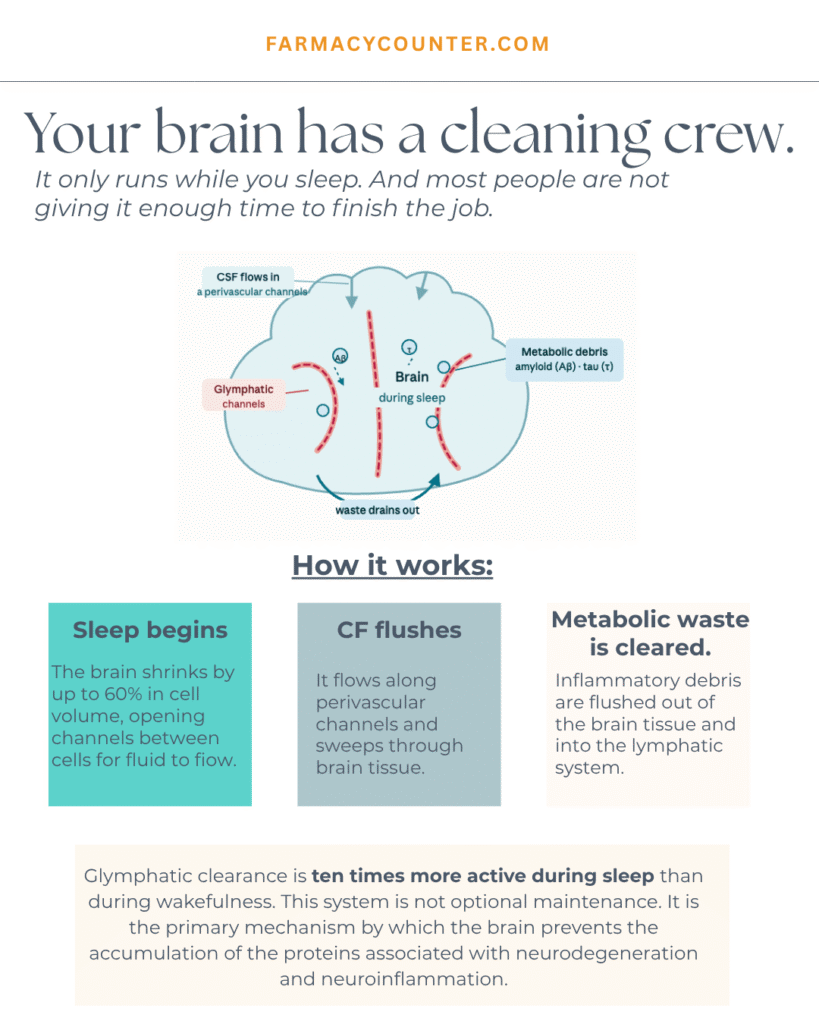
What Happens While You Sleep
When sleep begins, the brain’s interstitial cells shrink by up to 60% in volume. This isn’t pathological. It’s the mechanism. The shrinkage opens channels between cells, dramatically expanding the space through which cerebrospinal fluid can flow.
CSF then flows in through perivascular channels, sweeps through brain tissue along the glymphatic network, and carries metabolic waste products out of the brain and into the lymphatic system, where they are processed and cleared.
Glymphatic clearance is ten times more active during sleep than during wakefulness. This is not a small difference. It means the brain’s primary waste clearance mechanism is effectively offline during the day and depends almost entirely on sleep to function.
What gets cleared by this process matters significantly:
🧹 Beta-amyloid — the protein fragment associated with Alzheimer’s disease, which accumulates in plaques when clearance is insufficient
🧹 Tau proteins — associated with neurodegeneration and chronic traumatic encephalopathy when they accumulate abnormally
🧹 Inflammatory debris — cytokines, activated immune proteins, and the cellular remnants of neuroinflammation
🧹 Neurotoxic byproducts of neurotransmitter metabolism — the waste products of a day’s worth of serotonin, dopamine, and norepinephrine turnover
🧹 General cellular waste — the metabolic byproducts of the enormous energy demands the brain generates during waking hours
When sleep is consistently insufficient or disrupted, this clearance doesn’t happen adequately. The waste accumulates. And the downstream consequences show up not just in the distant future — they show up in mood, cognition, and anxiety regulation the next day and every day after.
Why Disrupted Sleep Is a Brain Health Problem, Not Just a Fatigue Problem
Most people frame poor sleep as an energy issue. They feel tired, they need coffee, they push through. What they don’t recognize is that the fatigue is a downstream symptom of something structural happening in the brain.
When glymphatic clearance is impaired because sleep is fragmented, short, or missing the slow-wave architecture the system depends on, metabolic waste accumulates in brain tissue. That accumulated waste — particularly beta-amyloid and inflammatory debris — drives neuroinflammation. And neuroinflammation then disrupts the same pathways that produce the neurotransmitters involved in mood, anxiety, and cognitive function.
This creates a cycle that is not intuitive from the outside but is well-documented in the research:
Poor sleep → impaired glymphatic clearance → accumulation of inflammatory debris → neuroinflammation → disrupted neurotransmitter synthesis → anxiety, mood instability, brain fog → poor sleep.
The cycle can be entered from any point, but disrupted sleep is one of the most common entry points I see clinically — and one of the most underaddressed, because the intervention for sleep disruption in standard care is typically a sleep medication rather than an investigation into why the sleep architecture is disrupted in the first place.

What Disrupts Glymphatic Function
The glymphatic system doesn’t just need sleep. It needs the right kind of sleep — specifically, slow-wave deep sleep, during which the interstitial shrinkage that opens the glymphatic channels is most pronounced.
Several factors impair glymphatic function even when sleep duration looks adequate:
HPA axis dysregulation and elevated nocturnal cortisol. Cortisol suppresses slow-wave sleep architecture. When the HPA axis is dysregulated from chronic stress, a history of significant stressors, or poor sleep patterns that have compounded over time, nighttime cortisol remains elevated at the point in the circadian rhythm when it should be at its lowest. The result is lighter, more fragmented sleep that doesn’t spend adequate time in slow-wave stages — even if total hours in bed look reasonable.
Neuroinflammation. Inflammatory cytokines directly impair sleep architecture, specifically reducing slow-wave sleep and increasing lighter sleep stages. This means neuroinflammation from any source — gut dysbiosis, systemic inflammation, chronic infection — both impairs glymphatic clearance and worsens the sleep it depends on. The two reinforce each other.
Sleep position. Research from Nedergaard’s group suggests lateral (side) sleeping positions may enhance glymphatic clearance compared to sleeping on the back or stomach, likely related to the direction of CSF flow through perivascular channels. This is a small but accessible intervention.
Alcohol. Alcohol induces sleep onset but significantly suppresses slow-wave sleep architecture. The sleep that follows alcohol consumption is lighter, more fragmented, and produces far less glymphatic clearance than unaffected sleep — which is why alcohol-impaired sleep consistently produces worse next-day cognitive and mood effects than the duration alone would suggest.
Histamine excess. Elevated histamine from gut dysbiosis, DAO deficiency, or undermethylation overstimulates the brain’s H1 alerting system and keeps the brain in a state of hyperarousal at night. This directly impairs the transition into slow-wave sleep and is one of the most common causes of wired-but-tired insomnia — exhausted body, activated brain — I see in practice.

The Anxiety and Mood Connection
The relationship between glymphatic function and anxiety isn’t just about long-term neurodegeneration risk. It’s immediate and daily.
The neurotoxic byproducts of neurotransmitter metabolism that accumulate when glymphatic clearance is impaired include quinolinic acid — a kynurenine pathway metabolite that overstimulates NMDA receptors and drives anxiety and mood dysregulation. They include oxidative stress byproducts that impair mitochondrial function in neurons. They include the inflammatory mediators that directly reduce GABA synthesis and receptor sensitivity.
A brain that hasn’t been adequately cleared overnight is running on a substrate that is measurably more inflammatory, more oxidatively stressed, and less capable of producing calming neurotransmitters than a brain that has. The anxiety and low mood that follow poor sleep are not just tiredness. They reflect the actual neurochemical state of a brain that has not completed its maintenance cycle.
This is also why sleep disruption doesn’t just make existing anxiety worse — it creates a neurochemical environment in which anxiety is biologically likely, independent of any psychological stressors.
What Actually Needs to Be Addressed
When someone comes to me with chronic sleep disruption alongside anxiety, mood instability, or brain fog, I’m not starting with a sleep hygiene checklist. The behavioral recommendations for sleep are reasonable as a first layer, but they don’t address the biological drivers that are disrupting sleep architecture in the first place.
The investigation looks at:
Cortisol rhythm via DUTCH testing. A four-point urinary cortisol assessment gives me the full arc of cortisol through the day and evening, the cortisol awakening response, and the metabolite picture that tells me how cortisol is being cleared. Elevated evening and nocturnal cortisol is one of the most common and most addressable findings in people with sleep disruption alongside anxiety.
Inflammatory markers. hs-CRP, ferritin, and in some cases IL-6 and TNF-alpha, tell me whether neuroinflammation is part of the picture driving both the sleep disruption and the mood symptoms.
Histamine and methylation status. Whole blood histamine and homocysteine together give me a picture of methylation capacity and histamine load — both directly relevant to sleep architecture and to the wired-but-tired pattern specifically.
Organic acids. Neurotransmitter metabolites including kynurenine pathway markers, GABA levels, and serotonin metabolism give me a window into what the brain’s chemistry is actually doing — and whether the disrupted sleep is downstream of a neurotransmitter production problem.
Thyroid. Free T3 and reverse T3, because subclinical hypothyroidism produces sleep disruption, brain fog, and mood symptoms that are commonly missed by TSH testing alone.
Sleep disruption is almost never just a sleep problem. It is usually a symptom of a biological driver that needs to be identified before the sleep — and everything it’s affecting — can actually improve.

What Changes When the Glymphatic System Works
The patients who notice the most dramatic shifts when their sleep architecture actually improves — not just duration, but depth — consistently describe something broader than feeling less tired.
Cognitive consistency improves. The morning sharpness that felt like it used to exist and had slowly disappeared comes back. Word retrieval improves. The ability to hold complex thoughts without losing the thread returns.
Emotional regulation improves. The reactivity that felt like a personality trait — the low frustration tolerance, the ease of being thrown off by small things — reduces noticeably. Not because anything psychological changed. Because the brain is running the maintenance cycle it depends on.
Anxiety baseline lowers. The background hum of activation that some people have carried for years — that floor they can never quite get below — often shifts when the sleep architecture improves and glymphatic clearance is actually happening. Because the neuroinflammatory load that was running the anxiety starts to reduce, one night at a time.
The brain heals more slowly than it becomes dysregulated. But the glymphatic system is working every night that sleep allows it to. Giving it the conditions to do its job is one of the most fundamental things you can do for brain health — and it’s almost never what sleep interventions in standard care are actually targeting.
Where to Start
If sleep disruption is part of your picture — particularly if it’s accompanied by anxiety, mood instability, or cognitive symptoms that are worse after poor nights — the investigation worth having is not about sleep hygiene. It’s about why your sleep architecture is disrupted and what that disruption is doing to your brain’s ability to clear itself overnight.
On a discovery call, I walk through the full sleep and symptom picture — the pattern of disruption, when it started, what else shifted at the same time, and what your specific symptoms suggest about which biological drivers are most likely involved.
If the Anxiety Pattern Decoder sounds like a useful starting point, it maps the four biological types of anxiety — several of which have sleep disruption as a central feature — and helps identify which pattern is most likely yours.
Download the free Anxiety Pattern Decoder below.
Your brain has a cleaning crew. The question worth asking isn’t how to sleep better. It’s what’s preventing the crew from doing its job.