You’re doing everything right. You’re taking selenium. You added zinc. Maybe you’re even on a T3-containing medication now instead of levothyroxine alone. Your labs have improved on paper. But none of it feels like it’s working. The fatigue hasn’t lifted. Your hair is still coming out in the shower. You’re still cold when everyone else is comfortable.
Your practitioner is confused. The nutrients are dosed correctly. The medication looks appropriate for your labs. On paper, this should be working.
Here’s what almost nobody checks: none of those thyroid nutrients, and often not even your thyroid medication, can do their job if your gut isn’t absorbing them. Selenium, zinc, iron, iodine, and tyrosine all have to cross an intestinal barrier before they can support thyroid hormone production or conversion. If that barrier is inflamed, if your stomach acid is too low, if your microbiome is out of balance, you can be swallowing the right supplements in the right doses and still functionally starving your thyroid.
I see this pattern constantly. Someone comes in with a beautifully dosed thyroid protocol that isn’t producing results, and when we look at gut function, we find low stomach acid, dysbiosis, or frank intestinal inflammation quietly blocking absorption at every step. Once we restore gut function, the same nutrients and medications people were already taking finally start working.
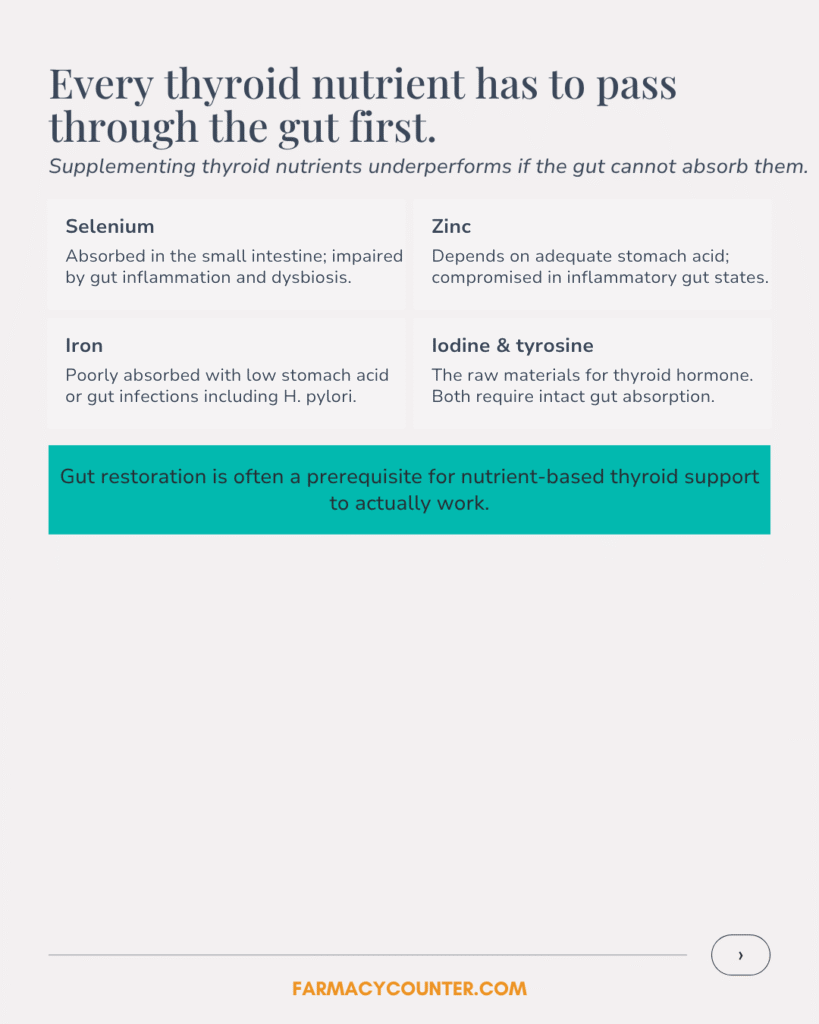
Every Thyroid Nutrient Has to Pass Through the Gut First
Thyroid hormone production and activation depend on a short list of nutrients, and every one of them requires an intact, functioning gut to be absorbed.
Selenium is required for the deiodinase enzymes that convert T4 into active T3. It’s absorbed primarily in the small intestine, and that absorption is directly impaired by gut inflammation and dysbiosis (1). You can supplement selenium at a therapeutic dose and still not raise your functional selenium status if inflamed intestinal tissue can’t take it up.
Zinc, another deiodinase cofactor, depends on adequate stomach acid to be liberated from food and supplements and absorbed. In inflammatory gut states, or in anyone with low stomach acid (which becomes more common with age, chronic stress, and long-term acid-blocking medication use), zinc absorption drops even when intake looks adequate.
Iron is required for thyroid peroxidase, the enzyme that helps produce thyroid hormone in the gland itself. Iron absorption is notoriously fragile. It’s poorly absorbed in anyone with low stomach acid, and it’s actively blocked in the presence of gut infections, including H. pylori, which competes for iron and disrupts the acidic environment iron needs to be absorbed (2).
Iodine and tyrosine are the literal building blocks of thyroid hormone. Both require an intact, absorptive gut lining to get from your plate into your bloodstream in usable form.
This is why gut restoration is often a prerequisite for nutrient-based thyroid support to actually work, not an optional add-on. You can correct every deficiency on paper and still not move the needle if the gut can’t deliver what you’re giving it.
Stomach Acid: The Gatekeeper Nobody Checks
Low stomach acid, or hypochlorhydria, is one of the most overlooked pieces of thyroid dysfunction, largely because thyroid hormone itself is part of what regulates stomach acid production. Thyroid hormone stimulates the parietal cells that produce hydrochloric acid. So when thyroid function is already compromised, stomach acid output often drops too, creating a self-reinforcing cycle: low thyroid function lowers stomach acid, and low stomach acid impairs absorption of the very nutrients needed to support thyroid function.
Wondering if your labs are missing the real reason your thyroid protocol isn’t working? Download The “Normal Labs, Not Normal Symptoms” Blueprint to see the four places a thyroid problem hides that standard testing never catches. Get it here.
Without adequate stomach acid, protein digestion is incomplete, mineral absorption (zinc, iron, magnesium) drops significantly, and the small intestine becomes more hospitable to bacterial overgrowth, since stomach acid is one of the body’s primary defenses against bacteria migrating upward from the colon. This sets the stage for SIBO, which creates its own layer of thyroid interference.
How Gut Bacteria Convert, and Sometimes Steal, Your Thyroid Hormone
Roughly 20% of T4-to-T3 conversion doesn’t happen in the liver or peripheral tissues at all. It happens in the gut, via bacterial enzymes (3). Specifically, healthy gut bacteria produce an enzyme called intestinal sulfatase, which cleaves the sulfate group off inactive, conjugated forms of thyroid hormone (T3 sulfate) that have been excreted into the bile, freeing up active T3 to be reabsorbed. This is part of the enterohepatic recirculation of thyroid hormone, a normal process where hormone is recycled rather than fully eliminated.
When the microbiome is disrupted, whether from dysbiosis, antibiotic use, chronic gut infection, or low microbial diversity, this bacterial conversion step is impaired. You lose a meaningful source of active T3 that a healthy gut would normally be reclaiming for you.
At the same time, certain overgrown or opportunistic bacteria can do the opposite: they can deconjugate thyroid hormone metabolites in a way that allows them to be reabsorbed in inactive or altered forms, or they can bind and sequester thyroid hormone and the minerals needed to produce it, effectively competing with you for your own thyroid support.
The Leaky Gut-Autoimmunity Link
If your thyroid dysfunction is autoimmune, meaning you have Hashimoto’s or elevated TPO and thyroglobulin antibodies, the gut isn’t just a supporting player. It’s often the initiating event.
Intestinal permeability, commonly called leaky gut, allows undigested food proteins, bacterial fragments, and lipopolysaccharide (LPS, a component of certain bacterial cell walls) to cross into the bloodstream where they shouldn’t be. This triggers immune activation. In genetically susceptible people, some of these bacterial and food proteins closely resemble thyroid tissue at the molecular level, a phenomenon called molecular mimicry. The immune system, trained to attack the foreign protein, ends up cross-reacting with thyroid tissue itself, driving the antibody production that defines Hashimoto’s (4).
LPS circulating from a permeable gut also directly increases inflammatory cytokine production, and those cytokines independently impair T4-to-T3 conversion and raise reverse T3, compounding the problem on top of the autoimmune piece.
This is why so many people with Hashimoto’s see meaningful antibody reduction when gut permeability and dysbiosis are addressed directly, sometimes before thyroid medication is even adjusted. The gut is upstream of the autoimmune process, not downstream of it.
Why SIBO and Dysbiosis Sabotage Thyroid Function From Multiple Angles
Small intestinal bacterial overgrowth deserves specific attention in thyroid patients because the relationship goes both directions. Hypothyroidism slows gut motility, which promotes SIBO. SIBO, in turn, worsens thyroid function through several mechanisms simultaneously.
Overgrown bacteria compete for and consume nutrients before you can absorb them, including the selenium, zinc, and iron your thyroid depends on. Bacterial fermentation byproducts and endotoxin production drive local and systemic inflammation, which raises reverse T3 and blunts conversion. And the resulting intestinal irritation further impairs the nutrient absorption that was already the point of failure.
Can’t figure out why your thyroid protocol isn’t working even though your numbers look right? Download The “Normal Labs, Not Normal Symptoms” Blueprint to understand what your labs still aren’t telling you. Get it here.
This is also part of why thyroid medication absorption itself can be inconsistent in people with unaddressed gut issues. Levothyroxine absorption in particular is highly sensitive to gut pH, motility, and the presence of certain bacterial overgrowth, which is one reason people can be on a seemingly appropriate dose and still show erratic labs or symptoms that don’t track with their numbers (5).
What Actually Needs to Be Assessed
When someone comes to me with a thyroid protocol that isn’t producing results, I need to see both the thyroid picture and the gut picture together, because treating one without the other rarely holds.
Comprehensive thyroid panel including TSH, free T4, free T3, reverse T3, and thyroid antibodies (TPO and thyroglobulin), so I know whether conversion, autoimmunity, or both are in play.
Comprehensive stool analysis to assess microbial diversity, presence of pathogenic or opportunistic organisms, markers of inflammation (like calprotectin), and digestive markers including pancreatic elastase and short-chain fatty acid production, all of which inform how well the gut can actually absorb and process thyroid-supportive nutrients.
SIBO breath testing when bloating, irregular bowel habits, or post-meal distension accompany the thyroid symptoms.
Markers of intestinal permeability, particularly in anyone with elevated thyroid antibodies, since a leaky gut is frequently part of what’s sustaining the autoimmune process.
Functional nutrient status for selenium, zinc, iron (including ferritin), and vitamin D, not just to see if supplementation is needed but to see if supplementation that’s already happening is actually working.
H. pylori testing, given its direct interference with stomach acid, iron absorption, and its documented association with autoimmune thyroid disease.
Beyond labs, I’m listening for the pattern: bloating, irregular digestion, food reactions, or a history of gut infections or long-term acid-blocker use in someone whose thyroid protocol looks correct on paper but isn’t translating into how they feel.
How We Actually Restore the Gut-Thyroid Axis
Once I understand where the gut is failing the thyroid, the intervention targets that specific breakdown rather than simply increasing doses of what isn’t being absorbed.
If stomach acid is low, we’re supporting it directly, sometimes with betaine HCl or digestive bitters, so that mineral absorption and protein digestion improve and the small intestine has one of its natural defenses against bacterial overgrowth restored.
If SIBO or dysbiosis is present, we’re addressing it directly with targeted antimicrobial or herbal protocols matched to what the testing shows, followed by supporting motility so it doesn’t simply recur.
If intestinal permeability is driving autoimmune activity, we’re working to repair the gut lining with targeted nutrients (glutamine, zinc carnosine, deglycyrrhizinated licorice) while identifying and removing whatever is perpetuating the permeability, whether that’s a food trigger, an infection, or chronic stress.
If nutrient absorption is the primary issue, we’re not just adding more selenium and zinc; we’re reassessing form and delivery, and in some cases using sublingual or otherwise more absorbable forms while gut healing is underway.
We’re also reviewing medication timing and gut conditions that affect thyroid hormone absorption itself, so a dose that looks right on paper is actually reaching your bloodstream the way it’s supposed to.
The common thread: we’re restoring the gut’s ability to deliver what the thyroid needs, so the protocol you’re already following, or the more targeted one we build together, can finally do its job.

What Happens When the Gut-Thyroid Axis Is Restored
When gut function is repaired alongside thyroid support, people typically see a different kind of improvement than they got from thyroid intervention alone. Symptoms that hadn’t budged despite “correct” labs start to shift.
Energy improves in a way that finally matches the numbers on paper. Hair shedding slows. Cold intolerance eases. Thyroid antibodies, in autoimmune cases, often begin trending down as the gut-driven immune activation quiets.
Digestion normalizes alongside it: less bloating, more regular bowel movements, fewer post-meal symptoms. And perhaps most tellingly, people find that the nutrients and medications they were already taking finally start behaving the way they were supposed to all along.
Let’s Figure Out If Your Gut Is Sabotaging Your Thyroid Protocol
If you’re doing the right things for your thyroid and still not feeling like yourself, the missing piece is often not another supplement or a higher dose. It’s whether your gut can actually deliver what you’re already giving it.
On a discovery call, we walk through your full symptom picture, thyroid and digestive, and review whatever thyroid and gut testing you’ve already had. Most people have never had the two looked at together. I’ll explain which tests would actually reveal whether gut dysfunction is limiting your thyroid protocol, and we’ll map out what it would take to fix the absorption problem underneath it.
If you’re ready to stop increasing doses of things your body can’t use and start understanding why, you can schedule a discovery call here. We’ll find out if your gut is the reason your thyroid protocol isn’t working, and what it takes to fix it.
Your thyroid isn’t failing because you’re doing the wrong things. It may be failing because none of the right things can get where they need to go. Let’s fix that.
References:
- Wu Q, Rayman MP, Lv H, et al. Low Population Selenium Status Is Associated With Increased Prevalence of Thyroid Disease. J Clin Endocrinol Metab. 2015;100(11):4037-4047.
- Bertalot G, Montresor G, Tampieri M, et al. Decrease in thyroid autoantibodies after eradication of Helicobacter pylori infection. Clin Endocrinol (Oxf). 2004;61(5):650-652.
- Virili C, Centanni M. Does microbiota composition affect thyroid homeostasis? Endocrine. 2015;49(3):583-587.
- Knezevic J, Starchl C, Tmava Berisha A, Amrein K. Thyroid-Gut-Axis: How Does the Microbiota Influence Thyroid Function? Nutrients. 2020;12(6):1769.
- Virili C, Bassotti G, Santaguida MG, et al. Atypical celiac disease as cause of increased need for thyroxine: a systematic study. J Clin Endocrinol Metab. 2012;97(3):E419-E422.