The Hormone Factory Inside Your Cells (And What Shuts It Down)
- By Dr. Ryan Wagner PharmD
- October 7, 2026
- 6 Min Read
Training harder, sleeping less, eating less. Then something shifts. For women, maybe the cycle changes: lighter, later, less predictable, or PMS that feels different. For men, maybe drive and libido fade, recovery drags, and the afternoon crash arrives like clockwork.
You get labs. Everything comes back “normal.”
Here is what almost never gets explained: every steroid hormone you make, including progesterone, estrogen, cortisol, and testosterone, starts in a tiny factory inside your cells. That factory is the mitochondria. And like any factory, it can only run as well as the fuel and conditions it gets.
Inside the Hormone Factory
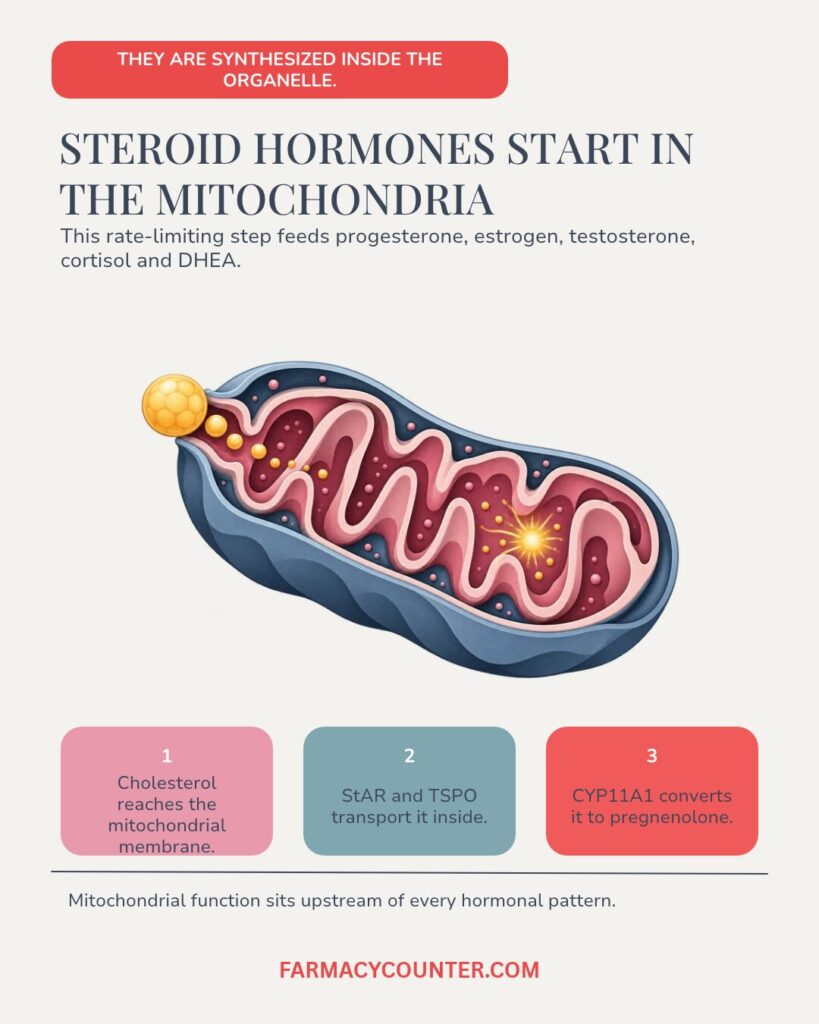
Mitochondria are best known as the cell’s power plants. They are also where hormone production begins. Here is the assembly line.
The raw material arrives
Cholesterol is the raw material for every steroid hormone. To start production, it has to be transported to the inner mitochondrial membrane.
One enzyme runs the first machine
At the inner membrane, an enzyme called CYP11A1 converts cholesterol into pregnenolone.
The first product feeds everything else
Pregnenolone is the starting material the body uses to build progesterone, cortisol, androgens, and estrogens through later steps in the pathway.
This first step happens in the mitochondria of:
- The ovaries, where it feeds progesterone and estrogen production
- The testes, where the same step feeds testosterone production
- The adrenal glands, where it feeds cortisol and adrenal androgens
Different organs, same starting line. Hormones do not begin in the ovaries or the testes as a whole. They begin inside the mitochondria within them.
The Factory Also Needs Power and Cleanup
Mitochondria do two other jobs that shape the environment hormone-producing cells work in:
Generate
ATP
The cellular energy that powers hormone synthesis, signaling, and repair.
Manage reactive oxygen species
The byproducts of energy production that influence cellular stress.
So a factory that is short on power, or buried in cellular stress, has a harder time doing its job. That is the biological reason energy, recovery, and hormone changes so often move together.
What Can Slow the Factory Down
This is the part most hormone conversations skip. Several everyday factors can strain energy production and the environment your hormone-producing cells work in:
Not enough fuel for the demand
Training harder while eating less is one of the most common patterns I see, in women and in men. When energy coming in does not keep pace with energy going out, the body prioritizes survival over hormone production.
Low iron or
B12
Both support oxygen delivery and cellular energy, and “in range” is not always optimal for how you feel.
Thyroid function
Thyroid hormone influences how cells use energy, and the signals behind both cycles and testosterone.
Blood sugar swings
Big highs and lows show up as crashes, cravings, and hormone changes.
Short or disrupted sleep
Sleep shapes cortisol rhythm and recovery.
Ongoing inflammation
Chronic low-grade inflammation changes the environment hormone-producing tissues work in.
Certain medications
Some affect energy, mood, and hormones in ways that rarely get connected back.
Not enough recovery
If you are still flat three days after a workout, the demand may be outpacing repair.
No single one of these is “the” cause. They overlap, and the mix is different for everyone. A 3 p.m. crash belongs in the history right alongside nutrition, sleep, medications, labs, and cycle or libido changes. It is data, not a character flaw.
What This Does Not Mean
I want to be clear about this.
It does not mean every cycle problem or low-testosterone picture is a mitochondrial problem. It does not mean there is a supplement that fixes your hormones. And it does not mean you should buy a “mitochondrial support” stack because a post told you your cells are tired.
It means that when symptoms cluster around energy, recovery, and hormone changes, the factory is one of several places worth looking, and the clinical question comes first. “Mitochondrial support” only makes sense with a real question behind it.
The Story I Hear Again and Again
I regularly hear some version of this:
A standard panel is built to catch overt disease. It does not show how your body is handling the demand you are placing on it, or whether your energy supply is keeping pace. The numbers are a snapshot. The history, the timing, and the pattern tell the story.
What a Thoughtful Workup Looks Like
In a functional medicine protocol, I start with questions before supplements:
- A detailed history covering cycle changes or libido and drive, training load, eating patterns, sleep, stress, and medications, with timing
- Iron studies and B12 status, interpreted for how you feel and not only whether you fall inside the reference range
- A full thyroid panel, not TSH alone
- Glucose regulation markers, to see whether blood sugar swings are part of the afternoon crash
- Hormone testing timed to your situation, such as cycle-timed testing for women, and a look at how hormones are being made and metabolized when it will change the plan
- A plan with a reason behind every step, so you know what we are testing, why, and what result would change direction
Your Next Step
If your energy, recovery, and hormones have shifted together and your labs keep coming back “fine,” the missing piece is usually a better map, not more effort.
For Women
Start by finding out which pattern your symptoms fit. Mitochondrial and hormonal dysregulation shows up across multiple pattern types, and in my practice cellular energy function is part of the upstream investigation for the Depleted and Misdirected patterns.
For Men
Start with a snapshot of how your hormone systems are functioning together, including energy, mood, sleep, metabolism, and drive.
Need Help Deciphering Your Results?
If you would rather talk through your specific picture, I also offer a free discovery call. No pressure, just a conversation about whether functional medicine is the right next step for you.
Frequently Asked Questions
Where are steroid hormones actually made?
Steroid hormones, including progesterone, estrogen, cortisol, and testosterone, are all built from cholesterol. The first step happens inside the mitochondria of hormone-producing cells in the ovaries, testes, and adrenal glands. There, an enzyme called CYP11A1 converts cholesterol into pregnenolone, the starting material for every steroid hormone the body makes downstream (1, 2).
Can eating too little or training too hard affect my cycle or testosterone?
Yes. When the energy you take in doesn’t keep pace with what you burn, the body shifts toward conserving energy, and reproductive hormones are among the first things it turns down. In women, this can disrupt the brain signals that drive ovulation, leading to lighter, later, or missed cycles. In men, it can lower testosterone, libido, and recovery. Researchers call this low energy availability, and it is the core of a condition called Relative Energy Deficiency in Sport (REDs) (3, 4, 5).
Why do my labs look normal when I feel off?
Standard reference ranges are designed to catch disease, not to show whether your body is keeping up with the demands you’re placing on it. A single blood draw is also a snapshot: it misses timing, trends, and how symptoms cluster together. “In range” and “optimal for you” aren’t always the same thing, which is why your history matters as much as the numbers.
Scientific References & Clinical Studies
- Miller WL. Steroid hormone synthesis in mitochondria. Mol Cell Endocrinol. 2013;379(1-2):62-73. doi:10.1016/j.mce.2013.04.014
- Miller WL, Auchus RJ. The molecular biology, biochemistry, and physiology of human steroidogenesis and its disorders. Endocr Rev. 2011;32(1):81-151. doi:10.1210/er.2010-0013
- Mountjoy M, Ackerman KE, Bailey DM, et al. 2023 International Olympic Committee’s (IOC) consensus statement on Relative Energy Deficiency in Sport (REDs). Br J Sports Med. 2023;57(17):1073-1097. doi:10.1136/bjsports-2023-106994
- Elliott-Sale KJ, Tenforde AS, Parziale AL, Holtzman B, Ackerman KE. Endocrine effects of relative energy deficiency in sport. Int J Sport Nutr Exerc Metab. 2018;28(4):335-349. doi:10.1123/ijsnem.2018-0127
- Loucks AB, Thuma JR. Luteinizing hormone pulsatility is disrupted at a threshold of energy availability in regularly menstruating women. J Clin Endocrinol Metab. 2003;88(1):297-311. doi:10.1210/jc.2002-020369
- Leproult R, Van Cauter E. Effect of 1 week of sleep restriction on testosterone levels in young healthy men. JAMA. 2011;305(21):2173-2174. doi:10.1001/jama.2011.710