

You’ve heard the advice a thousand times.
Eat less. Move more. Track your calories. Be consistent. Trust the process.
And you’ve tried it. Genuinely, wholeheartedly, repeatedly tried it.
Maybe it worked for a few weeks. Maybe it never worked at all. Either way, you eventually ended up in the same place — exhausted, frustrated, and stuck — wondering why advice that works for everyone else doesn’t work for you.
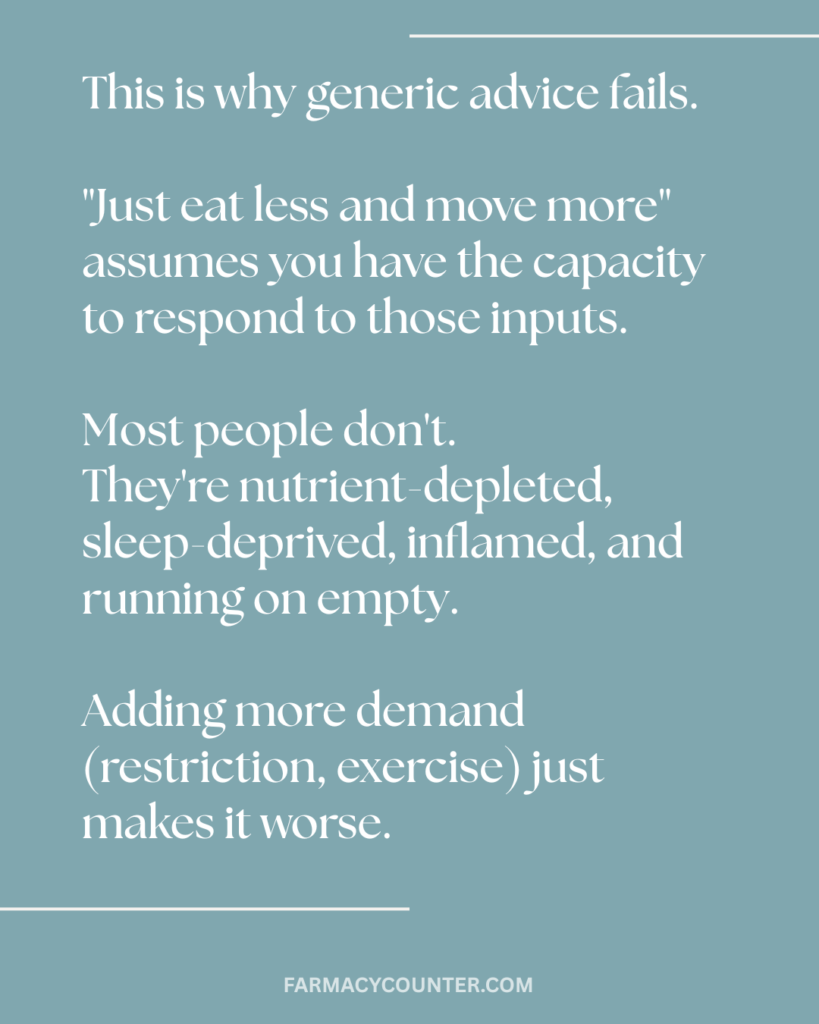
Here’s the answer: “Eat less and move more” assumes you have the metabolic capacity to respond to those inputs.
Most people with stubborn metabolic dysfunction don’t.
And that one assumption — that capacity is present when it isn’t — is why generic advice fails so completely for so many people who are genuinely trying.
What Generic Advice Gets Right (And Where It Goes Wrong)
To be clear: eating well and moving your body are not wrong. They are genuinely important inputs for metabolic health.
The problem isn’t the advice itself. The problem is the assumption underneath it.
“Eat less and move more” is built on a model that treats the body like a simple energy equation: calories in minus calories out equals change in body weight. Reduce one side of the equation, the other side adjusts.
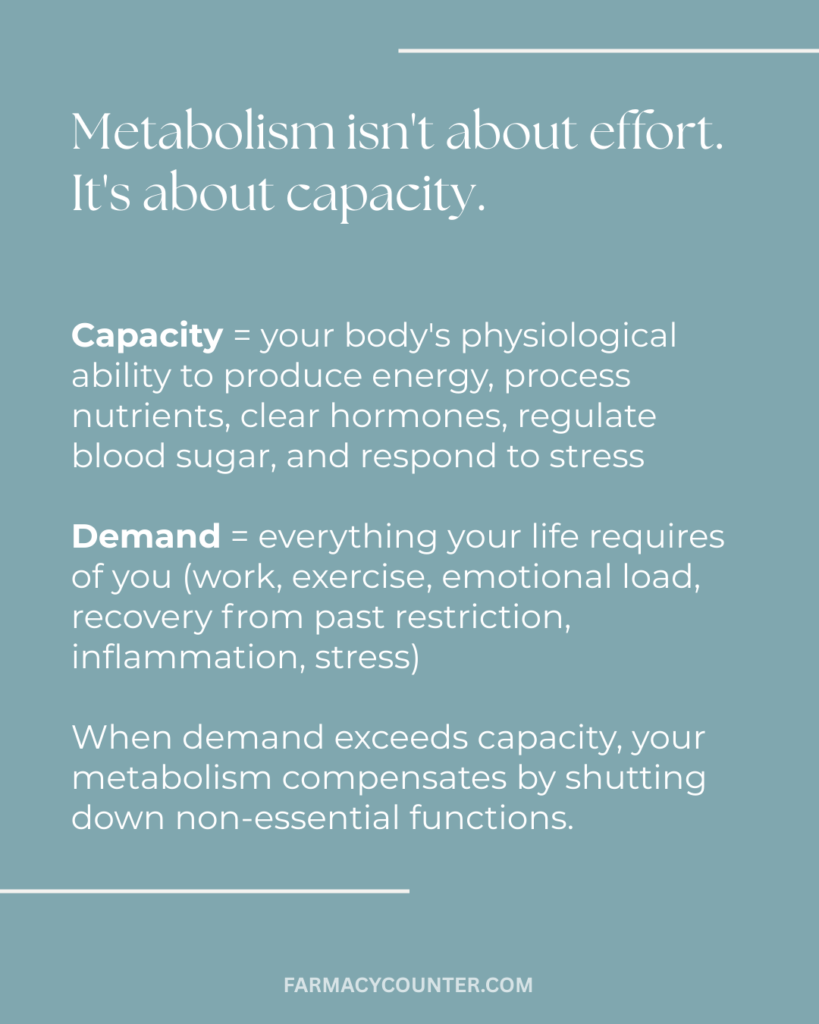
This model works when the metabolic machinery running that equation is functioning normally — when cells are responding to insulin appropriately, when mitochondria are producing ATP efficiently, when thyroid hormone is being converted and utilized, when cortisol is following its natural rhythm, when inflammation isn’t blocking fat release at the cellular level.
When those things are true, the simple equation works. Eat a little less, move a little more, body composition changes. Straightforward.
But when those things are NOT true — when your cells are nutrient-depleted, when your mitochondria can’t convert food into energy efficiently, when inflammation is blocking lipolysis, when your cortisol rhythm is inverted, when your thyroid conversion is suppressed — the equation breaks.
You reduce calories. Your body interprets it as a famine signal and slows metabolic rate further. You add more exercise. Your depleted system produces more cortisol and drives deeper adaptation. You track everything meticulously. Nothing moves.
And then you’re told you must be doing something wrong.
You’re not doing something wrong. The advice assumed capacity that doesn’t exist.
The People Generic Advice Was Designed For
Generic dietary and exercise advice was largely developed on and for people whose metabolic systems were functioning relatively normally.
Reduce calories in someone who is well-nourished, well-rested, not chronically stressed, with good thyroid function, appropriate insulin sensitivity, and low inflammatory burden — and yes, they lose weight. The equation works.
Now take someone who has been chronically restricting for years, sleeping six hours a night, running on cortisol and caffeine, with ferritin at 16, RBC magnesium depleted, thyroid conversion suppressed by chronic inflammation, and insulin resistance established from years of blood sugar swings — and tell them to eat less and move more.
Their body cannot respond to those inputs the way the advice intends. The machinery is broken. The capacity isn’t there.
Adding more demand to a system without capacity doesn’t produce the intended output. It produces adaptation, conservation, and deeper dysfunction.
This is not a willpower problem. This is a physiology problem.
Why Most People Stay Stuck for Years
The cruel cycle looks like this:
- Generic advice doesn’t work.
- The person assumes they’re doing it wrong and tries harder.
- Trying harder adds more demand to an already-depleted system.
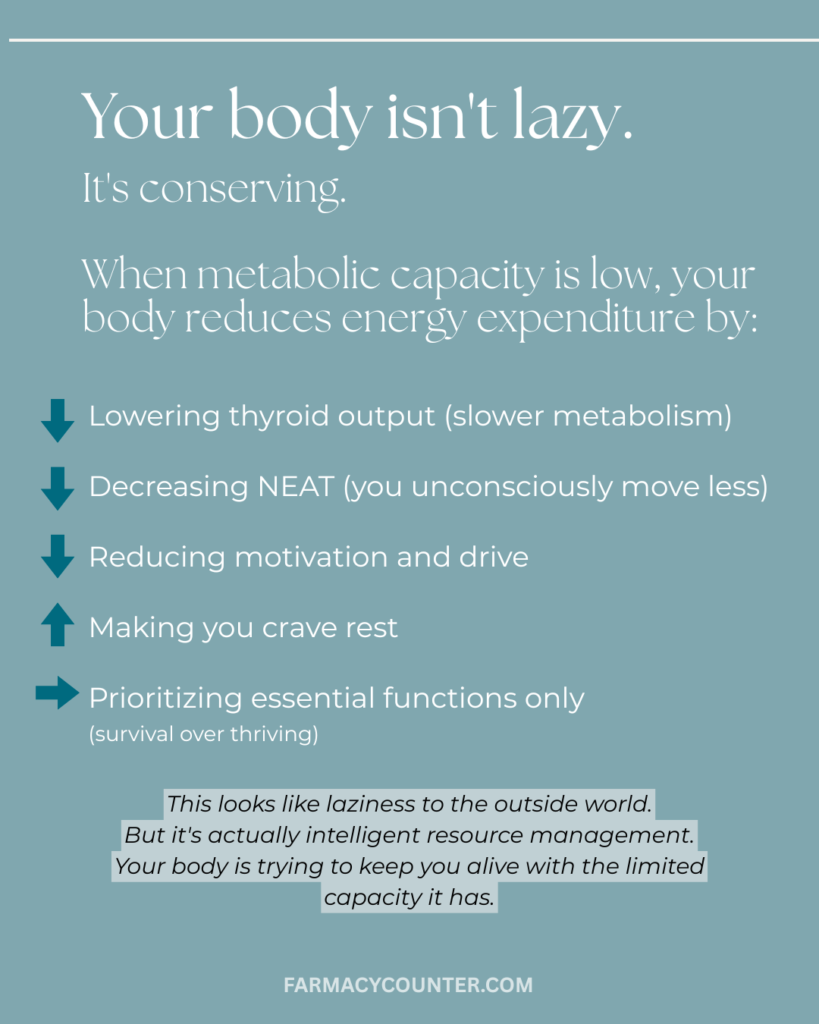
- The body conserves more aggressively — lowering thyroid output, reducing unconscious movement, spiking hunger hormones.
- Results get worse, not better.
- The person concludes they have no willpower, are broken, or just aren’t trying hard enough.
- They find a new generic protocol and repeat the cycle.
Meanwhile the actual drivers — the nutrient deficiencies, the sleep debt, the inflammatory burden, the HPA axis dysfunction, the impaired mitochondrial function — continue operating in the background. Unidentified. Unaddressed. Compounding over time.
The longer this cycle runs, the deeper the dysfunction becomes, and the less the person trusts their own body or their own judgment. By the time they reach a functional medicine practitioner, many have been in this cycle for five, ten, or fifteen years.
What “Eat Less and Move More” Actually Requires to Work
For dietary restriction and increased activity to produce the outcomes they’re supposed to produce, several things have to be true:
Mitochondrial function has to be intact. Your cells need to be able to convert food into usable energy efficiently. If mitochondria are damaged by chronic inflammation, nutrient depletion, or oxidative stress, reducing food intake just means less raw material for already-impaired machinery.
Insulin sensitivity has to be adequate. If your cells are insulin resistant, the fuel you eat gets directed into fat storage instead of burning. Eating less in this state doesn’t fix the direction problem — it just means less total fuel available while storage continues.
Cortisol has to be regulated. Calorie restriction is a stressor. Exercise is a stressor. If your HPA axis is already dysregulated, adding these stressors increases cortisol further — driving visceral fat storage, increasing appetite, and deepening the metabolic dysfunction you’re trying to fix.
Thyroid conversion has to be functional. Your resting metabolic rate depends on active thyroid hormone (T3). If conversion is suppressed, your metabolism is running slower than it should at baseline — meaning the caloric math that the generic advice is built on doesn’t apply to you.
Nutrient status has to be sufficient. Over 300 enzymatic reactions required for normal metabolism depend on adequate magnesium alone. Without the micronutrient cofactors that run cellular processes, even the best diet and exercise program can’t produce normal metabolic outputs.
When these foundations are in place, “eat well and move your body” works beautifully. It works because the body has the capacity to respond.
The job of functional medicine isn’t to replace that advice. It’s to restore the conditions under which that advice actually works.
The Approach That Actually Gets Results
People who consistently get results with complex metabolic cases — the ones who have tried everything and had it fail — aren’t following a different diet. They’re not doing a special exercise protocol.
They’re doing something fundamentally different:
They’re assessing capacity first.
Before adding any demand — dietary changes, exercise protocols, supplementation — they find out what’s actually happening inside the metabolism. Which nutrients are depleted. Whether mitochondrial function is impaired. What the cortisol rhythm looks like across the day. Whether thyroid conversion is working. Whether insulin sensitivity is adequate. Whether inflammation is blocking fat metabolism.
Then they address what they find — in the right order, specific to what the testing shows.
And then, once capacity is restored, the inputs that were failing before start working. Not because anything magical happened. Because the body finally has what it needs to respond.
The First Step
If you’ve been stuck in the generic advice cycle — doing everything right and going nowhere — the answer isn’t a better diet or a harder workout.
It’s finding out where your capacity has been depleted and addressing it at the root.
That starts with understanding which metabolic patterns are driving your specific symptoms.
Download the free Weight Resistance Decoder Guide →
It walks you through the four hidden patterns behind stubborn weight resistance and fatigue — including the specific symptoms that point to each pattern and what functional testing actually reveals.
Generic advice failed you because it wasn’t built for your situation. The right approach — specific to your biology — is something else entirely.