
You blamed the food. But the sleep you lost, the stress you carried, and the drinks you had set your metabolism up for disruption days before the meal.
The Monday after Thanksgiving follows a familiar script. You step on the scale, see a number that’s moved, feel the bloating, and start calculating. How much did you eat? What do you need to cut this week? How long will it take to get back?
And almost every time, the answer lands on the food. The stuffing, the pie, the second plate.
But think about what the rest of that week looked like. You stayed up later than usual several nights in a row. You slept somewhere unfamiliar: a guest bed, a couch, a room with thin walls and other people’s schedules. You navigated family dynamics with their own particular brand of exhausting. You traveled. You drank more than usual. And all of it happened before you sat down at the table.
By the time the meal arrived, your body wasn’t starting from baseline. It was running on disrupted sleep, higher cortisol, lower insulin sensitivity, and hormones leaning toward storing rather than burning. The meal landed on top of all of that.

| Factor | What it changes | The reset |
|---|---|---|
| Short or broken sleep | More hunger, less fullness, lower insulin sensitivity | Protect sleep first |
| Sustained stress | Higher blood sugar and more belly-fat storage | Calm, consistent days |
| Alcohol | Fragmented sleep and less overnight repair | Take a break from drinking |
| Travel and new beds | A disrupted body clock and lighter sleep | Regular meals and morning light |
| Monday restriction | More stress, more hunger, a slower metabolism | Restore, don’t restrict |
Sleep isn’t passive. It’s an active metabolic process that regulates hormones, blood sugar, appetite, and fat burning in ways that shape how your body handles food the next day.[3]
The two hormones most affected are ghrelin, which signals hunger, and leptin, which signals fullness. When you’re well rested, they’re balanced and appetite feels easy. After short sleep, ghrelin rises and leptin falls. In one study, healthy young men who slept four hours for two nights had:[1]
Short sleep also lowers insulin sensitivity. Even a single night of partial sleep loss has been shown to cause insulin resistance in healthy people the next day.[2][4] So when you eat Thanksgiving dinner after several nights of poor sleep, your body handles that glucose load with less capacity than usual.
It doesn’t take dramatic sleep deprivation. The inconsistent, shallow, interrupted sleep that comes with travel, house guests, and late nights is enough to make your body meaningfully worse at handling a big meal. Here’s what one bad night of sleep does.
Factor 2: StressCortisol is known as the stress hormone, but it’s also a major regulator of blood sugar, and it can raise your glucose no matter what you eat. It prompts your liver to release stored glucose, which is useful for a true emergency. The trouble is that the same response kicks in for travel logistics, family tension, and the background stress many people carry through the holidays.
After several days of elevated cortisol, your fasting blood sugar is already running higher than usual by the time you sit down to eat. Cortisol also makes your tissues less responsive to insulin, so the after-meal spike from the same plate runs higher and lasts longer.
Chronically high cortisol encourages fat storage around the abdominal organs while making that fat harder to break down. It’s a big part of the well-documented link between chronic stress and weight around the middle, and it’s one reason lowering cortisol matters year-round.
Alcohol’s effects go well beyond its calories, and much of the disruption happens overnight. Your liver treats alcohol as a priority and processes it first, which slows its job of releasing glucose to keep your blood sugar steady while you sleep.
Alcohol also changes your sleep itself. It suppresses REM sleep and fragments the second half of the night, so you wake up less rested even when you spent enough hours in bed.[5] Your body does much of its overnight repair, including growth hormone release for muscle repair and fat burning, during deep, uninterrupted sleep.
That broken, less restorative sleep stacks on top of the short sleep you were already getting, so you go into the biggest meal of the week with your body doubly behind.
Because alcohol slows your liver’s glucose release, drinking can cause low blood sugar overnight if you take insulin or a sulfonylurea such as glipizide or glyburide, especially if you drink without eating. Alcohol also adds to the sedating effect of sleep aids, some anxiety medicines, and opioids. If you take any of these, talk with your pharmacist about safe amounts before the holiday.
Even without crossing time zones, travel throws off your body clock. That clock decides when insulin sensitivity is highest, when fat burning is most efficient, and when appetite hormones rise and fall, and it’s set mainly by light and meal timing, both of which travel disrupts.
Sleeping somewhere new also triggers the “first-night effect.” Researchers have measured it with brain-wave monitoring: one side of your brain stays more alert during sleep in a new place, almost like a night watch, so your sleep is lighter and more broken.[6]
So even a short drive to a family member’s house adds a layer of disruption most people never account for.
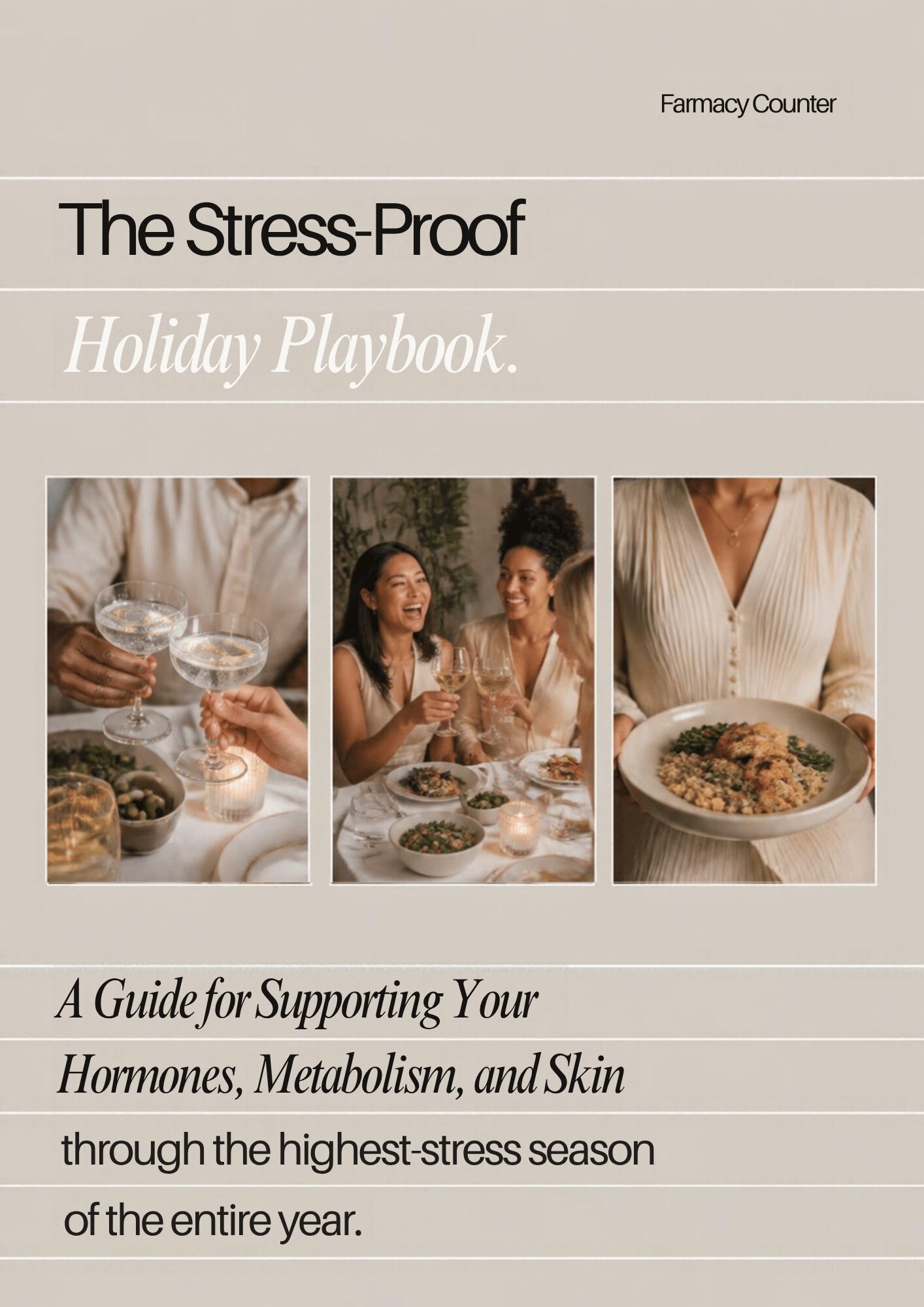
Sleep, stress, alcohol, and travel shape your holiday week more than any single meal. The Stress-Proof Holiday Playbook gives you practical strategies built around how your metabolism actually responds to the season, so you’re not starting over every January.
The usual response to post-holiday weight is to cut calories hard on Monday to make up for the weekend. It’s understandable, but it adds to the problem instead of solving it.
Much of the jump you see on Monday is water, not fat. Salty, carb-rich meals lead your body to store extra glycogen, which holds onto water, and stress and short sleep add to the retention. It usually settles within a few days as your routine returns.
Cutting hard after a week of short sleep and high stress signals scarcity to a system that’s already strained. Calorie restriction raises cortisol,[7] especially paired with intense exercise. Ghrelin rises, leptin falls, hunger climbs, and your body leans harder into conserving energy, the same adaptations that make years of dieting so hard to recover from.
The goal after Thanksgiving isn’t punishment. It’s resetting the conditions that were disrupted.
For some people, the holiday week amplifies patterns that are there all year. Sleep disruption exposes underlying sleep problems. The stress response reveals an HPA axis already running high. The dip in insulin sensitivity reveals blood sugar dysregulation that daily routine was quietly managing. An evaluation typically looks at:
| Test | What it reveals |
|---|---|
| Fasting insulin & HOMA-IR | Your baseline insulin sensitivity, the foundation every holiday disruption lands on. If it’s already impaired, the same week hits you much harder. |
| Four-point cortisol | Shows whether your stress response is calibrated well or running high at baseline, across the whole day. |
| Sleep assessment | Validated tools show whether sleep quality, duration, body-clock timing, or a mix is the issue, apart from holiday disruption. |
| Fasting glucose & HbA1c | Your blood sugar baseline, and how much room you have before disruption turns into real dysregulation. |
| Complete thyroid panel | Suboptimal thyroid function lowers metabolic flexibility and your resilience to stress and short sleep. |
| Sex hormones | In perimenopause and menopause, falling estrogen can lower insulin sensitivity and stress resilience, so a holiday week lands on more fragile ground. |
Together, these show not just what happened over Thanksgiving, but how resilient your metabolism is to every stressful, short-sleep week.
If the week around Thanksgiving consistently throws you off, leaves you feeling far behind, and takes weeks to recover from, that pattern is information.
It means your metabolic resilience is lower than it could be: your insulin sensitivity, your cortisol regulation, your sleep, or some combination is running below the point where normal life stressors can be absorbed without a big toll.
That’s not a willpower problem. It’s a physiology problem, and it can be understood and addressed.
If the holidays always leave you feeling metabolically behind, a free discovery call is where we start figuring out why, and what to do about it. If you haven’t yet, grab the free Stress-Proof Holiday Playbook before the season gets busy. And here’s a simple plan to stress-proof your holidays.
Book a Discovery Call →Much of it is the week, not just the meal. Short sleep raises hunger and lowers insulin sensitivity, sustained stress raises blood sugar, alcohol fragments sleep, and travel disrupts your body clock. Much of the number on the scale the next Monday is also water, not fat.
In one study, two nights of four-hour sleep raised the hunger hormone ghrelin by 28% and lowered the fullness hormone leptin by 18%, with stronger cravings for sweets, salty foods, and starches.
Sharp restriction tends to backfire. Cutting calories raises cortisol and hunger in an already-stressed system. Prioritizing sleep, regular meals, a break from alcohol, and short walks after meals helps your body reset more effectively.
It’s called the first-night effect. Brain-wave studies show one side of the brain stays more alert during sleep in an unfamiliar place, making sleep lighter and more broken.
Yes. Your liver prioritizes processing alcohol, which slows the glucose it releases overnight. That can cause low blood sugar in people who take insulin or certain diabetes medications, so check with your pharmacist about safe amounts.
For educational purposes only. Not a diagnosis, and not a substitute for care from your healthcare provider. If you take medications for diabetes, sleep, or anxiety, ask your pharmacist about alcohol before the holidays.