

You’re exhausted in a way sleep doesn’t fix. You’re cold when everyone else is comfortable. The scale is creeping up no matter what you do. You had your thyroid checked, TSH came back normal, and you were told everything looks fine.
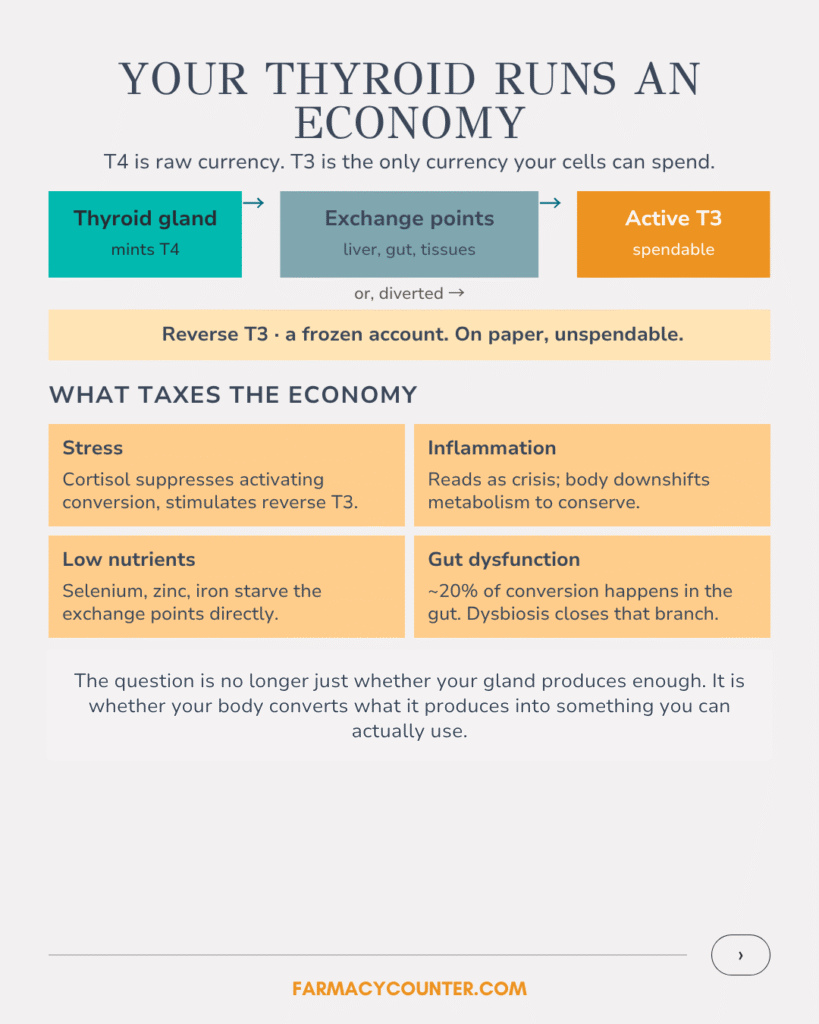
Here’s a framework that explains a lot of this without requiring anything to be broken: your thyroid doesn’t just produce a hormone level. It runs an economy. T4 is the raw currency your thyroid gland mints. T3 is the only currency your cells can actually spend. And a lot happens between minting and spending that a single lab value can’t show you.
The Difference Between Raw Material and Spendable Currency
T4 is the primary hormone your thyroid gland releases. On its own, T4 is largely inactive. It has to be converted into T3 before it can bind thyroid hormone receptors and do the things thyroid hormone is responsible for: regulating energy use, temperature, heart function, digestion, and cognition.
That conversion happens through enzymes called deiodinases, and it doesn’t happen in one place. It happens across several tissues, including the liver, kidneys, brain, and muscle, each acting as an exchange point where raw currency gets turned into something spendable. This is why looking at T4 alone tells you how much raw material is being minted, but says very little about how much of it your tissues are actually able to convert and use.
Why Lower T3 Isn’t Always a Red Flag
This is the part that gets oversimplified constantly, including in a lot of functional medicine content: lower T3 is not automatically evidence that something has gone wrong with your thyroid.
The conversion process changes deliberately during severe illness, calorie restriction, and other physiologic stressors. This is a well-documented adaptive response, sometimes called non-thyroidal illness syndrome or euthyroid sick syndrome, where the body intentionally downshifts T3 production to conserve energy during a period it perceives as a crisis (1). In that context, lower T3 isn’t the problem. It’s the body’s response to a problem happening somewhere else.
This matters clinically because it means the goal isn’t to chase T3 higher in every case where it’s on the lower end. The goal is to understand why the economy is behaving the way it is, and whether that behavior is adaptive or dysfunctional.
What Taxes the Conversion Economy
Several things reliably interfere with T4-to-T3 conversion, functioning like a tax on the exchange rate between raw material and usable hormone.
Stress is one of the most direct. Cortisol suppresses the activating conversion pathway and stimulates production of reverse T3, an inactive form that occupies receptor space without doing anything with it (2). Think of reverse T3 as a frozen account: on paper it’s thyroid hormone, but it isn’t spendable.
Inflammation acts similarly. The body reads systemic inflammation as a crisis signal and downshifts metabolism to conserve resources, which includes reducing active conversion (3).
Low nutrient status directly starves the exchange points themselves. Selenium, zinc, and iron are required cofactors for the deiodinase enzymes doing the converting. When these are depleted, the exchange points can’t operate at full capacity regardless of how much T4 is available.
Gut dysfunction closes off a meaningful branch of the economy entirely. Roughly 20% of T4-to-T3 conversion happens in the gut, and dysbiosis disrupts that pathway directly (4).
Where Reverse T3 Fits, and Where It Doesn’t
Reverse T3 gets a lot of attention in functional and integrative circles, and it’s a real and measurable part of the conversion economy. But it’s worth being precise about what it can and can’t tell you.
In routine outpatient thyroid management, reverse T3 rarely provides information that changes what I do clinically on its own. It’s affected by illness, fasting, and acute stress in ways that make a single elevated value hard to interpret in isolation. An elevated reverse T3 in someone who’s currently sick, under-eating, or in a high-stress period may simply reflect an adaptive response, not a distinct diagnosis requiring treatment.
Wondering whether your fatigue reflects an actual thyroid problem or something else taxing your conversion economy? Download The “Normal Labs, Not Normal Symptoms” Blueprint to understand the different places thyroid function can break down beyond a single number. Get it here.
A normal TSH addresses one part of the picture: it tells you the pituitary isn’t currently signaling for more thyroid hormone. It doesn’t tell you whether conversion is happening efficiently, whether nutrient status is supporting that conversion, or whether something outside the thyroid entirely is producing your symptoms.
What I Actually Look At Clinically
When someone comes in with symptoms that don’t match a “normal” thyroid panel, I’m not chasing a single number up or down. I’m asking a set of questions about the whole economy:
Is the diagnosis correct? Not every case of fatigue, weight change, or brain fog is thyroid-driven, even when someone’s convinced it is. Ruling in or out accurately matters before treating anything.
Is thyroid medication, if someone’s already on it, being taken and absorbed properly? Timing relative to food, coffee, calcium, iron, and certain gut conditions all meaningfully affect absorption, and a technically correct dose can still underperform if it isn’t being absorbed as intended.
Are other factors, like iron deficiency, sleep disruption, under-fueling, illness, or medication side effects, adding to or fully explaining the symptoms independent of thyroid status?
Do the labs and the lived pattern actually make sense together? A number can be accurate and still need context. Someone’s free T3 sitting at the bottom of the range means something different in a well-nourished, low-stress person than it does in someone who’s chronically under-eating or in an acute illness.

What This Means for You
The point of understanding your thyroid as an economy rather than a single gland with a single output is that it changes what questions are worth asking. Instead of “is my TSH normal,” the more useful question becomes: is raw material being produced, is it being converted efficiently, is anything taxing that conversion, and does the whole pattern, labs and symptoms together, actually make clinical sense.
Sometimes the answer is straightforward thyroid dysfunction that needs medication. Sometimes it’s an adaptive conversion shift responding to stress, illness, or under-fueling that resolves once the underlying driver is addressed. Sometimes it’s something unrelated to thyroid altogether that’s been mistakenly pinned on it. Getting that distinction right is the entire point of looking past a single lab value.
Let’s Look at Your Whole Thyroid Economy
If you’ve been told your labs are normal but you don’t feel like they add up to how you actually feel, that gap is worth investigating properly rather than assuming a single supplement, medication adjustment, or reverse T3 number will explain it.
On a discovery call, we walk through your full symptom pattern, any labs you’ve already had, and what else might be taxing your system: stress load, nutrient status, gut health, sleep, and how well any current medication is actually being absorbed. We figure out whether this is a conversion issue, an adaptive response, a diagnosis that needs correcting, or something else entirely contributing alongside it.
If you’re ready to understand the whole economy instead of a single number, you can schedule a discovery call here. We’ll figure out what your labs and your symptoms are actually telling you when you look at them together.
A normal number and a difficult reality can both be true at the same time. Let’s find out what’s actually happening underneath yours.
References:
- Fliers E, Bianco AC, Langouche L, Boelen A. Thyroid function in critically ill patients. Lancet Diabetes Endocrinol. 2015;3(10):816-825.
- Chatzitomaris A, Hoermann R, Midgley JE, et al. Thyroid allostasis-adaptive responses of thyrotropic feedback control to conditions of strain, stress, and developmental programming. Front Endocrinol (Lausanne). 2017;8:163.
- Boelen A, Kwakkel J, Fliers E. Beyond low plasma T3: local thyroid hormone metabolism during inflammation and infection. Endocr Rev. 2011;32(5):670-693.
- Virili C, Centanni M. Does microbiota composition affect thyroid homeostasis? Endocrine. 2015;49(3):583-587.