

You have been told your thyroid is “fine.” TSH came back in range, maybe your doctor even said “borderline, but nothing to worry about.” And yet your cycle is doing things a normal thyroid shouldn’t allow: irregular ovulation, a luteal phase that never quite feels right, periods that are unpredictable in a way they never used to be.
Here is what almost never gets explained: a “normal” TSH does not mean your thyroid is fully supporting your cycle. And when thyroid hormone is even subtly suboptimal, it does not affect one part of your reproductive system. It disrupts the entire thing, at the foundation.
What’s Actually Happening
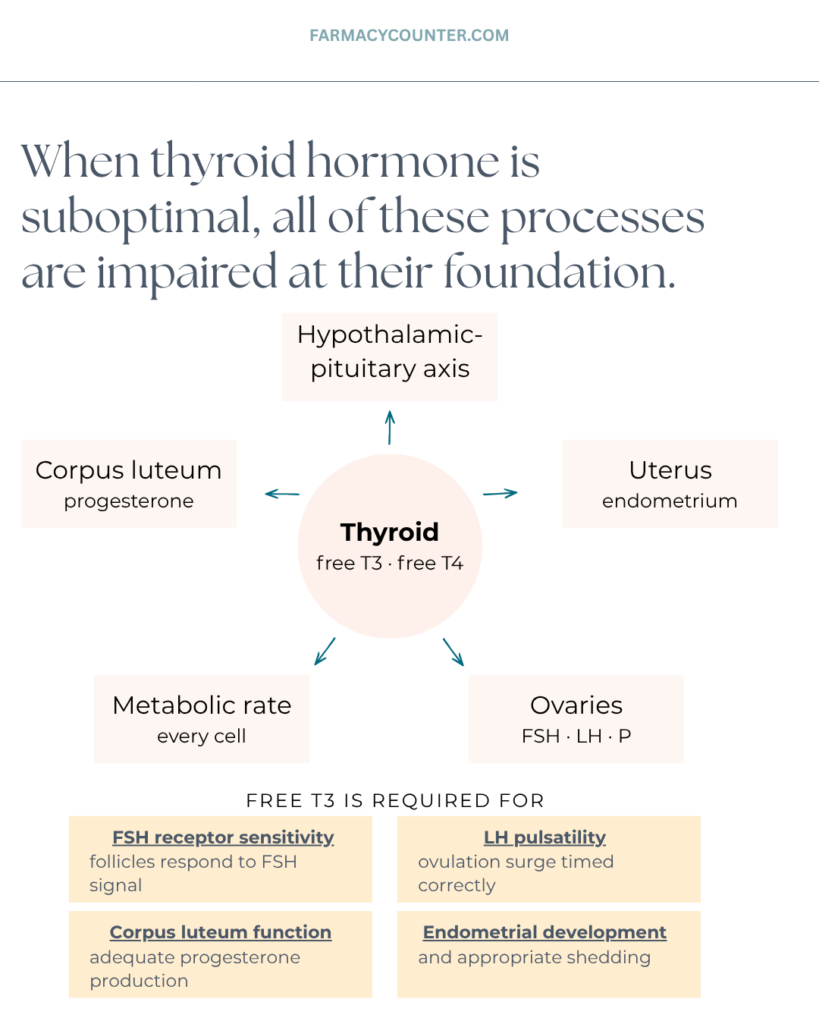
Think of thyroid hormone, specifically free T3, as a hub with four direct lines running out to the systems that make up your cycle.
Line one: the hypothalamic-pituitary axis. This is the command center that governs the entire hormonal cascade, from FSH and LH release to the timing of ovulation itself. Thyroid hormone feeds directly into how well this axis functions.
Line two: the ovaries. FSH, LH, and progesterone production all originate here, and all depend on the signaling coming from the HPA axis, which depends on thyroid hormone reaching it properly.
Line three: the corpus luteum. After ovulation, the corpus luteum is what produces progesterone for the rest of your luteal phase. Its function is not independent of thyroid status. It requires adequate free T3 to do its job.
Line four: the uterus and endometrium. The lining that builds and sheds each cycle depends on properly timed hormonal signaling, which again traces back to whether thyroid hormone is doing its job upstream.
Line five: your metabolic rate, in every cell in your body, including every cell involved in the four systems above.
When thyroid hormone is suboptimal, all five of these are impaired at their foundation, simultaneously. This is why thyroid dysfunction rarely shows up as one isolated symptom. It shows up as a cycle that is subtly wrong in several directions at once.
Why Free T3 Specifically
TSH is the number most doctors check, and it is a useful screening marker, but it is not the hormone doing the work at the tissue level. Free T3 is the active thyroid hormone your cells actually use, and it is required for four specific reproductive functions:
- FSH receptor sensitivity. Your ovarian follicles need to be able to respond to the FSH signal they receive. Free T3 supports that receptor sensitivity directly.
- LH pulsatility. Ovulation depends on LH being released in the correct pulsatile pattern, timed correctly. Free T3 is part of what keeps that timing accurate.
- Corpus luteum function. Adequate progesterone production after ovulation depends on the corpus luteum functioning well, which depends on sufficient free T3.
- Endometrial development. The uterine lining needs to develop and shed appropriately each cycle, a process that also relies on adequate thyroid hormone.
This is the detail that changes how most women think about their own labs: you can have a “normal” TSH and a genuinely low free T3, and that combination is enough to disrupt every one of these four functions. Your thyroid does not need to be diagnosably hypothyroid to interfere with your cycle. It only needs to be subclinical, meaning technically within range but not optimal for what your reproductive system actually needs.

Why This Matters More Than Most People Realize
This is one of the most clinically missed pieces of the low progesterone pattern I see in practice. A woman comes in with luteal phase symptoms, anxiety, poor sleep, an unpredictable cycle, and progesterone testing confirms it is low. The natural next step is to ask why. Often, the answer traces back to thyroid function that never got investigated beyond a standard TSH.
Subclinical thyroid dysfunction does not show up on a screening panel the way overt hypothyroidism does. It requires actually looking at free T3, not just TSH, to catch it. Most women have never had that specific marker run, which means this driver frequently goes unaddressed while the low progesterone gets treated as an isolated problem.
What Commonly Drives Subclinical Thyroid Dysfunction
A few patterns show up repeatedly in clinical practice:
- Nutrient insufficiency. Thyroid hormone conversion from T4 to the active T3 form requires selenium, zinc, and iodine in the right amounts. Deficiencies in any of these can suppress free T3 even when TSH looks normal.
- Chronic stress. Elevated cortisol interferes with T4-to-T3 conversion and can shift conversion toward reverse T3, an inactive form that takes up receptor space without doing the work.
- Gut and inflammation issues. A significant portion of T4-to-T3 conversion happens in the gut. Dysbiosis or chronic inflammation can impair that conversion step directly.
- Undiagnosed autoimmune thyroid activity. Thyroid antibodies can be elevated well before TSH moves out of range, and a standard panel often does not include them.

What’s Possible
Subclinical thyroid dysfunction is very treatable once it is actually identified, which is the part that usually gets skipped. In a real protocol, we look past TSH alone and build a full picture of what your thyroid is doing and why.
In a functional medicine protocol, I’d start with:
- A full thyroid panel: TSH, free T4, free T3, reverse T3, and TPO and TG antibodies, not TSH in isolation
- Mid-luteal progesterone, timed to your actual ovulation, to see how this is showing up downstream
- Nutrient status for selenium, zinc, and iodine, since these are common, correctable bottlenecks in T4-to-T3 conversion
- A 4-point cortisol test, since chronic stress is one of the most common reasons T3 conversion is impaired in the first place
- A targeted protocol addressing the actual bottleneck, whether that is nutrient repletion, HPA axis support, gut-related conversion issues, or in some cases, thyroid hormone support itself
Most women feel a meaningful shift in cycle regularity and luteal phase symptoms once the actual thyroid bottleneck is identified and addressed directly, rather than treating the progesterone symptom on its own.
Your Next Step
If your labs have always come back “normal” but your cycle tells a different story, this is often why. Thyroid function is one of four distinct hormonal patterns behind cycle and PMS symptoms, and it rarely gets investigated at the depth it actually needs.
Take the Free PMS Pattern Decoder → A quick self-assessment to find out which pattern is driving your symptoms, and what it means.
If you already have a good sense of your pattern and want to talk through your specific picture, including whether a deeper thyroid workup makes sense for you, I also offer a free discovery call. No pressure, just a conversation about whether functional medicine is the right next step.
→Book Your Free Discovery Call Here