

Leaky gut has become one of those terms that gets thrown around so much it’s lost its meaning. You’ve probably heard it on a podcast, seen it on a supplement label, or had someone suggest it might explain your symptoms — right before recommending a collagen powder.
So let’s start with the anatomy. Because what’s actually happening inside your gut lining is more specific, more measurable, and more connected to your symptoms than most people realize.
The Wall Between Your Gut and Your Bloodstream Is One Cell Thick
That is not a metaphor. That is anatomy.
Your intestinal lining — the barrier that separates the contents of your gut from your bloodstream — is a single layer of epithelial cells. One cell. That’s the entire wall standing between everything inside your intestines and your systemic circulation.
Under normal, healthy conditions, that single-cell barrier is extraordinarily functional. It selectively absorbs nutrients, water, and immune signals while keeping everything else — bacteria, undigested food particles, bacterial toxins — contained inside the gut where it belongs.
The key word is selectively. Your gut lining isn’t just a passive wall. It’s an active, intelligent barrier making constant decisions about what gets through and what doesn’t.
When that selectivity breaks down, the clinical term for what happens is intestinal permeability. This is what people mean when they say “leaky gut.” Not a vague wellness concept. A measurable breakdown in barrier function with documented, specific consequences.
What Keeps It Sealed: Tight Junction Proteins
The cells of your intestinal lining are held together by proteins called tight junctions. The ones that matter most here are occludin, claudin, and zonulin.
Think of tight junctions as the mortar between bricks. Your intestinal cells are the bricks. The tight junction proteins are what seal the gaps between them, maintaining the integrity of the barrier and controlling what passes through.
Under normal conditions, tight junction proteins keep those gaps sealed. Nutrients get absorbed through the cells themselves in a controlled, selective process. Everything that shouldn’t be in circulation stays on the gut side of the barrier.
When tight junction integrity is compromised — when those proteins loosen, degrade, or stop functioning properly — the gaps between cells widen. Things that should stay in your gut start crossing into your bloodstream. And that’s where the downstream symptoms begin.
What Breaks the Seal
Here’s where it gets clinically important, because tight junction breakdown doesn’t happen randomly. There are specific, documented triggers.
Gliadin, the protein in gluten, triggers zonulin release and loosens tight junctions — even in people without celiac disease. This was studied extensively by Dr. Alessio Fasano at Harvard, whose research fundamentally changed how we understand the gut barrier and its relationship to systemic disease.
Chronic NSAID use damages the gut lining directly through prostaglandin inhibition. NSAIDs are among the most commonly used medications in the world, and their effect on gut barrier integrity is well-documented and consistently underappreciated.
Alcohol disrupts tight junction proteins and accelerates intestinal permeability. This isn’t about drinking to excess — chronic moderate alcohol consumption is enough to affect barrier function over time.
Dysbiosis — a shifted microbial balance in the gut — generates low-grade inflammation that degrades lining integrity over time. This is one of the reasons that gut microbiome imbalance and intestinal permeability so frequently appear together. Each one makes the other worse.
Cortisol, produced under chronic stress, actively suppresses the gut’s ability to repair itself. The intestinal lining replaces itself every three to five days under normal conditions. Chronic stress slows that renewal process and impairs the tight junction proteins’ ability to reseal.
Most people with intestinal permeability have more than one of these drivers operating simultaneously. That’s why addressing one without assessing the others rarely produces lasting results.
What Gets Through That Shouldn’t: The LPS Problem
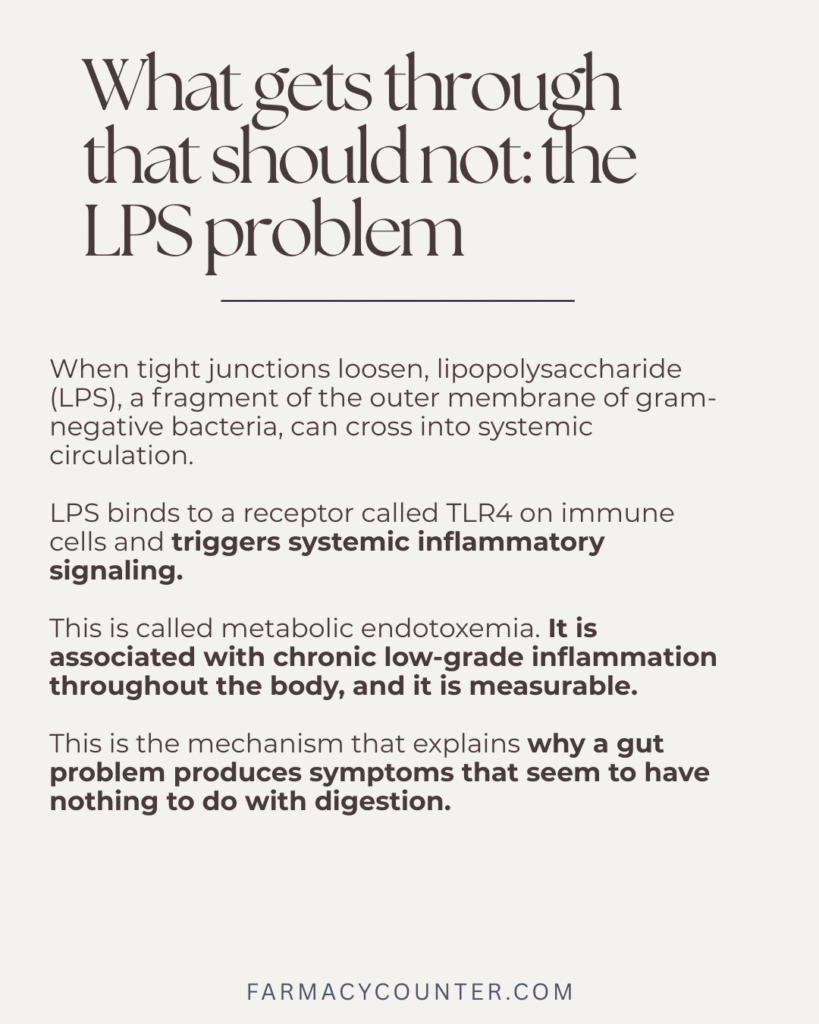
When tight junctions loosen, one of the most consequential things that crosses into systemic circulation is lipopolysaccharide — LPS — a fragment of the outer membrane of gram-negative bacteria.
LPS binds to a receptor called TLR4 on immune cells and triggers systemic inflammatory signaling. This is called metabolic endotoxemia, and it is associated with chronic low-grade inflammation throughout the body.
This is the mechanism that explains why a gut problem produces symptoms that seem to have nothing to do with digestion.
LPS-mediated inflammation doesn’t stay local. It travels. It activates immune cells throughout the body. It crosses the blood-brain barrier and activates microglia — the brain’s immune cells — producing neuroinflammation that creates brain fog, mood changes, and cognitive symptoms. It drives systemic inflammatory responses that show up in joints, skin, thyroid tissue, and connective tissue.
The gut is leaking. The inflammation is traveling. And the symptoms appear in places that seem completely unrelated to digestion — which is exactly why they go undiagnosed and untreated for years.
The Symptoms Nobody Connects to the Gut
This is the part that changes how most people understand their own health history.
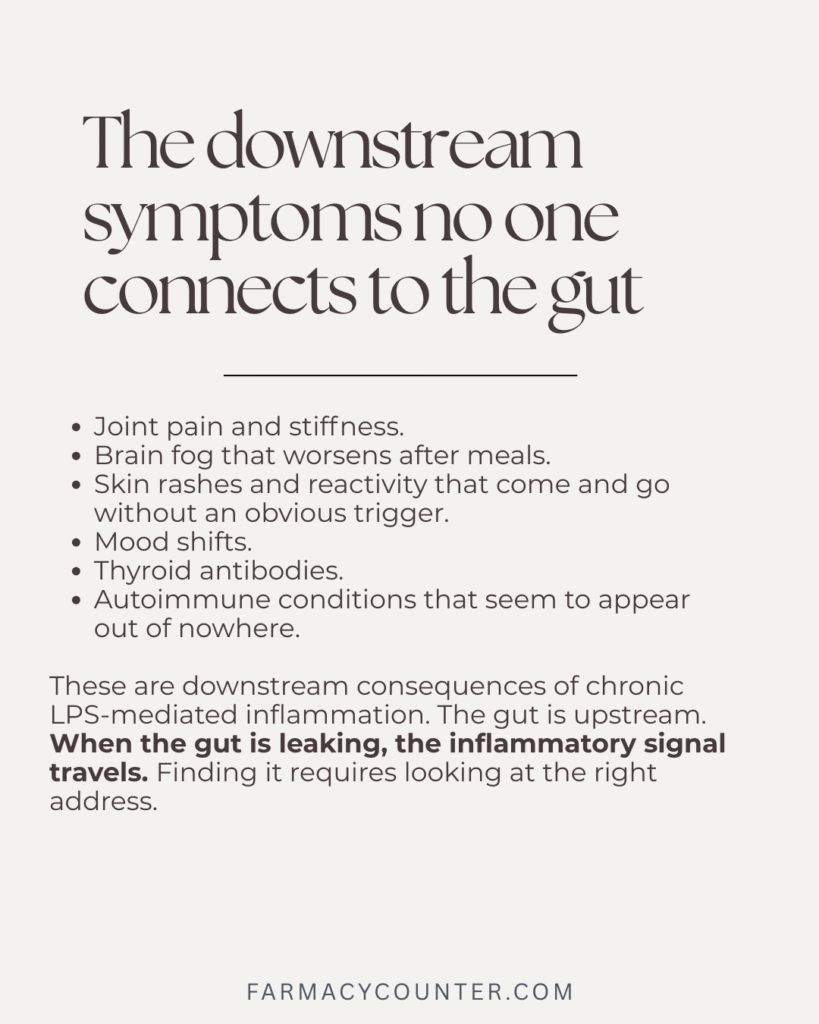
When intestinal permeability is driving systemic LPS-mediated inflammation, the symptoms that follow look nothing like a gut problem. They look like this:
Joint pain and stiffness — particularly morning stiffness or inflammatory joint symptoms without a clear diagnosis. LPS from gram-negative bacteria crossing a compromised gut lining triggers systemic inflammation that lands in connective tissue.
Brain fog that worsens after meals — a direct result of post-meal LPS translocation from a permeable gut into circulation, crossing the blood-brain barrier and activating neuroinflammation. You eat, LPS crosses, and within 30 to 45 minutes your cognitive function shifts.
Skin rashes and reactivity — the gut-skin axis runs through inflammatory cytokine signaling. Clearing intestinal permeability consistently improves skin reactivity for a significant number of patients, even when the skin issue has been treated topically for years.
Mood shifts — the same inflammatory cascade that affects joint tissue and skin affects neurotransmitter metabolism. Inflammation activates an enzyme called IDO that shunts tryptophan away from serotonin production. Lower serotonin, more mood instability. A gut driver with a brain consequence.
Thyroid antibodies — intestinal permeability is consistently found in elevated rates in people with Hashimoto’s thyroiditis. The proposed mechanism involves molecular mimicry: food proteins and bacterial fragments crossing the gut barrier trigger immune responses that cross-react with thyroid tissue. Addressing gut permeability is part of any comprehensive Hashimoto’s protocol.
Autoimmune conditions — the connection between intestinal permeability and autoimmune disease is one of the most researched areas in gut health, with Dr. Fasano’s work suggesting that all autoimmune conditions require three factors: genetic predisposition, an environmental trigger, and increased intestinal permeability. The gut barrier is a necessary part of the autoimmune equation.
If you have been chasing these symptoms in separate departments — rheumatology for the joints, dermatology for the skin, psychiatry for the mood, endocrinology for the thyroid — and no one has looked at your gut, you may have been treating downstream consequences while the upstream driver continues unaddressed.
The Research Is Solid. The Mechanisms Are Measurable.
One of the reasons intestinal permeability gets dismissed as a wellness buzzword is that it sounds vague. It isn’t. The mechanisms are specific, the markers are measurable, and the research base is substantial.
Dr. Alessio Fasano’s work at Harvard on zonulin and tight junction regulation established the molecular basis for intestinal permeability and its connection to autoimmune disease. Dr. Emeran Mayer’s research at UCLA documented the gut-brain connection and the role of gut barrier dysfunction in neuropsychiatric symptoms. Research from Dr. Pimentel’s group at Cedars-Sinai has consistently demonstrated the overlap between SIBO, gut barrier compromise, and systemic inflammatory conditions.
This is not alternative medicine. This is gastroenterology, immunology, and neuroscience converging on the same conclusion: the gut barrier is central to systemic health, and when it breaks down, the consequences are measurable and addressable.
How We Actually Test for It
Intestinal permeability isn’t diagnosed by symptoms alone. It’s measured.
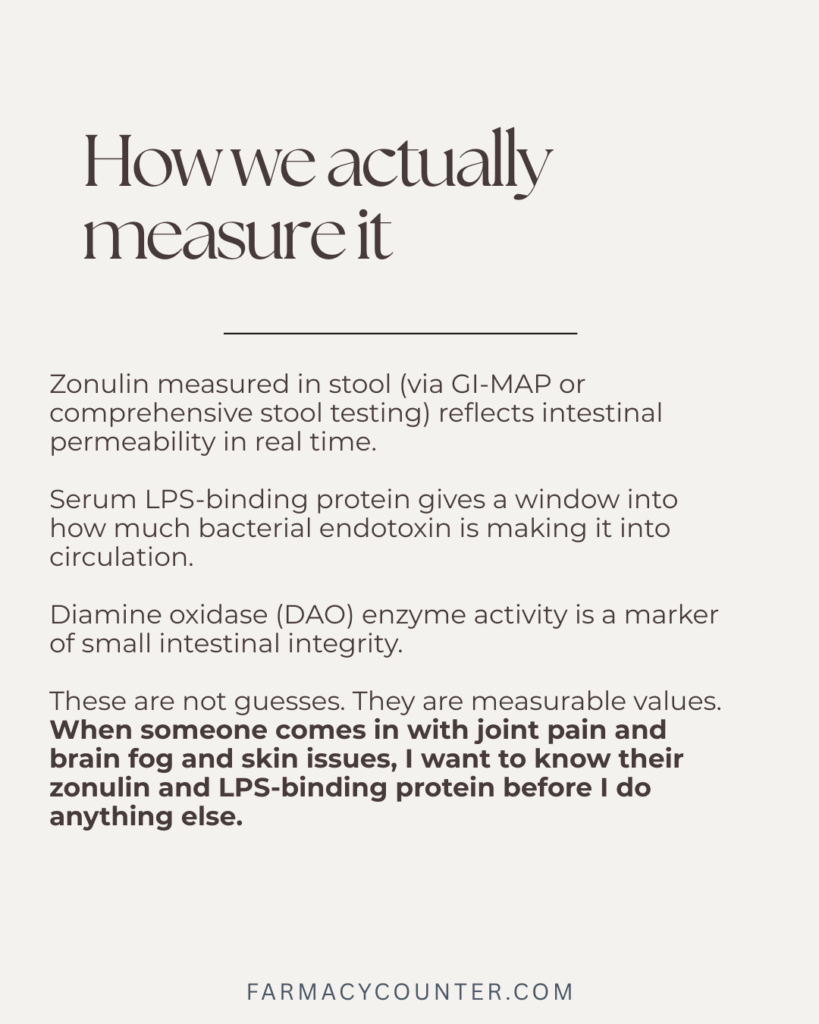
Zonulin measured in stool via GI-MAP or comprehensive stool testing reflects intestinal permeability in real time. Zonulin is the protein that regulates tight junction opening — when it’s elevated, tight junctions are being loosened.
Serum LPS-binding protein gives a window into how much bacterial endotoxin is making it into circulation. Elevated LPS-binding protein tells us that gram-negative bacterial fragments are crossing the gut barrier and entering the bloodstream.
Diamine oxidase (DAO) enzyme activity is a marker of small intestinal integrity. DAO is produced by intestinal cells — when the lining is compromised, DAO activity drops.
These are not guesses. They are measurable values. When someone comes in with joint pain, brain fog, and skin issues, these are the numbers I want to see before I do anything else.
Why Repair Fails Without Removing the Driver First
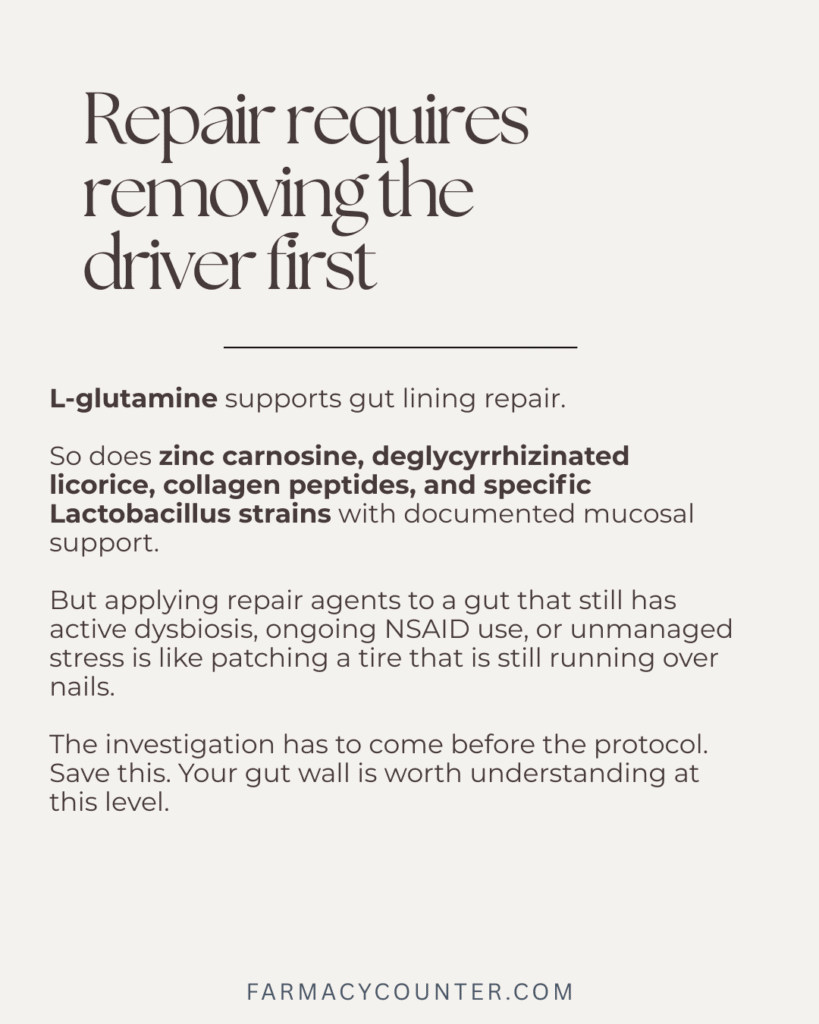
L-glutamine supports gut lining repair. So do zinc carnosine, deglycyrrhizinated licorice, collagen peptides, and specific Lactobacillus strains with documented mucosal support.
But applying repair agents to a gut that still has active dysbiosis, ongoing NSAID use, or unmanaged chronic stress is like patching a tire that is still running over nails. The repair can’t hold if the driver of the damage is still active.
This is why generic gut healing protocols fail so consistently. People take the L-glutamine. They drink the bone broth. They feel marginally better for a few weeks. Then everything comes back.
The investigation has to come before the protocol. What is driving the permeability? Is it dysbiosis that needs to be addressed first? Is it SIBO? Is it chronic stress dysregulating cortisol and suppressing gut repair? Is it ongoing NSAID use that needs to be managed differently?
Until that question is answered, repair is temporary at best.
What Needs to Happen Next
If you’re recognizing yourself in these symptoms — the joint pain that nobody can explain, the brain fog that gets worse after eating, the skin that flares without an obvious trigger, the thyroid antibodies that appeared seemingly out of nowhere — the gut barrier is worth investigating.
Not with a supplement protocol. With testing that tells you whether permeability is present, what’s driving it, and what needs to be addressed first.
The first step is completing our Digestive Health Assessment. Our team will review your full symptom profile — including the downstream symptoms that may never have been connected to your gut — to determine your most strategic next step.
We’re not guessing at what’s broken. We’re identifying it.
→ Start Your Digestive Health Assessment here
After reviewing your responses, we’ll recommend the right path forward — whether that includes functional gut testing, a targeted protocol, or a personalized strategy session.
Your gut lining is one cell thick. It’s worth understanding at this level.