
Most craving advice treats all cravings as the same problem.
Eat more protein. Drink more water. Distract yourself. Use willpower.
And for a while, maybe it works. But then the craving comes back — at the same time, in the same form, with the same urgency — and the strategy that helped last week does nothing this week. So you try something else. That works briefly too. Then stops.
The reason generic craving strategies produce generic results is simple: not all cravings come from the same place. There are three distinct craving types, each with a different origin, a different fingerprint, and a different root cause. Treating a metabolic craving with emotional regulation tools is like treating a broken arm with anti-anxiety medication. You’re addressing the wrong system entirely.
The craving type tells you which system to address first. And once you know your type, the confusion stops.
Why Identifying Your Craving Type Matters
Before we get into the three types, it’s worth understanding why this distinction is so clinically significant.
Your body produces cravings through completely different physiological pathways depending on what’s driving them. A blood sugar crash generates a craving through a stress hormone cascade — cortisol and adrenaline trigger an urgent neurological drive for fast glucose. A nervous system dysregulation generates a craving through the gut-brain axis and dopamine reward pathways. A luteal phase hormonal shift generates a craving through progesterone-driven insulin resistance and declining serotonin precursors.
Same experience on the surface. Completely different mechanism underneath.
This is why the same strategy works for one person and completely fails for another. And why the same strategy works for you in one context and fails in another. You’re not inconsistent. You’re experiencing different craving types at different times, and responding to all of them with the same tool.
Type 1: Emotional Cravings
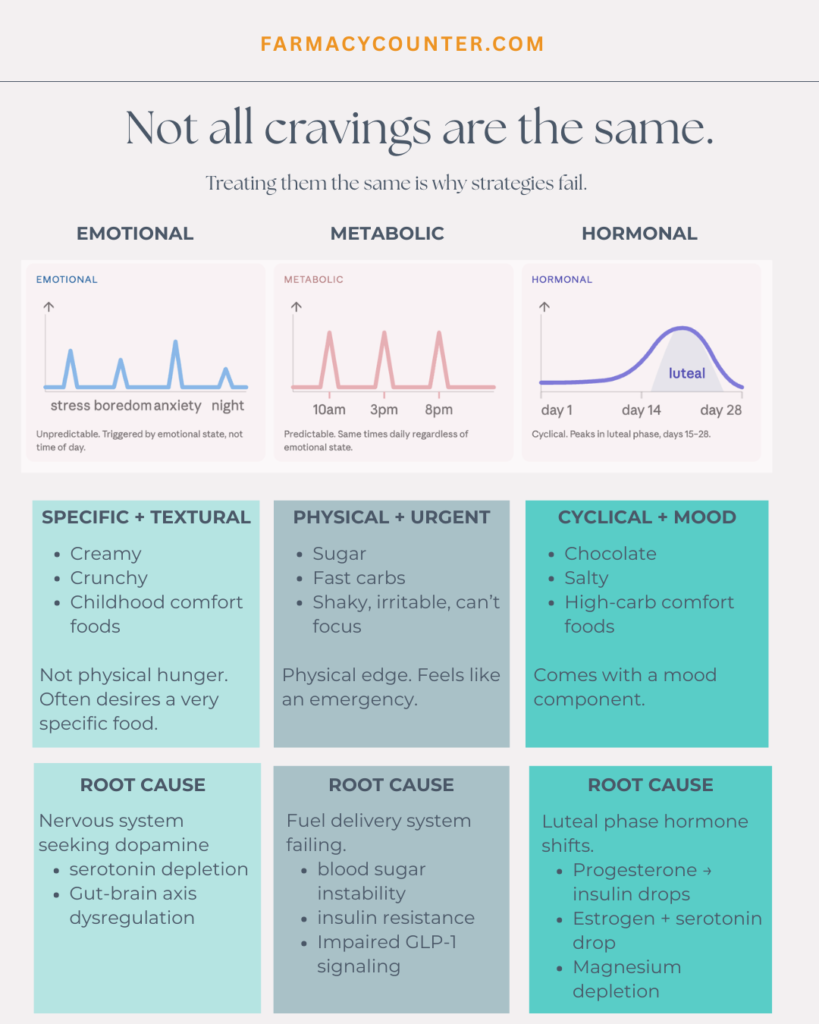
Timing: Unpredictable. Triggered by emotional state rather than time of day — stress, boredom, loneliness, anxiety, or as a comfort ritual right before bed.
Fingerprint: Specific and often textural. The craving is for something creamy, crunchy, or a particular childhood comfort food. It’s not physical hunger. You could eat other things, but you want that specific thing. The feeling driving it is emotional, not physiological.
What it feels like: You’re not actually hungry. You had dinner an hour ago. But something is pulling you toward the kitchen — and it’s not random. It’s the same thing every time, triggered by the same emotional state every time.
Root cause: The nervous system seeking a dopamine reward to soothe dysregulation.
When the nervous system is activated — by stress, emotional pain, boredom, or exhaustion — it looks for the fastest available pathway to relief. For most people, that pathway runs through food, specifically foods associated with comfort, reward, and emotional regulation from early life.
But there’s more physiology here than just habit. The gut-brain axis is directly involved. Serotonin — the neurotransmitter most associated with mood stability, calm, and satisfaction — is produced primarily in the gut, and gut-derived serotonin production depends on a healthy microbiome, adequate tryptophan intake, and a well-functioning enteroendocrine system. When serotonin precursor availability drops — from chronic stress, poor sleep, gut dysbiosis, or nutrient depletion — the nervous system becomes more reactive and the pull toward comfort foods becomes stronger.
This is why emotional cravings intensify during periods of high stress or poor sleep. It’s not a character issue. It’s a neurochemical one.
What doesn’t work: Willpower. Distraction in isolation. Eating more protein at the previous meal. None of these address the nervous system dysregulation or serotonin pathway issues driving the craving.
What does: Nervous system regulation practices — breathwork, somatic work, movement. Gut microbiome support and tryptophan-rich foods to support serotonin production. Addressing sleep quality, which is both a cause and a consequence of serotonin depletion. And identifying the emotional trigger so the craving can be read as information rather than fought as an enemy.

Type 2: Metabolic Cravings
Timing: Highly predictable. Typically appearing 2 to 3 hours after eating, at 3pm, or in the late evening. They follow a reliable schedule regardless of emotional state — which is the key distinguishing feature from emotional cravings.
Fingerprint: Carbohydrates, sugar, fast food. A physical urgency that can feel like shakiness, irritability, or difficulty concentrating if not addressed. There’s a physical edge to this craving — it feels like an emergency, because physiologically, it is one.
What it feels like: The 3pm crash that hits like clockwork. The inability to concentrate until you eat something. The shakiness that arrives 90 minutes after lunch even though you ate a full meal. The late-evening kitchen pull that happens every night at the same time whether you’re stressed or not.
Root cause: The fuel delivery system is failing.
Metabolic cravings are driven by blood sugar instability — specifically the spike-crash cycle that occurs when glucose rises sharply after eating and then drops below baseline as insulin overcorrects. When blood sugar drops, the body treats it as an emergency and activates a stress hormone cascade — cortisol and adrenaline rise to pull glucose back up, and the brain generates an urgent drive for fast carbohydrates to stabilize the system.
This is not a preference. It’s a hard-wired neurological survival response.
The underlying mechanisms include reactive hypoglycemia, early insulin resistance, and impaired GLP-1 signaling. GLP-1 is a gut hormone that slows gastric emptying, triggers satiety, and buffers the postprandial glucose rise. When GLP-1 signaling is impaired — which is common in the context of gut dysbiosis, chronic blood sugar volatility, and poor dietary fiber intake — blood sugar swings become more extreme and cravings become more frequent and more intense.
The defining characteristic of metabolic cravings is their predictability. They happen at the same times every day regardless of what’s happening emotionally. If you can set your clock by your cravings, they’re almost certainly metabolic.
What doesn’t work: Eating less. Skipping meals. Cutting carbohydrates without addressing cortisol. All of these strategies worsen the blood sugar instability that’s driving the craving — because caloric restriction raises cortisol, cortisol raises blood sugar, and the spike-crash cycle repeats with more intensity.
What does: Stabilizing the glucose curve through meal composition — protein and fat consumed before or with carbohydrates to slow gastric emptying and buffer the postprandial rise. Strategic meal timing to avoid the 4 to 5 hour gaps that allow blood sugar to drop into the craving threshold. Addressing insulin resistance if present. Supporting GLP-1 signaling through dietary fiber and gut microbiome health. And for those with significant blood sugar volatility, continuous glucose monitoring to make the pattern visible.
Type 3: Hormonal Cravings
Timing: Cyclical. Most pronounced in the luteal phase — the 7 to 14 days before menstruation — when progesterone peaks and then drops alongside estrogen.
Fingerprint: A strong pull toward chocolate specifically, salty foods, or high-carbohydrate comfort foods. Comes with a mood component — irritability, low mood, or emotional sensitivity that accompanies the craving rather than preceding it as a trigger.
What it feels like: The week before your period when you can eat well all month and then suddenly feel completely out of control around food. The chocolate craving that arrives so specifically and so predictably that it’s almost calendar-based. The salty snack pull that comes with a mood dip.
Root cause: Luteal phase hormonal shifts creating a perfect metabolic storm.
Three things happen simultaneously in the luteal phase that drive hormonal cravings.
First, progesterone peaks. Progesterone has an insulin-antagonizing effect — it reduces insulin sensitivity through a mechanism similar to the insulin resistance of pregnancy. In practical terms, this means the same meal that produced a stable glucose response in the follicular phase now produces a more exaggerated spike and a deeper crash in the luteal phase. The metabolic craving pattern intensifies simply because of the hormonal environment, not because anything changed in the diet.
Second, estrogen declines heading toward menstruation. Estrogen supports insulin sensitivity and acts as a serotonin precursor facilitator — higher estrogen levels support better serotonin production. As estrogen drops in the luteal phase, serotonin availability drops with it. The craving for chocolate is not random: cocoa contains tryptophan (a serotonin precursor) and magnesium, both of which the body is actively depleted in during this phase.
Third, magnesium is depleted. Magnesium plays a critical role in insulin receptor function, blood sugar regulation, and neurotransmitter production. The luteal phase increases magnesium requirements, and most people are already insufficient. Low magnesium amplifies both the insulin resistance and the mood component of luteal phase cravings.
The salty food craving has a separate but related mechanism: aldosterone, the adrenal hormone that regulates sodium and water balance, fluctuates around menstruation and can drive salt-seeking behavior as a compensatory response.
Hormonal cravings aren’t only a luteal phase phenomenon. Anyone — regardless of cycle — experiencing chronic cortisol elevation will encounter a version of hormonal craving driven by HPA axis dysregulation, adrenal-driven blood sugar volatility, and cortisol-mediated serotonin depletion. The timing differs but the mechanism overlaps significantly.
What doesn’t work: Treating luteal phase cravings as a discipline problem. Restricting food more tightly in the week before menstruation — this worsens both the insulin resistance and the cortisol load, intensifying the cravings rather than reducing them.
What does: Proactive magnesium supplementation in the luteal phase — particularly magnesium glycinate for its superior absorption and nervous system support. Adjusting carbohydrate timing and composition to account for the reduced insulin sensitivity of this phase rather than fighting it. Prioritizing tryptophan-rich foods to support serotonin production. And for those with significant luteal phase symptoms, understanding that the craving is a hormonal signal — not a failure of willpower — is itself therapeutic.

How to Identify Your Type
The fastest way to identify your craving type is to pay attention to two things: timing and trigger.
If your craving follows a schedule regardless of your emotional state — 3pm every day, every evening after dinner, 90 minutes after lunch — that’s almost always metabolic. Blood sugar doesn’t care whether you’re happy or stressed.
If your craving appears in response to a specific emotional state — stress, boredom, loneliness, exhaustion — and the object of the craving is specific and textural rather than urgently carbohydrate-focused, that’s almost always emotional.
If your craving follows your cycle — appearing or intensifying in the 7 to 14 days before menstruation — and comes with a mood component, that’s almost always hormonal.
Most people have a primary craving type with secondary elements from the other two. Metabolic instability can amplify emotional cravings by depleting the neurochemical resources needed for emotional regulation. Hormonal shifts can intensify an already-present metabolic pattern. Emotional dysregulation can worsen hormonal cravings by elevating cortisol and disrupting sleep. They’re not entirely separate systems — but one is almost always primary.
Identifying the primary driver is what allows you to stop applying every possible strategy and start applying the right one.
The Craving Is Always Communicating Something
The reframe that changes everything for most people is this: the craving is not the enemy. It is a message.
A metabolic craving is your body communicating that the fuel delivery system is unreliable. An emotional craving is your nervous system communicating that it needs support. A hormonal craving is your endocrine system communicating that specific resources — magnesium, serotonin precursors, stable glucose — are running low.
Every one of these messages can be worked with. Every one of them has a root cause that’s addressable.
The approach that doesn’t work is fighting the craving with discipline. The approach that does work is understanding what the craving is communicating — and addressing the system that’s sending the signal.
Not sure which craving type is driving yours?
The Cravings Root Cause Quiz identifies your pattern in two minutes — and explains the physiology behind what your body has been trying to tell you.