

When most people hear the word histamine, they think sneezing. Itchy eyes. Antihistamines in the spring. Maybe a reaction to shellfish or a glass of wine that didn’t agree with them.
What almost nobody knows is that histamine is also a neurotransmitter — produced by neurons in the hypothalamus, projecting to nearly every region of the brain, and regulating functions that have nothing to do with allergies: learning and memory, sleep-wake cycling, emotional processing, and appetite regulation.
Understanding the difference between these two systems — and what happens when they interfere with each other — explains a pattern of anxiety, insomnia, and cognitive symptoms that standard care almost never connects to histamine at all.
Two Distinct Histamine Systems
Your body runs two separate histamine systems, and they operate in completely different places for completely different purposes.
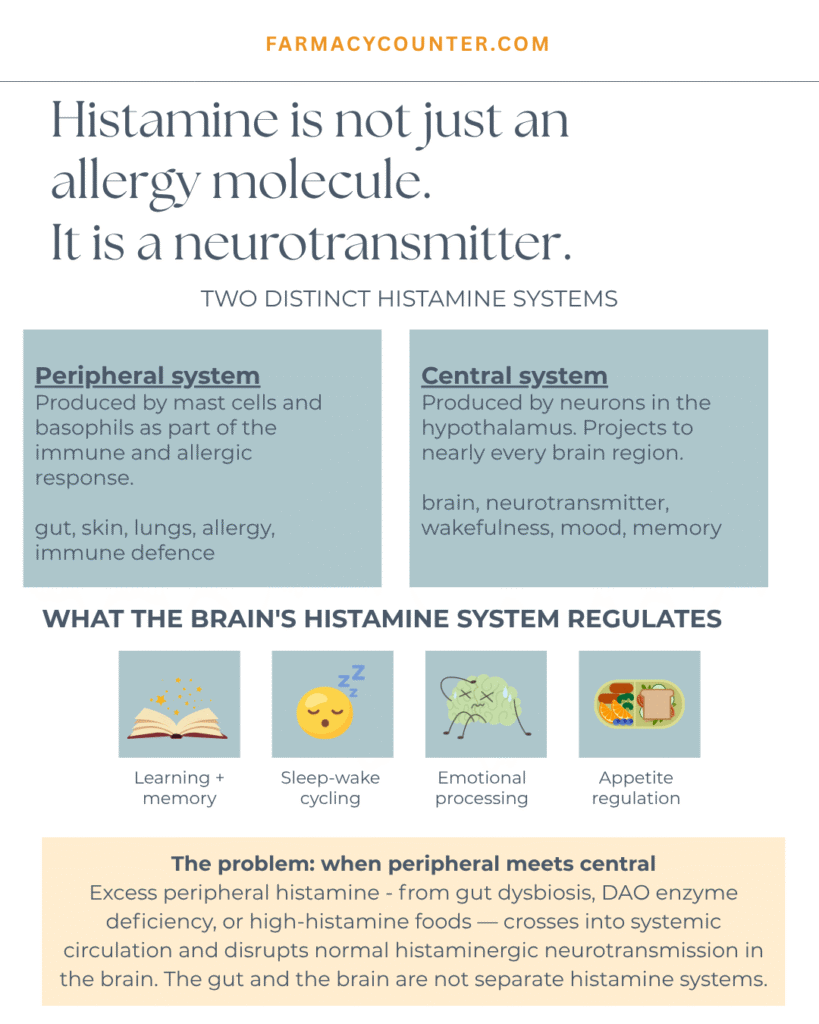
The peripheral system is the one most people know. Histamine here is produced by mast cells and basophils as part of the immune and allergic response. It operates in the gut, skin, and lungs — the tissues involved in immune defense and allergic reactions. When you take an antihistamine for seasonal allergies, this is the system you’re targeting.
The central system is the one almost nobody talks about. Histamine here is produced by a cluster of neurons in the tuberomammillary nucleus of the hypothalamus. From there, histaminergic neurons project to nearly every region of the brain — the cortex, the hippocampus, the amygdala, the brainstem — making histamine one of the most broadly distributed neurotransmitters in the central nervous system.
In the brain, histamine regulates:
🧠 Learning and memory — histaminergic signaling in the hippocampus and cortex supports memory consolidation and cognitive processing
💤 Sleep-wake cycling — histamine is the primary wakefulness-promoting neurotransmitter. This is why antihistamines make you drowsy: they block histamine’s alerting effect in the brain. That single fact tells you everything about what excess histamine does when it reaches the central system
😤 Emotional processing — histaminergic projections to the amygdala modulate emotional reactivity and stress response
🍽️ Appetite regulation — hypothalamic histamine signaling is involved in satiety and feeding behavior
These are not peripheral, allergy-related functions. These are core neurological functions — the same functions that become dysregulated in anxiety, insomnia, mood instability, and cognitive impairment.
The Problem: When Peripheral Meets Central
The two histamine systems are designed to operate relatively independently. The peripheral system handles immune and allergic responses in body tissues. The central system handles neurotransmission in the brain.
The problem is when excess peripheral histamine — from gut dysbiosis, DAO enzyme deficiency, or high dietary histamine load — crosses into systemic circulation and disrupts normal histaminergic neurotransmission in the brain.
The gut and the brain are not separate histamine systems. They are connected by the circulation. And when peripheral histamine production exceeds the body’s capacity to clear it before it reaches the bloodstream, the central histamine system is exposed to a load it was never designed to handle.
The result is overstimulation of the brain’s histamine-mediated alerting and arousal system — which shows up not as sneezing or hives, but as anxiety, racing thoughts, insomnia, hyperarousal at night, and waking between 2 and 4am with a brain that refuses to quiet down despite a body that is genuinely exhausted.
No allergy symptoms required. The entire presentation can be neurological, with no traditional histamine-intolerance picture at all.

Why This Gets Missed
The reason this connection is almost never made in standard care is that the two histamine systems are assessed and treated by completely different medical specialties using completely different frameworks.
Peripheral histamine is an allergy and immunology issue. Central histamine disruption is a psychiatry or neurology issue. Nobody is looking at the gut-histamine-brain axis as a single connected system — which means the person with anxiety, insomnia, and racing thoughts who also has gut dysbiosis and eats a diet high in fermented foods, wine, aged cheese, and leftovers gets an anxiety diagnosis and a sleep medication, with no investigation into whether histamine is the thread connecting all of it.
The tell is in the pattern. Histamine-driven neurological symptoms tend to be worse in the evening and at night, when the alerting effect of histamine is most disruptive. They’re often worse after high-histamine meals — wine, fermented foods, leftovers, aged cheese, smoked meats, spinach, tomatoes, avocado. They may be accompanied by frontal headaches, flushing, or itching — or they may not be, presenting as a purely neurological picture with no peripheral clues at all.
And they respond, at least partially, to antihistamines — which is the most diagnostic clue of all. If your anxiety or insomnia improves with a Benadryl, histamine is involved in your picture.
What the Investigation Looks Like
Identifying whether histamine is driving neurological symptoms requires looking at both systems — the peripheral load and the central clearance capacity.
On the peripheral side, whole blood histamine gives a direct marker of systemic histamine load, and plasma DAO enzyme activity tells us whether the gut’s primary histamine-clearing enzyme is functioning adequately. Comprehensive stool analysis identifies histamine-producing bacteria and maps the upstream source of the load.
On the central side, urinary methylhistamine — the primary metabolite produced when the brain successfully clears histamine via the HNMT enzyme — tells us whether brain histamine clearance is functioning. Low methylhistamine means the brain’s clearance pathway is underperforming.
Methylation markers — homocysteine and MTHFR status — are also critical here, because the brain’s histamine clearance enzyme (HNMT) requires SAMe from the methylation cycle to function. Impaired methylation means impaired brain histamine clearance, independent of what peripheral histamine is doing.
The complete picture — peripheral load, clearance capacity, and central methylation status — is what guides the intervention. And the intervention when histamine is the driver is completely different from standard anxiety or insomnia treatment, which is part of why those treatments often only partially help.
Where to Start
If the pattern described here sounds familiar — anxiety that’s worse at night, insomnia with hyperarousal, racing thoughts that feel out of proportion to your circumstances, symptoms that worsen after wine or fermented foods — histamine is worth investigating as a driver.
The Anxiety Pattern Decoder is a free assessment that walks you through the four biological types of anxiety and helps identify which pattern is most likely yours. Histamine-driven anxiety has a specific fingerprint the decoder helps identify.
Download the free Anxiety Pattern Decoder below.
Histamine is not just an allergy molecule. In the brain, it is one of the most powerful arousal and alerting signals in the nervous system. When it’s running too high and clearing too slowly, the nervous system doesn’t get the message to quiet down — regardless of how much you want it to.
References:
- Haas HL, Sergeeva OA, Selbach O. Histamine in the nervous system. Physiol Rev. 2008;88(3):1183-1241. doi:10.1152/physrev.00043.2007
- Panula P, Sundvik M, Karlstedt K. Developmental roles of brain histamine. Trends Neurosci. 2014;37(3):159-168. doi:10.1016/j.tins.2014.01.001
- Maintz L, Novak N. Histamine and histamine intolerance. Am J Clin Nutr. 2007;85(5):1185-1196. doi:10.1093/ajcn/85.5.1185