

You finally went in. You said you felt inflamed, exhausted, foggy, achy, not like yourself. They ran bloodwork.
It came back normal.
Maybe more than once. So you started to wonder if it was in your head.
It isn’t. The problem isn’t you. It’s what standard inflammation testing was actually built to catch.
Standard labs are built for a crisis, not a slow burn
The markers most doctors run — CRP, ESR, white blood cell count — are designed to detect acute inflammation: infections, injuries, major autoimmune flares. They’re loud-signal tests. They’re built to catch something dramatic happening right now.
What they’re not built to catch is the slow, persistent, low-grade inflammation that can simmer in the background for years, quietly contributing to:
- ⚡ Fatigue
- 🧠 Brain fog
- 🦴 Joint pain
- 😴 Poor recovery
- 🌿 Digestive issues
None of these are “crisis” symptoms. They’re the day-to-day cost of a system that’s been running hot for a long time, well below the threshold that would ever trip a standard alarm.
That’s the core problem with a single CRP or ESR: it’s one snapshot, on one morning, measuring for one kind of event. Your inflammation is a moving relationship between load and recovery. A single data point can’t see a moving deficit. It’s like checking your bank balance the one day your paycheck landed and deciding you have no money problems.
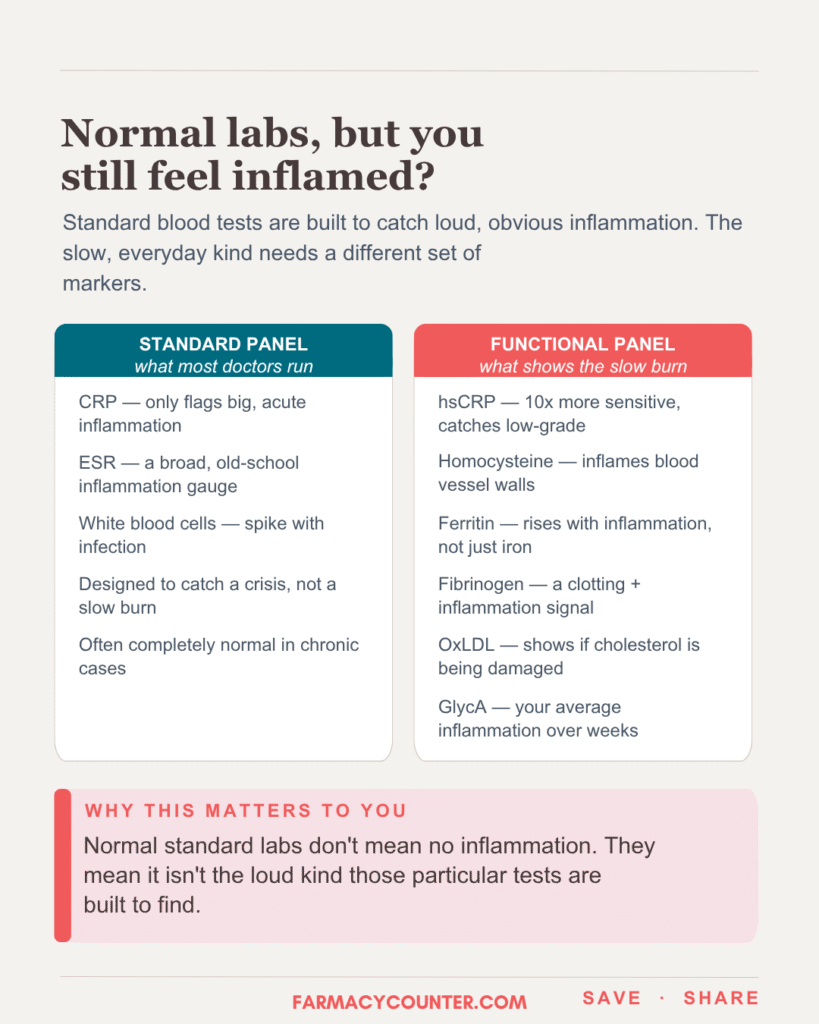
What standard labs check vs. what actually shows the slow burn
The standard panel is short for a reason. It’s built to catch a crisis, not a slow burn, which is exactly why it’s so often completely normal in chronic, low-grade cases:
- CRP — only flags big, acute inflammation
- ESR — a broad, old-school inflammation gauge
- White blood cells — spike with active infection
This is where functional medicine tends to look deeper. Depending on your history and symptoms, a practitioner may evaluate a different set of markers, each one catching something the standard panel misses:
- hs-CRP — roughly 10x more sensitive than standard CRP, catches low-grade inflammation
- Homocysteine — reflects inflammation at the level of your blood vessel walls
- Ferritin — rises with inflammation, not just iron
- Fibrinogen — a clotting and inflammation signal
- Oxidized LDL — shows whether cholesterol is actually being damaged, not just how much you have
- GlycA — reflects your average inflammation over the past several weeks, not just a single morning
None of these are typically run on a standard ten-minute visit. Together, they can paint a far clearer picture of chronic inflammation and metabolic health, even when routine bloodwork comes back looking completely clean.
Why this matters to you
A normal standard lab doesn’t mean no inflammation. It means the inflammation you’re carrying isn’t the loud, acute kind those particular tests are built to find.
Sometimes “normal” simply means the test wasn’t designed to detect the type of inflammation you’re actually experiencing.
That distinction changes everything about what to do next. If the standard panel already came back clean and you still feel far from fine, the answer usually isn’t to keep re-running the same tests and hoping for a different result. It’s to look at markers that were actually built to catch what’s happening under the surface.

What’s usually driving it
Chronic, low-grade inflammation rarely comes from one obvious source. It tends to build from a handful of ordinary things stacking on top of each other, the same way any slow burn does:
- Gut permeability. When the gut barrier is compromised, bacterial byproducts leak into circulation and keep your immune system quietly activated around the clock.
- Blood sugar swings. Every spike-and-crash cycle triggers its own small inflammatory response. Do that a few times a day, most days, and the load adds up fast.
- Chronic stress. Sustained cortisol elevation keeps inflammatory signaling turned on well past the point where it’s actually useful.
- Poor or broken sleep. Even a single night of disrupted sleep measurably raises inflammatory markers. Ongoing sleep debt keeps them elevated.
- Low-grade food reactions. Not a full allergy, just a persistent, low-level immune response to something you eat often, working in the background without an obvious symptom to point to.
None of these are dramatic on their own. That’s exactly why they don’t show up on a standard panel, and exactly why they’re so easy to miss until you’re specifically looking for them.

Why this gets missed for years
This is one of the most common stories I hear in practice: someone has been to multiple doctors, described feeling inflamed and exhausted, and been told everything looks fine. So they start to doubt themselves. They wonder if it’s stress, or aging, or something they should just push through.
It’s rarely any of those things. It’s usually that nobody ran the tests built to catch it. A standard panel isn’t wrong when it comes back normal, it’s just answering a different question than the one you’re actually asking. You’re asking “is my body running hot?” CRP and ESR are answering “is there an emergency happening right now?” Those are not the same question, and a clean answer to the second one tells you nothing about the first.
What a fuller picture actually looks like
When someone comes to me with normal labs and symptoms that say otherwise, I’m not just running the six markers listed above in isolation. I’m looking at the whole pattern together:
Inflammatory markers (hs-CRP, homocysteine, ferritin, fibrinogen, oxidized LDL, GlycA) to see whether a slow burn is actually present, and how significant it is.
Blood sugar regulation (fasting insulin alongside fasting glucose, HbA1c) because insulin resistance is one of the most common silent drivers of chronic inflammation, and fasting glucose alone consistently misses it until the problem is already advanced.
Gut function and permeability, because a meaningful share of total inflammatory load starts at the gut wall, and standard bloodwork never looks there at all.
Omega-3 to omega-6 balance, which reflects whether your body actually has the raw materials it needs to resolve inflammation once it starts, not just whether inflammation is present.
A full thyroid panel, not just TSH, because inflammation interferes with how your body converts and uses thyroid hormone, and a lone TSH can look perfectly normal while that entire downstream process is struggling.
Individually, each of these tells you something. Together, they tell you where your inflammation is actually coming from, which is the piece a “normal” CRP was never going to give you.

What changes once you can actually see it
Once the fuller picture is in front of us, the plan stops being generic. If gut permeability is driving the load, the work centers on repairing the gut barrier and calming what’s leaking through it. If blood sugar swings are the bigger driver, the work centers on stabilizing glucose and insulin. If it’s a combination, which it often is, we address them in the order that actually moves the needle instead of trying to fix everything at once.
This is also usually the point where people stop feeling like they’re imagining things. Having a number that reflects what your body has been telling you all along tends to be its own kind of relief, even before any treatment starts.
Where to start
You can’t address a slow burn you can’t see. If your labs keep coming back “normal” while you keep feeling anything but, it’s worth mapping where your personal inflammation load actually sits, and what’s driving it.
That’s exactly what the Inflammation Threshold Test does. It’s a free, 9-question self-assessment that looks at things a standard lab never asks about: how predictable your reactions are, how fast your body bounces back after a bad night or a flare, and how much of your day-to-day load (stress, sleep, gut issues, hormones, blood sugar) is already stacked up before anything even hits your plate. In about two minutes, it maps where your personal flare line sits right now and how much buffer you have left before the next crash.
Take the Inflammation Threshold Test below.