

There’s no single gene, no single food, no single infection that flips a switch and gives someone Hashimoto’s. According to one of the most widely cited models in autoimmune research, it actually takes three separate things happening at once, and understanding all three changes what’s actually worth addressing.
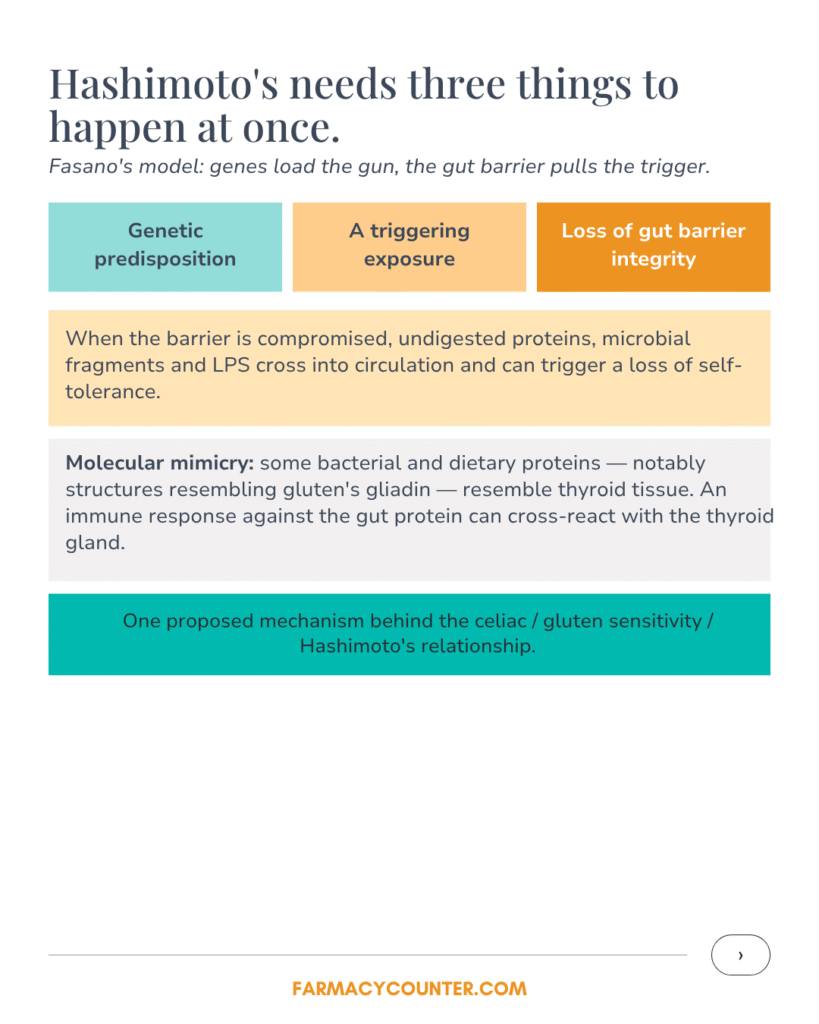
The model comes from Dr. Alessio Fasano, a researcher known for his work on intestinal permeability, and it’s often summarized this way: genes load the gun, the environment pulls the trigger, but the gut barrier is what lets the bullet through (1). For autoimmune thyroid disease specifically, that means three things need to line up simultaneously: a genetic predisposition, a triggering exposure, and a loss of gut barrier integrity.
Miss any one of the three, and the disease process doesn’t fully take hold. This is why two people with the same genetic risk can have completely different outcomes, and it’s why gut health keeps showing up as a lever worth pulling in autoimmune thyroid care, even though the thyroid itself is the organ under attack.
Genetic Predisposition: The Gun
Certain genes, particularly within the HLA (human leukocyte antigen) family, are associated with higher risk of autoimmune thyroid disease. Having these genes doesn’t mean someone will develop Hashimoto’s. It means the underlying machinery for a misdirected immune response is present, loaded and waiting.
This piece isn’t modifiable. You can’t change your genetics. But genetic risk on its own isn’t a diagnosis, and this is often where the story gets oversimplified, either into “it’s just genetic, nothing to be done” or the opposite extreme of ignoring genetics as if it plays no role at all. It’s neither. It’s the first of three necessary conditions, not a sufficient one by itself.
A Triggering Exposure: The Trigger
Something has to happen to actually activate that underlying predisposition. This can take many forms: a viral infection, a period of significant physical or emotional stress, pregnancy and the postpartum hormonal shift, environmental toxin exposure, or in some cases a specific dietary trigger.
This is also highly individual. The same exposure that triggers autoimmune activity in one genetically susceptible person may pass through another person without incident. The trigger matters, but it only matters in combination with the other two pieces.
Loss of Gut Barrier Integrity: What Lets It Through
This is the piece that gets the most attention in functional medicine, and for good reason: it’s often the most modifiable of the three.
Your intestinal lining is meant to be selectively permeable, allowing nutrients through while keeping undigested food particles, microbial fragments, and toxins contained. When that barrier is compromised, a state commonly called increased intestinal permeability or “leaky gut,” things that shouldn’t cross into circulation do.
Specifically, undigested proteins, microbial fragments, and lipopolysaccharide (LPS, a component of certain bacterial cell walls) cross into the bloodstream where they trigger immune activation. In someone who already has the genetic predisposition and has experienced a triggering exposure, this compromised barrier is what allows the immune system’s confusion to actually take hold and become a loss of self-tolerance, the point where the immune system stops distinguishing “self” thyroid tissue from a foreign threat.
Molecular Mimicry: Why the Immune System Gets Confused
Here’s the specific mechanism that connects a permeable gut to an autoimmune attack on the thyroid: certain bacterial and dietary proteins structurally resemble thyroid tissue closely enough to confuse the immune system. This is called molecular mimicry.
The most studied example involves gliadin, a protein found in gluten. Structures within gliadin bear a notable resemblance to thyroid tissue at the molecular level. When gliadin crosses a permeable gut barrier and the immune system mounts a response against it, that response can cross-react with actual thyroid tissue, because the immune system is, in effect, responding to what looks like the same threat in two different places (2).
This is one proposed mechanism behind the well-documented clinical overlap between celiac disease, non-celiac gluten sensitivity, and Hashimoto’s thyroiditis. People with celiac disease have a meaningfully higher rate of autoimmune thyroid disease than the general population, and this shared mechanism, a compromised gut barrier plus a structurally mimicking protein, is one of the leading explanations for why (3).
Wondering whether gut health is playing a role in your own thyroid antibodies? Download The “Normal Labs, Not Normal Symptoms” Blueprint to understand what standard thyroid testing does and doesn’t catch. Get it here.
Why This Model Matters Clinically
Understanding autoimmunity as requiring all three conditions simultaneously changes what’s actually worth investigating and addressing once Hashimoto’s is on the table.
The genetic piece explains why family history matters and why some people are more susceptible than others, but it isn’t something we can act on directly. The trigger is worth identifying when possible, since knowing what set off the initial immune response sometimes informs ongoing management, but it’s often a single past event rather than something requiring ongoing intervention.
The gut barrier is the piece with the most ongoing, modifiable relevance. It’s not just about the historical event that may have “let the bullet through” in the first place. An already-compromised gut barrier continues driving ongoing immune activation and antibody production in a lot of people with established Hashimoto’s, which means addressing gut integrity isn’t only about prevention, it’s often directly relevant to managing an existing diagnosis.
This is also why a trial elimination of gluten is a reasonable, evidence-informed conversation to have with anyone who has confirmed thyroid antibodies, independent of whether they’ve been formally diagnosed with celiac disease. The molecular mimicry mechanism doesn’t require a celiac diagnosis to be clinically relevant; it requires gluten exposure, a permeable gut, and the underlying genetic and antibody picture already in place.
What This Doesn’t Mean
It’s worth being clear about what this model doesn’t claim. It doesn’t mean gluten causes Hashimoto’s in everyone, or that removing gluten will resolve established autoimmune thyroid disease on its own, or that gut healing is a substitute for appropriate thyroid hormone management when it’s needed. All three conditions, genetics, trigger, and barrier integrity, are necessary; none of them alone is sufficient, and none of them alone is a complete treatment plan.
What it does mean is that gut barrier integrity is a legitimate, mechanistically grounded piece of the picture for anyone managing autoimmune thyroid disease, not just a wellness trend layered on top of conventional care.

What Actually Gets Assessed
When someone comes in with confirmed or suspected Hashimoto’s, understanding where they stand on this three-part model shapes what we look at.
Thyroid antibody levels (TPO and thyroglobulin) to establish or confirm the autoimmune picture and track it over time.
Celiac screening or a structured gluten elimination trial, particularly in anyone with gut symptoms, a family history of celiac or autoimmune disease, or antibody levels that aren’t responding to other interventions.
Markers of intestinal permeability, when available and clinically indicated, to assess whether the gut barrier is currently a contributing factor.
Comprehensive stool testing to identify dysbiosis, infections, or inflammation that may be perpetuating a compromised barrier.
A history focused on timing: when antibodies were first identified relative to any major stressors, infections, or dietary patterns, since that history sometimes points toward the original triggering exposure and toward what’s still active now.
Let’s Look at What’s Driving Your Antibodies
If you have confirmed thyroid antibodies, or you suspect Hashimoto’s based on symptoms and family history, understanding your own version of this three-part picture is worth doing properly rather than assuming gluten, or gut health generally, is either irrelevant or a complete fix.
On a discovery call, we go through your history, any antibody testing you’ve already had, and your gut symptoms, then map out what’s worth investigating: a gluten trial, gut barrier support, dysbiosis testing, or a combination, alongside whatever thyroid hormone management is already appropriate for where you are.
If you’re ready to understand what’s actually driving your antibodies instead of guessing, you can schedule a discovery call here. We’ll figure out which pieces of this picture apply to you, and what’s actually worth doing about it.
Genetics load the gun. A trigger pulls it. But the gut barrier is often the piece still open, and still worth closing.
References:
- Fasano A. Leaky gut and autoimmune diseases. Clin Rev Allergy Immunol. 2012;42(1):71-78.
- Lerner A, Jeremias P, Matthias T. Gut-thyroid axis and celiac disease. Endocr Connect. 2017;6(4):R52-R58.
- Ch’ng CL, Jones MK, Kingham JG. Celiac disease and autoimmune thyroid disease. Clin Med Res. 2007;5(3):184-192.