

You open the patient portal. There’s one line: TSH: within range. That’s it. That’s the whole workup.
Meanwhile: you’re exhausted after eight full hours of sleep. Your fingers are cold in a room everyone else finds comfortable. Your hair is collecting around the shower drain faster than it should. The extra fiber isn’t touching the constipation. And you’re rereading the same email twice because your brain won’t hold onto it the first time.
One number, and none of that explained.
TSH Matters. It’s Also Not the Whole Story.
Let’s start with what TSH actually is, because it gets treated like a verdict when it’s really more like a request.
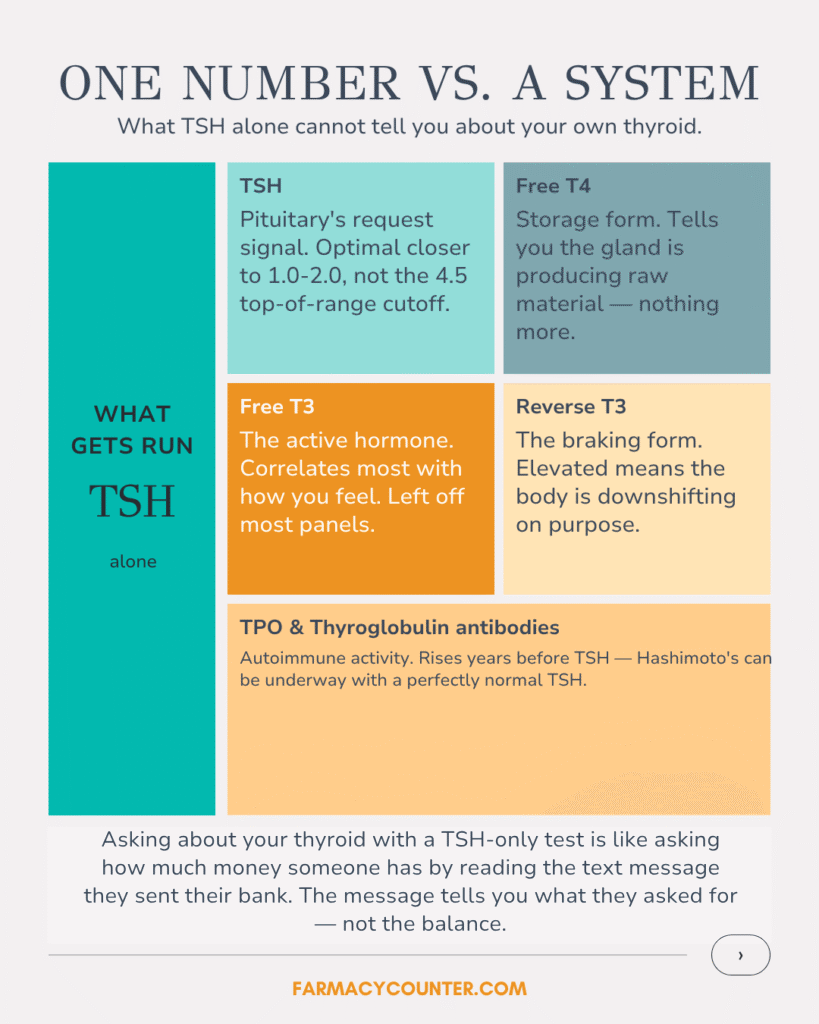
TSH, thyroid-stimulating hormone, is produced by the pituitary gland, not the thyroid itself. It’s the brain’s signal telling the thyroid how much hormone to make. When thyroid hormone runs low, the pituitary turns up TSH to ask for more. When it’s adequate, TSH comes back down. It’s the recommended first-line screening test for primary thyroid dysfunction, and for good reason: it’s sensitive, it’s inexpensive, and in a lot of straightforward cases it catches the problem.
But TSH is a request, not a receipt. It tells you what the brain is asking for. It doesn’t tell you what’s actually being delivered, whether that delivery is being used, or whether “in range” means the same thing for you that it means on a population-wide reference chart.
There’s also a quieter issue with the range itself. The standard reference range runs up to roughly 4.5, but a meaningful body of clinical opinion, including within conventional endocrinology, considers optimal TSH closer to 1.0 to 2.0 for most adults (1). Someone sitting at 3.8 is technically “within range” and may still be functionally underserved by their own thyroid.
The Full Panel: What Each Piece Actually Tells You
If TSH is the request, here’s what the rest of the system can tell you that TSH alone can’t.
Free T4 is the storage form of thyroid hormone, the raw material your thyroid gland actually produces and releases into circulation. Free T4 confirms the gland is producing hormone. It doesn’t tell you whether that hormone is being converted into something your cells can use.
Free T3 is the active hormone, the form that actually binds receptors and does the job: regulating metabolism, temperature, digestion, cognition. Of everything on a thyroid panel, free T3 correlates most closely with how someone actually feels day to day. It’s also the marker most frequently left off standard panels entirely.
Reverse T3 is an inactive, mirror-image form of T3 that occupies receptor space without activating it. It functions as a kind of built-in brake. When the body is under significant stress, illness, or calorie restriction, reverse T3 tends to rise as part of a deliberate, adaptive slowdown, not necessarily a sign that something’s broken.
TPO and thyroglobulin antibodies measure autoimmune activity against the thyroid gland itself. This one matters more than people realize: antibody levels can rise years before TSH ever moves out of range. Hashimoto’s can be actively underway in someone with a perfectly normal TSH, which means antibody testing is often the only way to catch it early.
Where Free T3 and Reverse T3 Actually Fit
It’s worth being precise here, because this is a place a lot of functional and integrative content overstates the case: free T3 and reverse T3 have a limited, specific role in routine hypothyroidism workups. They’re not universal answers, and I don’t order or interpret them as if every low T3 or elevated reverse T3 automatically means “start treatment.”
Reverse T3 in particular rises during illness, fasting, and acute stress as an adaptive response, so a single elevated value in someone who’s currently unwell or under-eating may simply reflect that response rather than indicate a separate condition needing treatment on its own. These markers are tools I use selectively, when the clinical picture calls for them, not defaults I run on everyone regardless of context.
Curious what a full thyroid workup actually looks like when TSH doesn’t explain your symptoms? Download The “Normal Labs, Not Normal Symptoms” Blueprint to see the four places a thyroid problem can hide beyond a single number. Get it here.
What Gets Investigated When TSH Doesn’t Line Up With Symptoms
TSH matters, and so does the question it was actually ordered to answer. When symptoms and an initial “normal” result don’t line up, the next step isn’t necessarily more thyroid testing. It’s often widening the lens to what else produces the exact same symptom cluster:
Free T4, to confirm the gland is producing what it should.
Medication timing and dose, for anyone already being treated, since absorption issues can make a technically correct dose underperform.
Thyroid antibodies, when autoimmune disease is a reasonable concern based on history or symptom pattern.
Iron status, since iron deficiency alone produces fatigue, hair shedding, and cold intolerance that can look identical to hypothyroidism.
Sleep quality, since poor sleep architecture (not just duration) produces daytime exhaustion that no amount of “eight hours” fixes.
Blood sugar regulation, since post-meal crashes and energy instability often trace back to glucose handling rather than the thyroid at all.
Perimenopause, which overlaps heavily with thyroid symptoms and is frequently the actual driver in the decade before menopause.
Nutrient deficiencies, particularly the ones (selenium, zinc, ferritin, vitamin D) that affect energy and thyroid conversion independently of thyroid disease itself.
And other causes of the same symptom cluster entirely, because fatigue, cold intolerance, hair thinning, and constipation are common enough symptoms that they show up in a long list of conditions having nothing to do with the thyroid.
A Lab Range Can Help Identify Disease. It Can’t Conduct the Whole Interview.
This is the piece that gets lost when a workup is reduced to a single value: a reference range is a statistical tool for flagging disease. It was never designed to explain a specific person’s lived experience of fatigue, temperature regulation, hair, digestion, or focus.
Asking about someone’s thyroid with a TSH-only test is a bit like trying to figure out how much money someone has by reading the text message they sent their bank. The message tells you what they asked for. It doesn’t tell you the balance.
This is why I never want someone to leave an appointment with a screenshot of one in-range number and no explanation for why they still need a sweater indoors, a 3pm coffee they didn’t used to need, and two rereads of the same email to actually absorb it. A normal TSH can be entirely accurate and still not be the end of the conversation.

Let’s Look at Your Whole Panel, Not Just One Line
If your entire thyroid workup so far fits on one line in a patient portal, it’s worth asking what that line was actually designed to tell you, and what it wasn’t.
On a discovery call, we go through your full symptom pattern alongside whatever labs you’ve already had, and figure out whether the next step is a fuller thyroid panel, a look at iron, sleep, or blood sugar, or something else entirely that’s been hiding behind a thyroid-shaped set of symptoms.
If you’re ready for more than a screenshot and a shrug, you can schedule a discovery call here. We’ll figure out what your one number isn’t telling you, and what actually is.
References:
- Fatourechi V. Subclinical hypothyroidism: an update for primary care physicians. Mayo Clin Proc. 2009;84(1):65-71.