
The restrict, overeat, and guilt cycle isn’t a willpower problem. It’s a hormone problem. Here’s the science behind why it happens, and how to break it.
Every holiday season, the same pattern plays out. You eat lightly for a few days before Thanksgiving to “make room.” You sit down to the meal and eat more than you meant to. You feel guilty. Monday arrives with a plan (cut carbs, skip meals, add extra workouts), and by December the whole thing repeats.
Eat light to “make room”
Hunger hormones take over
Stress hormones rise
Monday’s plan resets the trap
↻ And the cycle starts over in December.
Most people assume this is a discipline problem. It isn’t. It’s a predictable physiological sequence that follows from how your body responds to restriction, rebound, and the stress hormones guilt produces. And each time the cycle runs, it gets a little harder to break: your metabolism adapts, recovery takes longer, and the Monday plan that worked a few years ago stops working.
Understanding why this happens, and what to do instead, changes the entire experience of holiday eating.

Eating light before Thanksgiving makes intuitive sense: create a buffer and enjoy the meal. But your body doesn’t experience a few days of restriction as smart planning. It experiences it as scarcity, and it responds with a coordinated hormonal shift designed to drive food-seeking and store energy once food shows up.
Here’s what’s happening by the time dinner is served:
Your main hunger hormone climbs with restriction and helps trigger the drive to eat.[1] After several days of under-eating, appetite runs higher overall, with stronger pulls toward calorie-dense, carb-rich foods.
Leptin, the hormone that tells your brain your energy stores are adequate, drops quickly when you under-eat.[6] With less of it, fullness arrives later and less clearly than usual.
Without steady fuel, blood sugar dips, and cortisol steps in to prompt your liver to release stored glucose. You arrive at dinner with your blood sugar regulation already off balance.
After restriction, your brain’s reward response to rich foods tends to get louder, so the stuffing and pie are harder to stop at “enough.”
After a few days of restriction, you’re not sitting down to a normal meal. You’re sitting down in a hormonal state built to maximize intake. Eating past fullness in that state is your body doing exactly what it’s designed to do.
After a few days of eating very little, your body often handles a big carbohydrate load less smoothly than usual, so the same plate can produce a higher, longer rise in blood sugar and insulin. Higher insulin pulls more fuel into storage and pauses fat burning after the meal. That’s not a reason to feel worse about the meal. It’s a reason to skip the restriction that set it up.
The guilt and shame after a holiday meal aren’t just uncomfortable feelings. They’re physiologically active. Like physical stressors, they raise cortisol.
And cortisol has a particular relationship with belly fat. The visceral fat around your abdominal organs has more cortisol receptors than the fat under your skin, so when cortisol stays high, fat storage shifts toward that area while fat breakdown there slows.[4]
Monday’s restriction adds to this. Cutting calories hard is a stressor in its own right and raises cortisol,[7] and adding intense workouts to “burn it off” raises it more. Meanwhile ghrelin climbs again, setting the stage for the next round of overeating within days.
The Monday plan plants the seed for December’s version of the same cycle.
The Long GameOne holiday doesn’t permanently change your metabolism. But the restrict-rebound-restrict pattern, repeated over years and often all year long, adds up:[3][5]
These changes aren’t permanent, but they’re durable. They reverse with consistent, adequate nutrition and strength training over time, not with more restriction. It’s much of what people mean when they say their metabolism has “gotten slower” over the years. Here’s more on what years of dieting does to your metabolism.
The alternative isn’t eating perfectly or avoiding every rich food on the table. It’s consistency: eating enough all week so the meal itself doesn’t arrive as a metabolic event.
Regular meals with protein, fiber, and healthy fats keep ghrelin and leptin balanced, so the meal lands on a calm baseline and fullness works the way it should.
Skipping meals to “save up” sets up the exact hormonal state you’re trying to avoid. A protein-rich breakfast keeps you steady until dinner.
Even 15 minutes improves blood sugar clearance without the stress of an intense workout. It’s the 10-minute habit that changes how your body handles every meal.
Sleep normalizes insulin sensitivity and appetite hormones more effectively than any calorie cut.[2] (Here’s how the holiday week itself affects your metabolism.)
No skipping, no punishing workouts. Just your usual meals. Without the stress of deprivation, recovery happens quietly, without a plan.
The goal isn’t to eat less than you want. It’s to let an accurate hunger signal decide what you want.
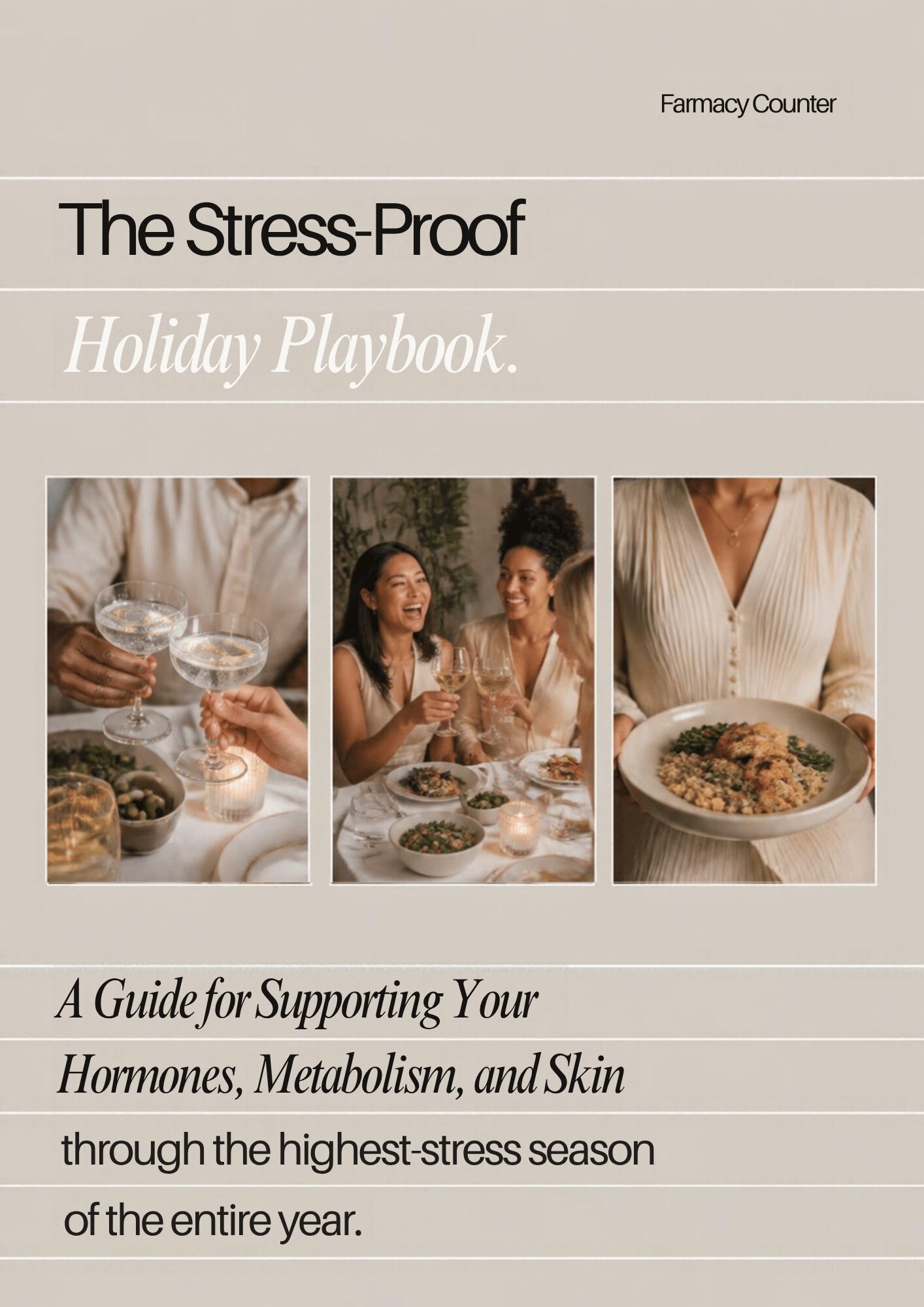
The Stress-Proof Holiday Playbook gives you practical strategies for the whole season, without the restrict-overeat-regret spiral, including a blood sugar decision tree for parties and a weekly check-in to see what’s working.
For some people, the holiday cycle amplifies patterns that are there all year: a metabolic rate already turned down, leptin resistance from years of cycling, or a stress response running high at baseline. A metabolic evaluation looks at the markers the cycle affects most:
| Test | What it reveals |
|---|---|
| Fasting insulin & HOMA-IR | How much insulin resistance has built up, the starting point for any recovery. |
| Complete thyroid panel | Free T3, free T4, reverse T3, and TSH show whether repeated restriction has slowed thyroid hormone conversion, a common and often missed effect of long-term dieting that TSH alone won’t catch. |
| Four-point cortisol | Shows whether your stress response is chronically switched on, which keeps belly-fat storage and metabolic resistance going regardless of what you eat. |
| Leptin | Shows whether leptin resistance has developed, where your brain stops responding to fullness signals even when energy stores are adequate. |
| Sex hormones | Estrogen, progesterone, and testosterone are often suppressed by chronic restriction, and they shape insulin sensitivity, muscle, and cortisol regulation. |
Together, these show what the cycle has actually done, and give you a roadmap to reverse it, through targeted nourishment and a steady eating pattern rather than more restriction.
The restrict-overeat-regret cycle isn’t a character flaw. It’s a physiological trap, set by the idea that holiday eating has to be earned and atoned for, and sprung by your body’s predictable response to that idea.
Breaking it starts with something simpler than any Monday plan: eating enough, consistently, all week, before the meal and after it.
If this has been your pattern for years and you want to understand what it’s done to your metabolism, and how to reverse it, a free discovery call is where we start. If you haven’t yet, grab the free Stress-Proof Holiday Playbook first. And if you’re wondering why you feel so tired after the big meal, here’s the science.
Book a Discovery Call →It usually backfires. A few days of restriction raises your hunger hormone ghrelin and lowers leptin, your fullness signal, so you arrive at the meal primed to overeat. Eating normally in the days before helps your fullness cues work the way they should.
Often because of what came before. Restriction, skipped meals, and short sleep shift your hunger hormones and blood sugar so the meal lands on a body built to maximize intake. It’s physiology, not a lack of willpower.
Sharp restriction raises cortisol and hunger and sets up the next round of overeating. Returning to your normal meals, walking after eating, and prioritizing sleep helps your body reset more effectively.
Guilt and shame raise cortisol, and chronically elevated cortisol is linked with storing more fat around the middle. Dropping the guilt is part of breaking the cycle.
Repeated restriction can slow thyroid hormone conversion, cost muscle, and make your body more efficient at running on less. These changes reverse with consistent, adequate nutrition and strength training over time.
For educational purposes only. Not a diagnosis, and not a substitute for care from your healthcare provider.