
Gratitude isn’t a cure for burnout, and I won’t pretend it is. But practiced at the right time of day, it can help your stress response do what it’s built to do: switch on, then switch back off.
There’s something about this time of year that makes us stop and notice what’s good. The people around the table, the pie, the twinkle lights on the neighbor’s porch that will probably stay up until March.
It’s also one of the busiest seasons of the year. Late nights, travel, a packed calendar, and a to-do list that keeps growing.
Here’s the nice part: a little gratitude can do more than lift your mood. Your stress response is built to switch on when you need it and ease back off when the moment passes. The holidays give it plenty of reasons to switch on. A simple gratitude practice can be one of those small moments that helps it switch off.
Gratitude is a support, not a treatment, and that’s exactly why it’s worth a few minutes.
Below are four easy ways to try it, plus my favorite time of day for each one.

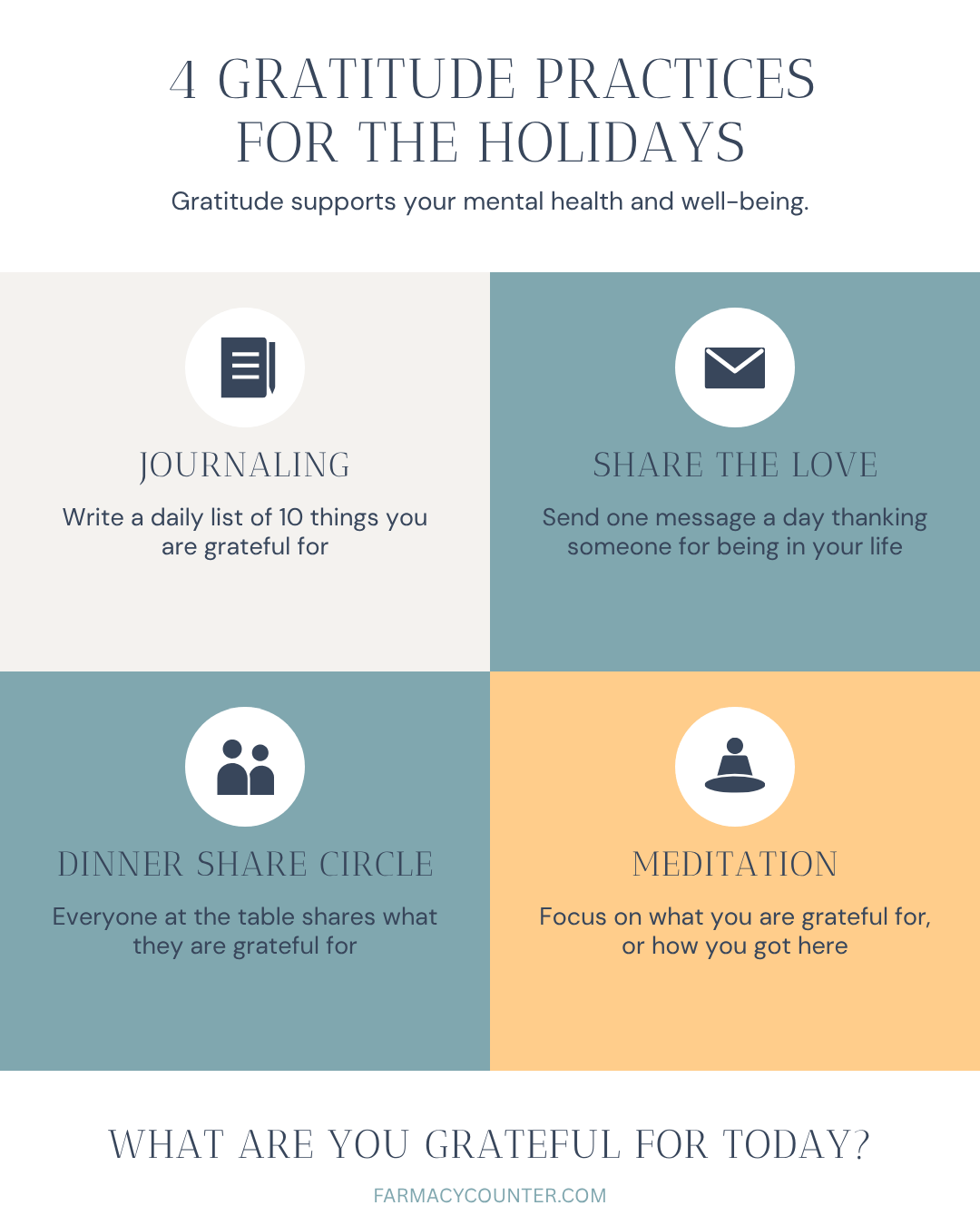
| Practice | How it may help your stress response | Best time of day | Time it takes |
|---|---|---|---|
| Gratitude journaling | Gives a busy mind something calmer to settle on before sleep | Evening | 3 to 5 minutes |
| Share the love | Strengthens connection, one of your best stress buffers | Midday | 2 minutes |
| Dinner share circle | Turns a big meal into a moment of connection instead of a performance | At the table | 5 to 10 minutes |
| Gratitude meditation | Practices downshifting your nervous system on purpose | Morning or early evening | 5 to 10 minutes |
Your cortisol follows a daily rhythm. It rises sharply after you wake, tapers through the afternoon, and should be at its lowest around bedtime so you can sleep. When stress keeps the system switched on, that evening drop is often the first thing to go. You feel tired all day and wired at night.
So where does gratitude fit? Here’s my honest read of the research.
In one of the early studies, people who wrote down things they were grateful for each week reported feeling better about their lives, more optimistic, and fewer physical complaints than people who wrote about hassles.[1] Other work shows that gratitude practices tend to strengthen relationships, and connection matters a lot for how your body handles stress (more on that below).
A large review of 27 studies found that gratitude exercises had only a small effect on symptoms of anxiety and depression, and often weren’t much better than a neutral writing exercise.[2] That’s why I don’t hand someone a gratitude journal and call it a plan for burnout, anxiety, or depression. Those deserve real care.
There isn’t strong research showing that gratitude on its own changes cortisol levels. There is good evidence that stress management practices as a group, like mindfulness, relaxation, and mind-body work, can shift cortisol in a healthier direction.[3] I think of gratitude as one doorway into that kind of practice. It’s often an easier first step than “just relax.”
Gratitude is a support, not a treatment. It works best layered on top of the basics of sleep, light, and steady meals, which I cover in holiday stress and your cortisol rhythm.
Pick the one that sounds most doable this week, not the one that sounds most impressive.
If your mind starts racing the minute your head hits the pillow, this is the one to try. What you think about right before sleep shapes how quickly you fall asleep and how well you sleep. People who tend toward grateful thoughts at bedtime, rather than worried ones, report better sleep.[4]
How I’d do it: Keep a notebook by your bed, not your phone. Write down three specific things from today. “My sister called” works better than “my family.” The graphic says ten, and if ten feels good, go for it. But if ten turns into homework, three you actually mean will do more for you. Some research even suggests a few times a week can feel fresher than every single day.[5] (More on how journaling helps you process stress.)
Send one short message a day thanking someone for being in your life. In one well-known study, writing and delivering a thank-you letter gave people a noticeable lift in happiness that lasted about a month.[6] This one matters for your stress response because connection is one of the strongest buffers your body has. In a lab study, people who had support from a friend before a stressful task had a smaller cortisol spike than people who faced it alone.[7]
How I’d do it: Pair it with something you already do midday, like after lunch. Two sentences is plenty. Specific beats long.
Before or during the big meal, everyone at the table shares one thing they’re grateful for. Holiday meals can carry a lot of tension: old dynamics, hosting pressure, and a schedule that ran late. A shared moment of gratitude shifts the table from performance to connection, if only for a few minutes.
How I’d do it: Keep it light and optional, and go first so others know how simple it can be. Kids are often the best at this. It also slows the pace of the meal, which helps you notice when you’re full. For more on that, read how to enjoy holiday meals without regret.
Sit quietly and focus on what you’re grateful for, or on how you got to where you are. This is practicing a downshift on purpose. Meditation research suggests cortisol benefits show up most in people who are under real stress, the exact people the holidays tend to wear down.[8]
How I’d do it: Five minutes, eyes closed, slow breaths. In the morning, it can take the edge off a wired, anxious start. In the early evening, it can help mark the end of the “on” part of your day. If your nights are where things fall apart, pair it with my evening wind-down routine, or fold it into a 10-minute daily reset.
If gratitude practice makes you feel worse, like you’re failing at being thankful, stop. That’s useful information, not a personal failing. It may mean your system needs more support than a practice can give right now.
Knowing when your stress response runs off-track tells you which practice to reach for, and when. A wired, anxious morning calls for something different than a 10 p.m. second wind or a 3 a.m. wake-up. The Cortisol Rhythm Decoder helps you find your pattern in about five minutes: spiking, flat, running late, or stuck on at night. It also explains why a single morning blood test can’t see it, and which testing actually shows your rhythm.
.
Gratitude pairs well with good care. It never replaces it. A few things I want you to know this season:
If you’d like extra support while you work on your evenings and your stress response, these are the options I trust for supporting relaxation and restful sleep. Check with your pharmacist or provider first, especially if you take something for mood or sleep.
Available through my Fullscript dispensary. Farmacy Counter may earn a commission on purchases.
Gratitude is a good habit. It isn’t the right tool when your body or mind is asking for more. Reach out to your provider if:
Gratitude can help you notice what’s good. It can’t show you what your stress response is actually doing across the day. If you’re tired of guessing, a free discovery call is where we start. We’ll talk through your energy, sleep, and stress, look at any labs you’ve had in context, and map out which testing would actually show your rhythm. If you haven’t yet, grab the free Cortisol Rhythm Decoder first.
Book Your Free Discovery Call →I’m grateful you’re here, and I mean that.
To your health and vitality, Dr. Ryan
There isn’t strong research showing that gratitude on its own lowers cortisol. Stress management practices as a group, like meditation and relaxation, can shift cortisol in a healthier direction. Gratitude can be an easy way into that kind of practice.
It depends on your pattern. Evening journaling can help if your mind races at bedtime. A short morning meditation can help if you wake up wired or anxious. Midday is a natural time for a quick thank-you message.
Three specific things you actually mean usually work better than a long list that feels like homework. Writing a few times a week can feel fresher than every day.
It can help with how you feel day to day and with your relationships, and it gives your nervous system a short break from “on.” It works best alongside steady sleep, morning light, and regular meals.
No. Research shows only a small effect on anxiety and depression symptoms. If you’re struggling, please talk with your provider about care that’s proven to help.
For educational purposes only. Not a diagnosis, and not a substitute for care from your healthcare provider or a licensed mental health professional. Do not start, stop, or change any medication or supplement without talking with your provider or pharmacist.