
Late nights, travel, and a full calendar don’t just make you tired. They shift the daily rhythm that sets your energy, sleep, and mood. Here’s what changes and the small habits that keep you steadier.
The holiday season is here. For a lot of people, that means later nights, a flight or a long drive, more sugar and alcohol than usual, and a calendar with almost no white space left in it.
None of that is bad. Some of it is the best part of the year. But your body keeps time, and every one of those changes nudges the clock.
Cortisol, your main stress-response hormone, doesn’t just rise and fall with stress. It follows a daily rhythm, and that rhythm takes its cues from light, sleep timing, meals, and how much recovery you get between demands. When those cues shift for a weekend, you bounce back. When they shift for six weeks straight, many people start to feel it.
Your body keeps time, and every holiday change nudges the clock.
In practice, I don’t ask anyone to skip the celebrations. I’d rather you enjoy them. What I focus on instead is a short list of anchors, small habits that help your rhythm hold its shape while everything else on the calendar moves around.

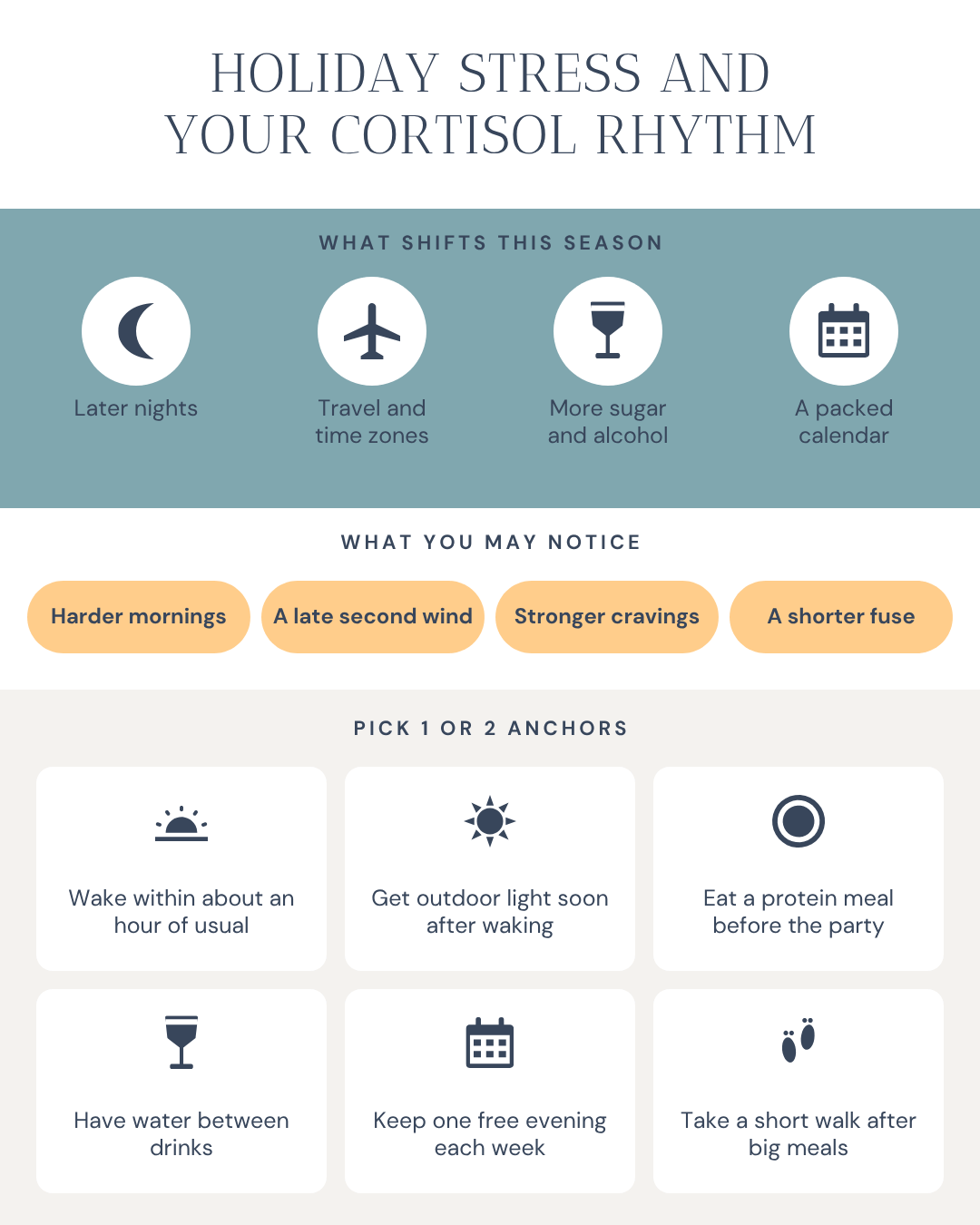
| What shifts | What it can do to your rhythm | An anchor that helps |
|---|---|---|
| Later nights | Pushes your body clock later, so mornings feel harder | Wake within about an hour of your usual time |
| Travel and time zones | Puts your internal clock out of step with local time | Get outdoor light soon after waking |
| More sugar and alcohol | Bigger blood sugar swings and lighter, more broken sleep | Protein first; water between drinks; finish alcohol early |
| A packed calendar | Less recovery between demands, so stress stays switched on | Keep one unscheduled evening each week |
In a healthy pattern, cortisol rises sharply in the first 30 to 45 minutes after you wake, peaks in the morning, tapers through the afternoon, and reaches its lowest point around bedtime so you can sleep. That curve is run by a master clock in your brain that keeps roughly 24-hour time.[1]
That clock doesn’t keep perfect time on its own. It resets every day based on the signals you give it:
This is the strongest cue. Bright morning light tells the clock it’s daytime and helps trigger that morning cortisol rise.[2] Light late at night tells it the day isn’t over yet.
When you fall asleep and, even more, when you wake up.
When you eat, and how steady your blood sugar stays between meals.
Your stress response is built to switch on, then switch off. It needs real downtime between demands to reset. When demands stack up without a break, the system can stay switched on longer than it should.[3]
The holidays change all four cues at once. That’s why the season can feel harder on your body than the to-do list alone would explain.
Staying up late for a party, then sleeping in on the weekend, works like a small time-zone change you take every week. Researchers call this “social jetlag.”[4] Short sleep has its own effect, too. In one classic study, cortisol stayed higher than normal the evening after a night of sleep loss, right when it should be winding down.[5]
Crossing time zones puts your internal clock out of step with the clock on the wall. Your body adjusts, but slowly, and often by only about an hour a day.[6] Even a long drive with a 4 a.m. start can shift things for a few days.
Holiday food tends to come in long stretches of grazing, then big meals later in the day. That pattern means bigger blood sugar swings, and your body uses cortisol to help steady blood sugar when it dips. If you’ve ever felt wiped out on the couch after a big plate, it’s not just the turkey. Alcohol can make it easier to fall asleep, but it tends to fragment sleep in the second half of the night.[7] That’s often when the 2 or 3 a.m. wake-up happens. If one glass lately feels like three, I wrote about why alcohol hits harder after 40.
Work deadlines, shopping, hosting, travel logistics, and family dynamics all draw on the same stress-response system. The problem usually isn’t one big event. It’s the lack of an off-switch between them.
When these cues shift for weeks at a time, the most common things I hear are:
For some people the season shows up in other ways. Women in perimenopause often find holiday anxiety feels different. Men often notice it first as lower energy and drive. And if your hair starts shedding a few months after a hard stretch, read why your hair may be shedding.
They don’t all mean the same thing. They point to different rhythm patterns, and each one calls for a different approach. The Cortisol Rhythm Decoder helps you find yours in about five minutes. It walks you through four patterns: spiking, flat, running late, or stuck on at night. It also explains why a single morning blood test can’t see them, and which testing actually shows your rhythm.
You don’t need all six. Pick one or two that fit your plans this season. Small habits you can repeat tend to carry further than an all-or-nothing plan you drop by December 10th.
Even after a late night. Sleeping in feels like recovery, but a big swing in wake time shifts your whole clock later, which makes the next morning harder. If you’re short on sleep, a short early-afternoon nap is usually gentler on your rhythm than a long lie-in.
Ten to twenty minutes outside, even on a cloudy Ohio morning, gives your clock a much stronger signal than indoor lighting. This matters most after travel. Morning light at your destination is one of the best tools for helping your clock catch up to local time.[6]
Showing up starving is how a plate of cookies becomes dinner. A meal with protein beforehand helps keep blood sugar steadier, so you’re choosing food instead of chasing it. For more on this, see how to enjoy holiday meals without regret.
Water between drinks slows the pace without anyone noticing. Giving yourself a few alcohol-free hours before bed gives your body time to process it, so the second half of the night is less likely to fall apart.[7]
Put it on the calendar like an appointment, because it is one. No hosting, no errands, no “quick” stop. Your stress response needs an off-switch to reset, and an empty evening is one of the simplest ways to give it one. (More in how to stress-proof your holidays.)
It doesn’t have to be long. In a review of seven studies, even two to five minutes of light walking after eating meaningfully lowered post-meal blood sugar compared with sitting.[10] A lap around the block after dinner counts, and it’s a nice way to get a few minutes with the people you came to see.
This is the part of the season I see go sideways most often, and it rarely gets talked about.
If you want support through the season, these are the options I trust for supporting sleep and a calmer stress response. Check with your pharmacist or provider first, especially if you take other medications.
Available through my Fullscript dispensary. Farmacy Counter may earn a commission on purchases.
Most holiday rhythm changes settle within a week or two of getting back to your usual routine. It’s worth looking into if:
See your doctor promptly for loud snoring with gasping or pauses in breathing, chest pain or a racing heart, fainting, or unexplained weight loss.
If the season brings low mood that won’t lift, or thoughts of harming yourself, please reach out to your provider, a mental health professional, or emergency services today.
Symptoms point toward a pattern. Testing shows it. If the season has left you running on empty, or your sleep still hasn’t recovered by January, a free discovery call is where we start. We’ll walk through your energy, sleep, and stress, look at any labs you’ve had in context, and talk through which testing would actually show your rhythm. If you haven’t yet, grab the free Cortisol Rhythm Decoder first.
Book Your Free Discovery Call →Enjoy the season, and pick your one or two anchors.
To your health and vitality, Dr. Ryan
It can. Your cortisol rhythm takes its cues from light, sleep timing, meals, and recovery. Late nights, travel, irregular meals, and a packed schedule shift all of those at once, which is why many people notice harder mornings or a late second wind this time of year.
Late nights and evening light can push your body clock later, so cortisol starts its rise later and stays up longer in the evening. Keeping your wake time steady and getting morning light are two of the simplest ways to pull it back.
Yes. Alcohol can make you drowsy at first, but it tends to break up sleep later in the night. Finishing your last drink a few hours before bed gives your body time to process it.
For most people, a week or two of steady wake times, morning light, and regular meals is enough. If you still feel exhausted, wired at night, or wake at 3 a.m. into January, it’s worth a closer look.
A four-point cortisol test, from saliva or dried urine, measures cortisol at several points across one day. A single morning blood draw only shows one moment, so it can’t show the shape of your rhythm.
For educational purposes only. Not a diagnosis, and not a substitute for care from your healthcare provider. Do not start, stop, or change any medication or supplement without talking with your provider or pharmacist.