
Adrenal Fatigue: How to Actually Fix It (Not Just Manage It)
Adrenal fatigue is real — but most people never get properly tested for it. If you’re exhausted no matter how much you sleep, crashing mid-afternoon, relying on caffeine to function, and feeling overwhelmed by stress that never seems to let up, your adrenal system may be struggling. As a functional medicine practitioner and licensed pharmacist, I’ve worked with hundreds of patients who were told their labs were “normal” while they felt anything but. This guide explains what adrenal fatigue actually is, why standard bloodwork misses it, what the DUTCH adrenal test reveals instead, and the exact steps I use clinically to help patients recover their energy and resilience for good.
What is Adrenal Fatigue?
Adrenal fatigue — more accurately called HPA axis dysfunction — occurs when the communication between your brain and adrenal glands becomes dysregulated after prolonged physical, emotional, or physiological stress. Your adrenal glands sit on top of your kidneys and produce cortisol, your primary stress hormone. Under normal circumstances, cortisol follows a predictable daily rhythm: high in the morning to get you going, gradually tapering through the day, and low at night so you can sleep. When you’re under chronic stress — whether from work, poor sleep, gut dysfunction, blood sugar instability, toxic exposure, or emotional strain — this rhythm breaks down. Cortisol output becomes dysregulated. Some people produce too much (wired and tired). Others produce too little (flat and exhausted all day). Many cycle between both. This is not a disease that shows up on a standard blood panel. It’s a functional pattern — and it requires functional testing to find it.
Common Symptoms of Adrenal Fatigue
Adrenal fatigue rarely looks the same in every person, but the most common patterns I see clinically include:
- Exhaustion that sleep doesn’t fix
- Afternoon energy crashes (typically 2–4pm)
- Difficulty getting up in the morning despite adequate sleep
- Feeling “wired but tired” — exhausted but unable to wind down
- Salt and sugar cravings
- Brain fog and poor concentration
- Anxiety, irritability, or low mood
- Frequent illness or slow recovery
- Low libido
- Sensitivity to light and noise
- Feeling overwhelmed by tasks that used to feel manageable
If several of these resonate, your HPA axis deserves a closer look — not just reassurance that your blood work is “normal.”

Why Standard Bloodwork Misses Adrenal Fatigue
Conventional medicine tests for adrenal disease — specifically Addison’s disease (severe adrenal insufficiency) and Cushing’s syndrome (extreme cortisol excess). These are serious conditions. But they represent the extreme ends of the spectrum. Most people with adrenal fatigue fall in the middle — functioning, but not well. Their cortisol isn’t so low it triggers an Addison’s diagnosis, and not so high it triggers Cushing’s. Standard blood cortisol tests are drawn once, in the morning, and measure only one snapshot of a hormone that changes by the hour. As a pharmacist, I was trained to understand how the body processes and metabolizes hormones — not just whether they’re present. That’s exactly what the DUTCH test measures, and why I use it with every adrenal patient.
The DUTCH Adrenal Test — What It Shows That Blood Tests Don’t
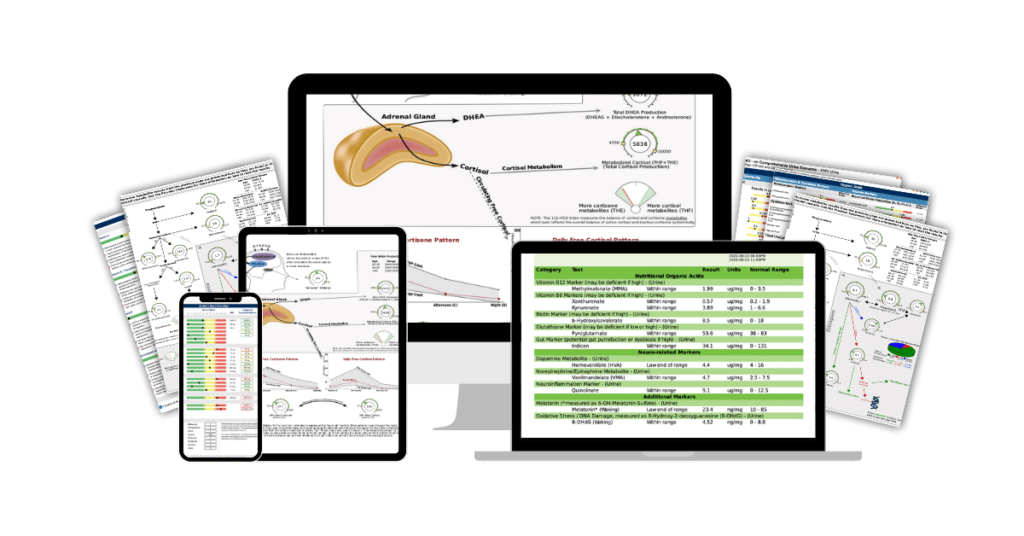
The DUTCH (Dried Urine Test for Comprehensive Hormones) Adrenal Test measures your cortisol pattern across four time points throughout the day — morning, noon, evening, and night — giving a complete picture of your stress hormone rhythm rather than a single snapshot. More importantly, it measures both free cortisol and cortisol metabolites (THF, THE, a-THF, b-THE, b-THF). This distinction matters enormously. You can have normal free cortisol levels but high metabolites — meaning your body is producing plenty of cortisol but breaking it down too quickly. Or low metabolites with normal free cortisol — meaning production is declining but clearance is slow. Standard blood tests cannot see this.
The DUTCH Adrenal Test also measures:
- Cortisol: Morning, Noon, Evening, Night
- Cortisone: Morning, Noon, Evening, Night
- DHEA-S (your resilience and anti-aging hormone)
- Cortisol and cortisone metabolites (total production picture)
This data tells me exactly what your adrenal system is doing — and more importantly, why you feel the way you do. Then we correct what we find. We don’t guess.

Root Causes of Adrenal Fatigue
In functional medicine, we always ask why. Adrenal fatigue is a downstream effect of something upstream. The most common root causes I find in practice:
- Chronic psychological stress — the most obvious driver. Ongoing work pressure, relationship stress, financial strain, or trauma history keep cortisol chronically elevated until the system burns out.
- Poor sleep — cortisol and sleep are deeply intertwined. Disrupted sleep elevates cortisol, and elevated cortisol disrupts sleep. This cycle is one of the most common patterns I see.
- Blood sugar dysregulation— every blood sugar crash triggers a cortisol response. People eating high-sugar, low-protein diets are constantly triggering their adrenal response throughout the day without realizing it.
- Gut dysfunction — leaky gut, dysbiosis, and chronic gut inflammation are physiological stressors that tax the adrenal system just as much as emotional stress.
- Overtraining — excessive high-intensity exercise without adequate recovery is one of the most underrecognized causes of adrenal dysfunction, particularly in driven, health-conscious people.
- Toxin exposure — environmental toxins including mold, heavy metals, and chemical exposures create ongoing physiological stress that depletes adrenal reserves.
- Underlying infections— chronic low-grade infections, including Epstein-Barr reactivation, Lyme, and other stealth pathogens, are significant adrenal stressors that often go undetected.

5 Easy Steps to Overcome Adrenal Fatigue
Once I have DUTCH test results in hand, treatment becomes targeted rather than generic. Here’s the framework I use:
Step 1: Correct what the labs show: Depending on your cortisol pattern and DHEA-S levels, targeted supplementation may include:
- Adaptogens (ashwagandha, rhodiola, holy basil) — help regulate the cortisol response and build stress resilience
- Phosphatidylserine — clinically shown to blunt excessive cortisol responses, particularly useful for high-cortisol patterns
- B vitamins (especially B5 and B6) — essential cofactors for adrenal hormone production
- DHEA or pregnenolone — when labs show these precursor hormones are depleted, targeted supplementation can support adrenal recovery
- Vitamin C and magnesium — foundational adrenal support nutrients
As a pharmacist, I pay particular attention to how these supplements interact with any medications you’re taking — something most wellness coaches aren’t trained to assess.
Step 2: Stabilize blood sugar: Every meal is an opportunity to either stress or support your adrenals. Protein at every meal, reducing refined carbohydrates, and eliminating the blood sugar rollercoaster is often the single fastest way to reduce the daily cortisol burden.
Step 3: Regulate the nervous system: Your adrenals respond to your nervous system. Chronic sympathetic dominance (fight-or-flight mode) keeps cortisol elevated regardless of what supplements you take. Breathwork, vagal tone exercises, strategic rest, and sleep optimization are non-negotiable parts of adrenal recovery.
Step 4: Match exercise to your recovery capacity: This is where the Oura Ring becomes a clinical tool rather than a fitness gadget. Your readiness score reflects your adrenal recovery state each morning. Pushing through low-readiness days is one of the most common ways people with adrenal fatigue sabotage their own recovery. I teach patients to train with their biology, not against it.
Step 5: Address the root cause: If gut dysfunction, chronic infection, toxic exposure, or blood sugar dysregulation are driving the adrenal dysfunction, supplements alone won’t create lasting recovery. Functional medicine means finding and fixing the upstream driver.

How Long Does It Take to Recover from Adrenal Fatigue?
Recovery timelines vary depending on how long the dysfunction has been present and what’s driving it. In my clinical experience:
- Mild adrenal dysregulation with good compliance: 6–12 weeks
- Moderate dysfunction with multiple root causes: 3–6 months
- Severe or long-standing HPA axis dysfunction
- 6–12 months The key is testing first, then correcting what you find.
Patients who come to me having already tried generic adrenal supplements without testing often spend months taking the wrong things for their specific pattern. The DUTCH test eliminates that guesswork entirely.
Ready to Find Out What Your Adrenals Are Actually Doing?
If you’ve been exhausted, overwhelmed, and told your labs are normal, it’s time to test what conventional medicine doesn’t. The Energy & Adrenal Optimization Lab includes the DUTCH Adrenal Test plus my step-by-step mini course. This is the same approach I use with patients in my functional medicine practice — test, don’t guess, then correct what we find with targeted, evidence-based protocols.
👉 Get the Energy & Adrenal Optimization Lab here — (Includes DUTCH test kit, adrenal health mini course, recipe pack, breathing guide, and sleep checklist)

FAQs
You've got questions? We have answers!
The most effective approach is to test first with a DUTCH adrenal test to identify your specific cortisol pattern, then use targeted supplements, nutrition, nervous system regulation, and lifestyle changes based on your results. Generic adrenal protocols without testing often miss the mark because high-cortisol and low-cortisol patterns require opposite interventions.
Mild adrenal dysfunction typically improves in 6–12 weeks with the right protocol. Moderate to severe cases can take 3–12 months depending on root causes and compliance. Testing helps set accurate expectations and track progress.
The DUTCH Adrenal Test is the most comprehensive option available. Unlike a single blood cortisol draw, it measures cortisol patterns across four time points plus cortisol metabolites, giving a complete picture of adrenal function and total cortisol production
Yes. Dysregulated cortisol — particularly chronically elevated cortisol — promotes fat storage especially around the midsection, drives sugar cravings, disrupts thyroid function, and impairs insulin sensitivity. Addressing adrenal dysfunction is often a critical missing piece for people who aren’t losing weight despite diet and exercise.
The term “adrenal fatigue” is not recognized as a formal medical diagnosis, but HPA axis dysfunction is well-documented in research. Functional medicine practitioners use the term to describe a spectrum of adrenal dysregulation that falls below the threshold of Addison’s disease but significantly impacts quality of life. The DUTCH test provides objective data to identify and address this pattern.
The most evidence-supported supplements include adaptogens (ashwagandha, rhodiola), phosphatidylserine, B vitamins, DHEA, pregnenolone, magnesium, and vitamin C. However, the right combination depends on your specific cortisol pattern — high cortisol requires different support than low cortisol. Testing before supplementing prevents wasted money and wasted time.