

Most people assume their energy crashes, afternoon slumps, and evening cravings are personality quirks. Or stress. Or getting older. Or not having enough willpower to resist the chocolate at 4pm.
What they don’t know is that their blood sugar has been running on a very specific, very predictable rhythm all day long — and that rhythm is responsible for almost all of it.
Your blood sugar is not random. Once you understand when it rises, when it falls, and what drives it in each direction, a lot of things that have felt personal start to make physiological sense.
Here is what is actually happening inside your body every hour of the day.
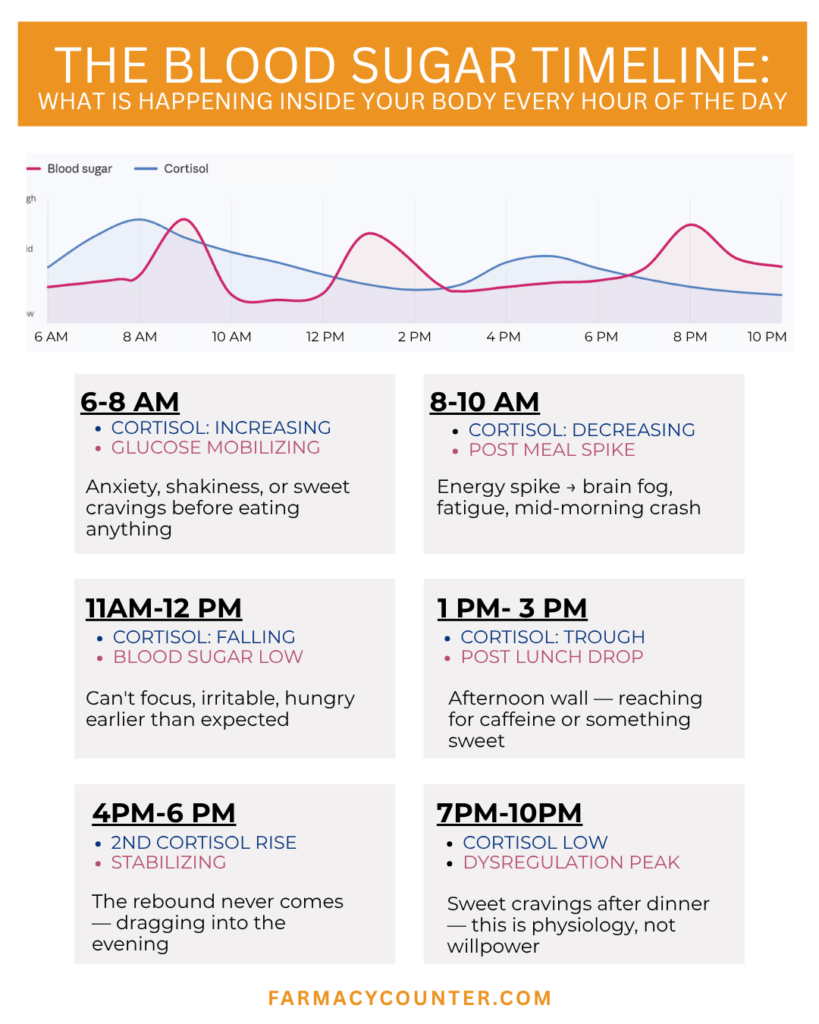
6 to 8am — The Morning Surge
You haven’t eaten a single thing yet, but your blood sugar is already moving.
In the first 30 to 45 minutes after waking, cortisol rises sharply as part of what’s called the cortisol awakening response. This is designed to mobilize glucose from the liver — essentially, your body’s way of fueling you up for the day before breakfast arrives.
In a well-regulated system, this is smooth and unremarkable. You wake up, feel alert, and move through your morning without drama.
But in someone with blood sugar dysregulation, this cortisol surge can drive a significant glucose release — enough to spike blood sugar and then drop it before you’ve made it to the kitchen. That drop triggers a stress hormone cascade, and by the time you’re standing at the coffee maker, you’re already anxious, shaky, or craving something sweet — not because you’re hungry, but because your body just ran a blood sugar event while you were still in bed.
If you wake up feeling immediately hungry, anxious, or desperate for caffeine before breakfast — this mechanism is worth understanding.

8 to 10am — The Breakfast Window
If you eat breakfast, blood sugar rises. How fast, how high, and how sharply it falls afterward depends on three things: what you ate, in what order you ate it, and how sensitive your cells currently are to insulin.
A carbohydrate-only breakfast — oatmeal, toast, a smoothie with fruit and no protein — delivers glucose into a bloodstream that has already been primed by the morning cortisol surge. In a stressed, insulin-resistant body, this combination can produce a significant spike followed by a hard crash before 10am.
The spike itself often produces a brief window of energy and focus. The crash is where the trouble begins.

11am to 12pm — The Pre-Lunch Wall
If breakfast caused a sharp rise and fall, the late morning is typically when the consequences show up.
Focus disappears. Irritability spikes. You start thinking about food earlier than you expected and feel slightly frantic about it even though lunch is only an hour away. The brain — which is the most glucose-dependent organ in the body — has started running low on fuel, and it’s communicating that urgency through mood, cognitive performance, and hunger signals.
Most people blame their concentration problems on lack of sleep, stress, or distraction. The blood sugar piece is almost never part of the conversation.

1 to 3pm — The Afternoon Crash
This is the window most people are familiar with — the post-lunch dip that sends half the workforce to the coffee machine.
Blood sugar rises from lunch, insulin responds to clear the glucose, and blood sugar drops. That drop coincides with a natural circadian cortisol trough in the early afternoon — a point in the day when cortisol is at its lowest, providing less of the blood sugar stabilization it offers in the morning.
The combination of a post-meal insulin response and a low-cortisol window is why most people hit a wall somewhere between 1pm and 3pm and reach for caffeine or something sweet to get through it.
This is not a personal failing. It is a predictable physiological pattern. And it has a pattern underneath it that can be addressed.

4 to 6pm — The Rebound That Often Doesn’t Come
In a regulated system, a second cortisol rise in the late afternoon helps stabilize blood sugar heading into the evening. This is what’s supposed to provide a natural energy lift that carries you through dinner and the first part of the night.
But when cortisol is dysregulated — which is extremely common in people living with chronic stress, poor sleep, or HPA axis dysfunction — this second rise is blunted. The late-afternoon energy recovery never arrives. You drag through the 4 to 6pm window feeling flat, relying on caffeine you already know will disrupt your sleep, counting down to when you can stop for the day.

7 to 10pm — The Evening Craving Window
If blood sugar has been running unstable all day — spiking, crashing, spiking again — the evening hours are when the body most reliably seeks fast fuel to stabilize before sleep.
The craving for something sweet after dinner, the pull toward crackers or chips or chocolate at 9pm even though you ate a full meal two hours ago — these are not emotional eating problems. They are the downstream result of a blood sugar pattern that has been dysregulated since morning.
A body that has been running on cortisol-driven glucose swings all day is running low on stable fuel by evening. It reaches for the fastest available source. Every night. On schedule. Not because of a lack of discipline but because of biology doing exactly what it was designed to do.
What This Actually Means
The 3pm crash, the 9pm cravings, the waking at 2am, the anxiety before breakfast — these are not separate problems. In most cases they are one pattern expressing itself at different points throughout the day.
And that pattern has a root cause.
Understanding when your symptoms show up is the first step to understanding why. Once you can see the rhythm, you can start to ask the right questions — not just “how do I stop craving sugar at night” but “what happened earlier in the day that created this?”
That is what functional investigation looks like. Not more discipline. More information.
If you recognized yourself in more than one of these time blocks, your cravings and energy crashes are telling you something specific. The Cravings Root Cause Quiz identifies whether your pattern is metabolic, hormonal, or stress-driven — and explains the physiology behind what your body has been trying to communicate.
Get the free Cravings Root Cause Quiz here.