

When a symptom shows up, most people ask the same question: what caused this?
It’s the natural question. You ate the thing, or you had the stressful week, or you didn’t sleep, and now you’re bloated, foggy, achy, or breaking out. So you point at the most recent event and call it the cause.
But that question sends you looking in the wrong place. The more useful question is: what pushed you over your threshold?
Because the trigger you’re blaming almost never acted alone.
Inflammation isn’t a switch. It’s a line.
Most people think of inflammation as binary — inflamed or fine, on or off. That’s not how it works in a real body.
Every person has an inflammation threshold: a personal line that represents how much total load your system can carry before symptoms appear. Below that line, inflammation is doing exactly what it’s supposed to do. A scrape heals. An infection resolves. A stressful week passes and you return to baseline. You don’t feel any of it, because your system is managing the load within its capacity.
Cross the line, and symptoms appear.
What changes at that moment isn’t the nature of the inflammation. It’s whether the total load exceeds your system’s ability to resolve it.
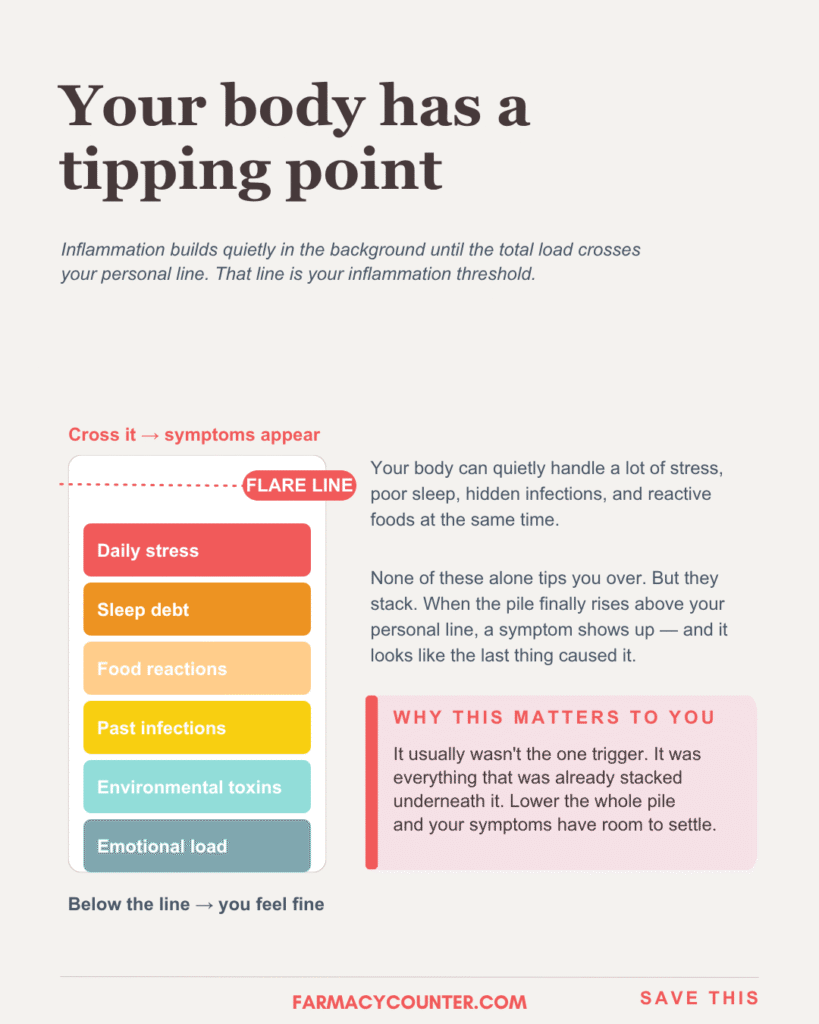
Your threshold isn’t fixed, and it isn’t the same as anyone else’s
This is why the same lunch does nothing to you on a Tuesday and wrecks you by Friday. The food didn’t change. Your available buffer did.
Where your personal line sits is shaped by a combination of things, most of which have nothing to do with what you ate today:
- Genetics
- Stress history
- Gut integrity
- Sleep quality
- Nutrient status
- Infection history
- The cumulative burden of everything your immune system has already been managing quietly in the background
None of these show up on a standard lab panel as “the problem.” But together, they determine how much room you have before the next input tips you over.

The inputs that push you toward the line are rarely dramatic
This is the part that trips people up. They’re looking for one big, obvious cause, and it’s usually not there. Instead, it’s a slow accumulation of ordinary things:
- Poor sleep for a month
- A stressful job transition
- A gut infection that resolved but left dysbiosis behind
- A food that creates a low-level immune response every time you eat it
- An emotional loss that kept cortisol elevated longer than a typical acute stressor would
Each one of these, on its own, sits well below your threshold. You could absorb any single item on that list without noticing. The problem is that they don’t arrive one at a time. They stack.
Why the “last trigger” gets blamed for years of buildup
When you finally cross your threshold, the symptom that shows up looks like it was caused by whatever just happened. The glass of wine. The bad night of sleep. The stressful meeting.
But that’s almost never the real story. The real story is the load that had already been accumulating for months, sometimes years, before that one ordinary input happened to be the thing that tipped the scale.
This is also why standard bloodwork so often comes back “normal” even when you feel clearly inflamed. Markers like CRP are built to catch significant, late-stage, whole-body inflammation. They’re not built to catch the slow, sub-threshold buildup that’s been quietly eating your buffer long before it ever crosses into “abnormal” on a lab report. A normal result doesn’t mean nothing is happening. It often just means you haven’t gotten sick enough yet to trip the alarm that test was designed for.

What this means for recovery
If the trigger isn’t really the cause, then removing the trigger isn’t really the fix.
This is where most generic approaches fall short. Cut the wine. Cut the dairy. Add a supplement. Try harder. That treats inflammation like an input problem — as if there’s one lever to pull. But once your buffer is genuinely depleted, it’s not an input problem anymore. It’s a capacity problem, and you cannot supplement your way out of a capacity deficit.
Recovery isn’t about eliminating the last thing that seemed to set you off. It’s about reducing your total load far enough below your threshold that your system has room to actually resolve inflammation, instead of just suppressing it and waiting for the next thing to tip you over again.
That’s also why the same protocol can work beautifully for one person and do almost nothing for another. It depends entirely on how much room each person already has — and where their particular load is coming from.
Where to start
You can’t lower a load you can’t see. The first step isn’t another elimination diet or another supplement stack. It’s figuring out where your personal line actually sits right now, and what’s sitting closest to it.
That’s the whole purpose of the Inflammation Threshold Test — a short, self-scored assessment that maps how much buffer you currently have and what’s most likely eating into it.
Take the Inflammation Threshold Test below.