

Most people think of stress as something that comes and goes. You have a hard week, you feel it, then things settle and you assume your body settles back with it.
That’s not quite how it works.
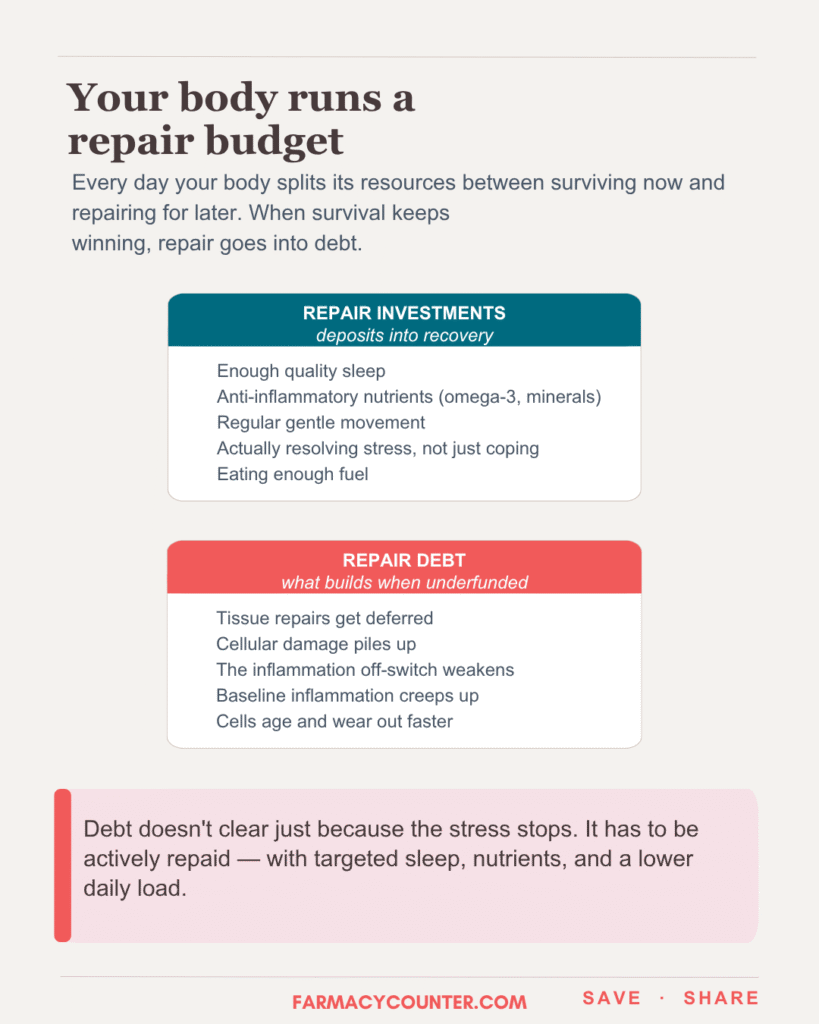
Your body runs something closer to an economy. Every day, it allocates biological resources between two competing priorities: handling whatever’s happening right now, and repairing and maintaining everything underneath it. When today’s demands are manageable, your body invests in repair. When today’s demands are overwhelming, it pulls resources away from repair and puts them toward survival instead.
That shift isn’t a malfunction. It’s your body correctly prioritizing the threat in front of it. The problem isn’t the shift itself. The problem is what happens when that shift becomes the norm instead of the exception.
What repair actually buys you
When your system has enough bandwidth, it’s quietly running a maintenance program in the background, most of which you never notice:
- Clearing out damaged cells before they cause problems
- Resolving low-grade inflammatory signals before they become chronic
- Restoring tissue integrity
- Regenerating the lining of your gut
- Consolidating immune memory while you sleep
This is what “recovering” actually looks like at a cellular level. It’s not just feeling less tired. It’s your body spending resources to undo the wear from the day before, so tomorrow starts from a clean baseline instead of a depleted one.
What pulls the budget away from repair
Repair gets deprioritized whenever your body decides survival needs the resources more urgently. That reallocation gets triggered by things like:
- Chronic stress
- Sleep deprivation
- Caloric restriction
- Infection
- Environmental toxin burden
- Emotional crisis
Any one of these, for a short stretch, is completely normal. Your body is built to survive a hard week, a rough illness, a stretch of bad sleep. It pulls resources from repair, gets you through it, and pays the budget back once things settle.
The problem is when the underfunding isn’t occasional. It’s chronic — stretched across months or years instead of days. That’s when you stop simply “recovering later” and start accumulating something closer to debt.

How the debt builds without you noticing
This is the part that makes repair debt so easy to miss. It doesn’t announce itself. It accumulates quietly, one underfunded system at a time.
Cellular cleanup slows down. Your cells have built-in systems (autophagy, proteasome function) that clear out damaged components before they cause dysfunction. Those systems require resources to run. When repair is underfunded, cleanup slows, and damaged cellular material starts to pile up instead of getting cleared.
Your gut lining stops keeping up. The cells lining your intestines turn over every 3 to 5 days. That’s an enormous, constant regeneration project, and it requires a steady supply of resources to keep pace. When repair funding drops, that turnover falls behind, and gut barrier integrity starts to degrade.
Mitochondrial damage outpaces repair. Your cells’ antioxidant defenses are supposed to keep up with the oxidative stress your mitochondria generate as a normal byproduct of making energy. When repair is underfunded, those defenses get outpaced, and oxidative damage accumulates faster than it gets cleared.
Old, damaged cells stop getting cleared out. Senescent cells (cells that have stopped functioning properly but haven’t died off) are supposed to get cleared by your immune system on an ongoing basis. That clearance requires resources too, and it’s one of the first things to get deprioritized when your body is in survival mode.
Your baseline creeps upward. All of this accumulated, unresolved damage sends a steady stream of pro-inflammatory signals. Over time, that standing signal becomes the new normal your immune system calibrates against, gradually raising the baseline level of inflammation your body considers “resting.”
None of these show up as a single dramatic symptom. They show up as a slow drift: slightly worse recovery, slightly more inflammation, slightly less resilience than you used to have, all building in the background while everything still technically looks fine.

Why removing the stressor isn’t enough
This is the piece that trips people up. Once things calm down, the reasonable assumption is that the debt should just clear on its own. Stop the stressor, and repair should catch back up.
It doesn’t work that way. Debt has to be actively repaid, not just stopped from growing. Your cellular cleanup systems, your gut regeneration, your antioxidant defenses, your immune clearance mechanisms, all need to be actively refunded before they can catch back up to where they were.
That repayment generally requires:
- Targeted nutrient support for the specific systems that were underfunded
- Actual sleep restoration, not just “less bad” sleep
- A reduction in ongoing inflammatory load, so incoming demand drops enough for repair to get ahead of it
- Deliberately rebuilding the cellular maintenance systems that were shortchanged, rather than assuming they’ll rebuild themselves
Removing the stressor stops the debt from growing. It doesn’t pay off what’s already accrued.
Where to start
You can’t repay a debt you haven’t measured. If you’ve been running on survival mode for a while and you’re not sure how much repair capacity you actually have left, that’s exactly what the Inflammation Threshold Test is built to map.
It’s a free, 9-question self-assessment that looks at your reaction patterns, your recovery speed, and what’s currently sitting on your plate, stress, sleep, gut issues, and more, to show you how much buffer you actually have left before the next flare.
Take the Inflammation Threshold Test →