
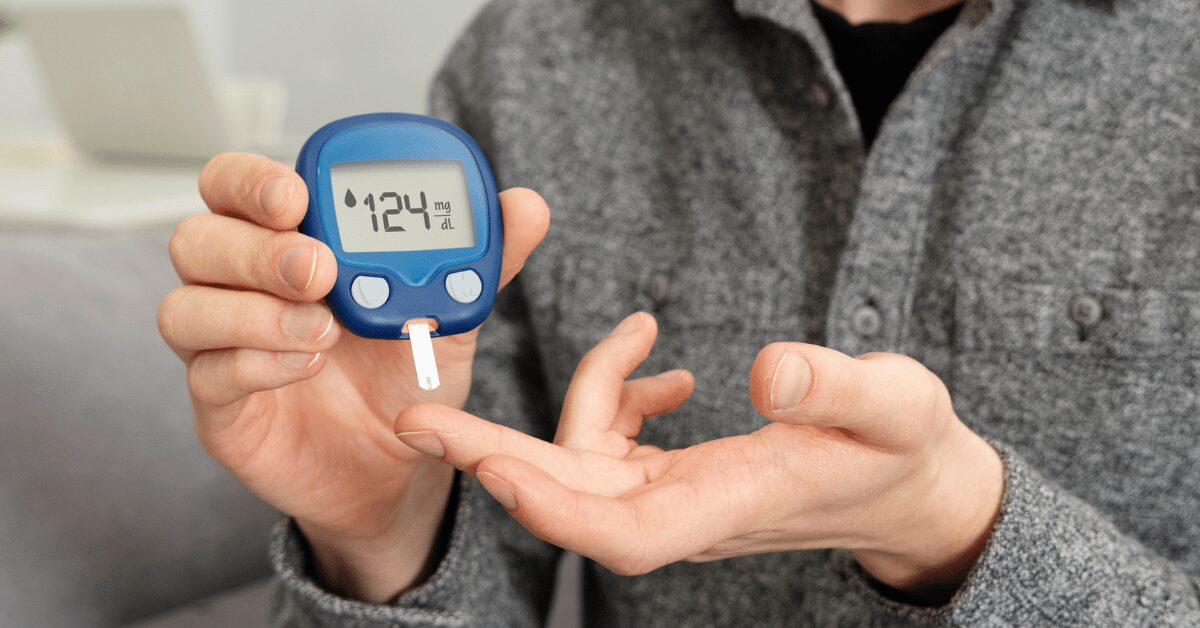
If you’ve read anything about insulin resistance, you’ve probably encountered one of two versions of the story.
Version one: it’s a diabetes precursor. Something to worry about later, when your fasting glucose starts climbing. Version two: it’s caused by eating too much sugar and not exercising enough. Fix the diet, fix the problem.
Both versions are incomplete. And the incompleteness is why so many people spend years with recognizable, specific symptoms — fatigue after meals, cravings that run on schedule, weight that won’t move, brain fog at predictable times — while their labs show nothing and their doctors tell them they’re fine.
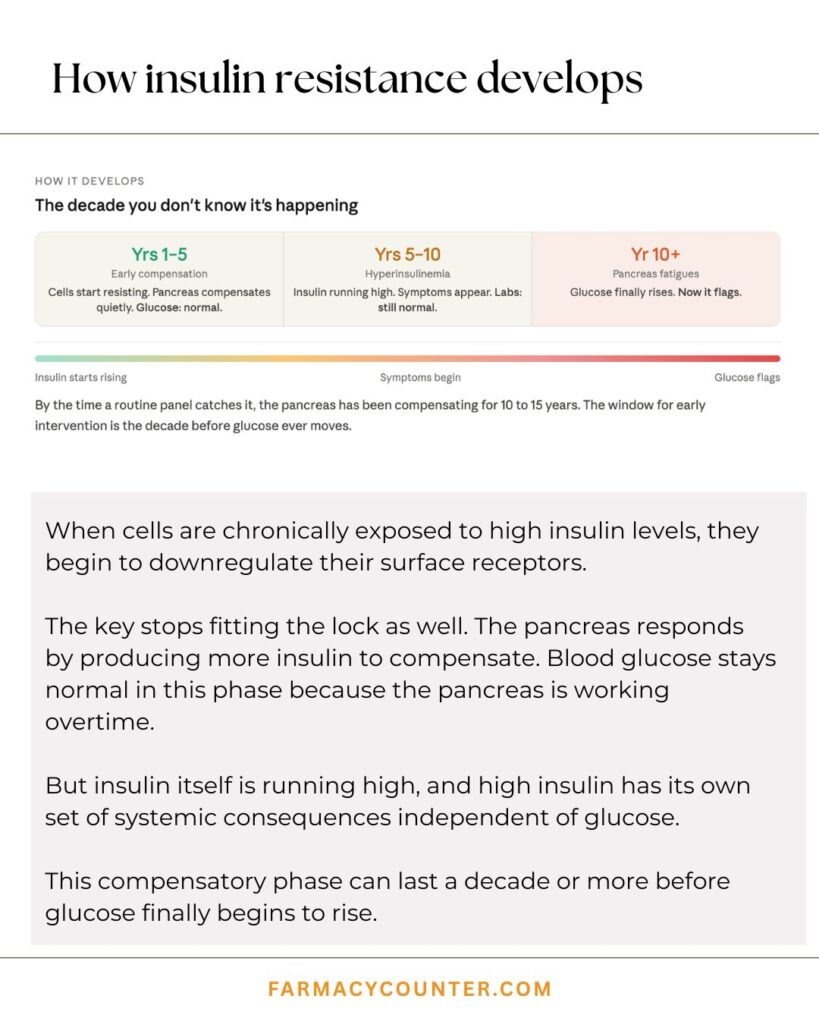
The full story of how insulin resistance develops is a staged progression that unfolds over a decade or more. Each stage has a distinct biological picture. Each stage produces different symptoms. And crucially, each stage has a different window of intervention — with the earliest stages being the most reversible and the most commonly missed.
Here is what actually happens, stage by stage.
Why Most Doctors Miss It Until It’s Advanced
Before getting into the stages, it’s worth understanding the central problem with how insulin resistance is conventionally monitored.
Standard blood sugar panels measure two things: fasting glucose and HbA1c. Fasting glucose tells you where your blood sugar sits after an 8 to 12 hour fast — your metabolic system at complete rest, under the most favorable conditions possible. HbA1c gives you a 90-day average.
Neither test measures insulin.
This is the critical gap. Insulin resistance develops through a compensatory process — as cells become less responsive to insulin, the pancreas produces more of it to maintain normal blood sugar. For years, sometimes a decade or more, this compensation keeps fasting glucose and HbA1c looking completely normal.
By the time those markers start moving, the process has already been underway for a very long time.
The test that catches insulin resistance early is fasting insulin — ordered alongside fasting glucose and used to calculate HOMA-IR, a simple ratio of the two numbers. Most standard panels never include it. Most people never know their fasting insulin level. And so the early stages pass completely undetected.
Stage 1 — Insulin Spikes. Labs Look Perfect.
The first stage of insulin resistance is almost never caught because every conventional lab marker is entirely normal.
Here’s what’s happening underneath.
After eating — particularly a carbohydrate-heavy meal — blood sugar rises. In a healthy system, the pancreas releases a proportionate insulin response that efficiently clears the glucose. In Stage 1 insulin resistance, the pancreas is already having to work harder than it should. Insulin spikes higher and stays elevated longer than the meal actually warrants, because cells are beginning to require more insulin to produce the same glucose uptake.
Fasting values, however, remain normal. The compensation is still working. A fasting blood draw taken the morning after looks completely unremarkable.
Meanwhile, the metabolic consequences of repeated postprandial insulin surges are already underway. Excess glucose that cells aren’t absorbing efficiently gets converted to fat — including intramuscular fat and early liver fat. Oxidative stress begins to accumulate at the cellular level.
Most people in Stage 1 notice nothing particularly alarming. Perhaps a slight energy dip after larger meals. Perhaps a tendency to feel hungry again sooner than expected. Nothing dramatic enough to prompt investigation.
This is actually the highest reversibility window in the entire progression. Dietary change, movement, and stress management alone can fully reverse Stage 1 insulin resistance. But because labs look normal and symptoms are subtle, almost no one is caught here.

Stage 2 — Fasting Insulin Rises. The First Lab That Tells the Truth.
In Stage 2, the compensatory demand on the pancreas becomes large enough that fasting insulin — not just post-meal insulin — becomes chronically elevated.
This is the first stage that shows up on any lab test, but only if fasting insulin is ordered. Fasting glucose is still normal. HbA1c is still normal. The standard panel still says fine.
If someone runs fasting insulin alongside fasting glucose and calculates HOMA-IR, Stage 2 becomes visible. HOMA-IR above 1.5 to 2.5 indicates early insulin resistance. Fasting insulin between 15 and 25 μIU/mL places someone clearly in this stage.
The symptom picture in Stage 2 is significantly more recognizable than Stage 1. Blood sugar instability begins producing real daily experiences.
Hypoglycemic episodes start occurring — blood sugar crashes between meals that feel like shakiness, irritability, difficulty concentrating, and urgent cravings for fast carbohydrates. The spike-crash-craving cycle that so many people recognize as their normal daily rhythm is the Stage 2 experience. Worsening dietary choices driven by blood sugar instability make the underlying pattern worse. Triglycerides start climbing as the liver processes the excess glucose load into fat. Free fatty acids increase. Early beta cell dysfunction begins — the pancreatic cells that produce insulin are starting to show the strain of years of overproduction.
There is also an important gut connection at Stage 2 that is almost never discussed. Intestinal permeability begins to increase as chronic insulin elevation and metabolic stress affect the integrity of the gut lining. This enhanced permeability means the gut itself starts contributing to insulin resistance through inflammatory signaling — creating a feedback loop that makes the metabolic picture harder to resolve with diet alone.
One clinical note that matters: at Stage 2, when fasting insulin is already elevated, it is critical not to add supplements that increase insulin secretion — gymnema, fenugreek, and vanadium all drive more insulin output, which worsens the cycle when insulin is already high. This is one of the most common supplement mistakes people make when trying to address blood sugar without knowing their actual stage.
Stage 2 is fully addressable with active intervention. Blood Sugar Breakthrough territory. Paleo dietary template, targeted supplements that improve insulin sensitivity rather than insulin secretion, movement, and stress management can reverse this stage within 3 to 6 months with consistent application.

Stage 3 — Fasting Glucose Rises. Conventional Medicine Finally Notices.
Stage 3 is where conventional medicine begins to pay attention — which means it’s also the stage where most people are finally told they have a blood sugar problem, despite the fact that the problem has been developing for years.
In Stage 3, the pancreatic compensation has become insufficient. The pancreas has been overproducing insulin for so long that beta cell function begins to decline meaningfully. Insulin output can no longer fully compensate for the cellular resistance, and fasting glucose starts climbing. HbA1c rises above 5.4%.
The metabolic picture at Stage 3 is significantly more complex than the earlier stages. Triglycerides are considerably elevated. Central visceral adiposity has increased — the abdominal fat accumulation that is both a consequence of chronic hyperinsulinemia and a contributor to ongoing insulin resistance. Intramuscular fat has increased, reducing the metabolic capacity of skeletal muscle. Fatty liver is more established. Oxidative damage is accelerating. Liver enzymes may begin rising. Hypertension often appears at this stage as the vascular consequences of chronic metabolic stress become measurable.
Paradoxically, fasting insulin may actually start declining at Stage 3 — not because insulin resistance is improving, but because the pancreas is becoming exhausted. This is clinically significant because it can make the picture look deceptively better on a single marker while the actual metabolic dysfunction is worsening.
Reversal is still possible at Stage 3 but requires more comprehensive intervention and a longer timeline — a minimum of 6 months of sustained, dramatic change rather than the incremental adjustments that work at earlier stages. The supplement protocol shifts: berberine becomes most effective at this stage because it works through AMPK activation — a completely different mechanism from insulin secretion — to reduce hepatic glucose production and improve cellular insulin sensitivity.

Stage 4 — Systemic Dysfunction. Reversal Requires Major Sustained Effort.
Stage 4 is where insulin resistance has transitioned into what conventional medicine calls metabolic syndrome, and where the downstream consequences extend well beyond blood sugar.
Pancreatic insufficiency is now significant. Beta cell function has declined substantially. The liver has accumulated meaningful fat. Visceral adiposity is considerable. Oxidative damage has been accumulating for years. Gut imbalances are almost universally present at this stage, with dysbiosis contributing to ongoing inflammatory signaling that perpetuates insulin resistance.
The downstream risk at Stage 4 extends to cardiovascular disease, certain cancers, Alzheimer’s disease — now increasingly referred to as Type 3 diabetes in the research literature — and kidney disease. These aren’t hypothetical future risks. They’re the consequences of a metabolic environment that has been dysregulated for a decade or more.
Stage 4 reversal is still possible but requires physician coordination alongside the functional medicine protocol. The timeline is 6 months minimum, with maintenance at approximately 80% adherence ongoing thereafter. Pharmaceutical support may be appropriate as part of a comprehensive plan — not as a substitute for the metabolic work, but as a bridge while the root cause intervention takes effect.
Where Most People Actually Are — and What That Means
The clinical reality is that the vast majority of people experiencing recognizable blood sugar symptoms — daily energy crashes, predictable cravings, weight resistance, brain fog, mood shifts around meals, disrupted sleep — are in Stage 2 or early Stage 3.
They have been there for years. Their labs have been coming back normal the entire time. And because neither the symptoms nor the labs have prompted the right investigation, the process has continued progressing without intervention.
This is not a failure of the individual. It’s a failure of the testing protocol. When the test that detects this problem early — fasting insulin — isn’t being ordered, the problem doesn’t get detected early. That’s not complexity. That’s a gap in the standard of care.
The functional medicine approach is to catch this at Stage 1 or Stage 2 — when the intervention required is the least intensive and the reversibility is the highest. That means ordering fasting insulin. Calculating HOMA-IR. Looking at the triglyceride-to-HDL ratio. Running a complete picture rather than two markers and a checkbox.
Understanding which stage you’re at changes everything about what intervention makes sense — which dietary approach, which movement protocol, which supplements are appropriate and which are contraindicated. Generic blood sugar advice is generic precisely because it doesn’t account for where in the progression a person actually is.
The stage determines the strategy. And knowing your stage requires asking the right questions — which almost never happens unless you ask for them.
If you recognized your symptom pattern somewhere in these stages, the Cravings Root Cause Quiz is a good first step toward understanding which type of blood sugar pattern is driving your daily experience.
Ready to go deeper? The Blood Sugar Rhythm masterclass walks through the full pattern behind your energy, cravings, and mood — and what to do about it.