

If you’ve supplemented with 5-HTP and felt nothing. If GABA supplements never touched your anxiety. If you’ve been on an SSRI that helped a little and then plateaued—there’s a question almost nobody asks, and it’s the question that actually matters:
Are the raw materials even there to build the neurotransmitter in the first place?
Your neurotransmitters are not made from nothing. They are built, step by step, from dietary amino acids and nutrient cofactors—and when any one of those inputs is missing, the production line slows or stops at that exact step. This is why deficiency-driven anxiety and depression often don’t respond to reuptake inhibitors. The problem isn’t how quickly serotonin is being cleared. The problem is how little is being produced in the first place. You can’t reuptake what was never made.
Here’s what the actual assembly lines look like, and where they tend to break.
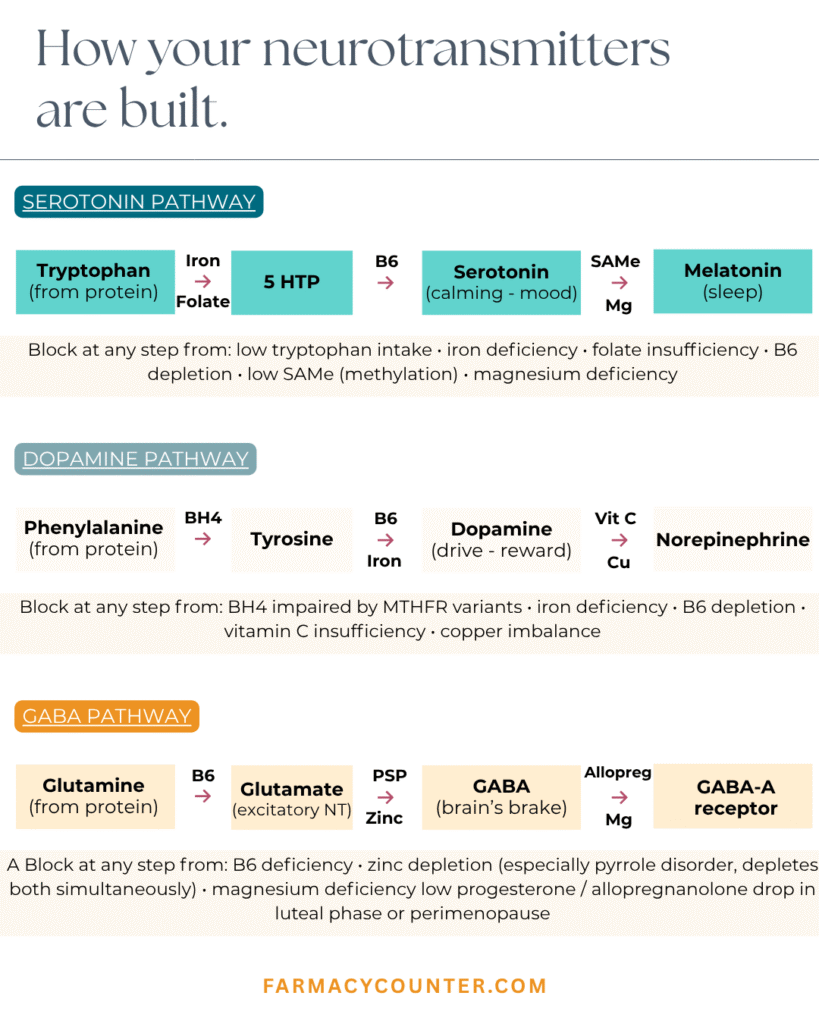
The Serotonin Pathway
Serotonin doesn’t start as serotonin. It starts as tryptophan, an amino acid from dietary protein, and travels through a multi-step conversion before it becomes the neurotransmitter associated with calm and stable mood—and eventually, melatonin for sleep.
Tryptophan → 5-HTP
The enzyme tryptophan hydroxylase converts tryptophan to 5-HTP. This step requires iron and folate. If either is insufficient, the conversion slows here—before serotonin is even on the table.
5-HTP → Serotonin
The enzyme aromatic amino acid decarboxylase converts 5-HTP to serotonin. This step requires vitamin B6 in its active form. Without adequate B6, 5-HTP accumulates without becoming serotonin—which is part of why supplementing with 5-HTP alone often produces underwhelming results. The precursor is there. The conversion isn’t happening.
Serotonin → Melatonin
Serotonin is methylated and converted to melatonin using SAMe (from the methylation cycle) and magnesium. This is the step that connects serotonin production directly to sleep. If this conversion is impaired, you can have adequate serotonin during the day and still struggle with sleep onset at night.
Where this pathway breaks: Low dietary tryptophan intake, iron deficiency, folate insufficiency, B6 depletion, or low SAMe from impaired methylation can each independently slow or stop this production line at a specific, identifiable point.
The Dopamine Pathway
Dopamine—the neurotransmitter associated with motivation, drive, and reward—follows its own multi-step conversion from a different starting amino acid, and the pathway doesn’t stop at dopamine. It continues on to norepinephrine.
Phenylalanine → Tyrosine → L-DOPA → Dopamine
Phenylalanine converts to tyrosine, then to L-DOPA, then to dopamine. Each of these conversions requires BH4 (biopterin), iron, and vitamin B6. BH4 is particularly significant here because its production is directly impaired by MTHFR variants—the same genetic variants that affect methylation and folate metabolism. This means a single genetic factor can simultaneously affect both the serotonin and dopamine production lines.
Dopamine → Norepinephrine
Dopamine is converted to norepinephrine using vitamin C and copper. Deficiencies in either nutrient leave dopamine produced but not converted forward, which has implications for the alertness and stress-response functions norepinephrine governs.
Where this pathway breaks: BH4 impairment from MTHFR variants, iron deficiency, B6 depletion, vitamin C insufficiency, or copper imbalance can each interrupt this pathway at a specific step—with downstream effects on motivation, focus, and the dopamine-norepinephrine balance that affects energy and stress response.
The GABA Pathway
GABA is the brain’s primary calming neurotransmitter—often described as the brain’s brake. Without adequate GABA production, the nervous system has a harder time downshifting out of activation, which shows up clinically as anxiety, racing thoughts, and difficulty settling.
Glutamine → Glutamate
Glutamine, from dietary protein, converts to glutamate—itself an excitatory neurotransmitter. This step requires vitamin B6.
Glutamate → GABA
Glutamate is converted to GABA by the enzyme glutamate decarboxylase. This conversion is entirely dependent on vitamin B6 in its active form, pyridoxal-5-phosphate (PSP), and zinc is a required cofactor for the enzyme that converts B6 into that active form. This is a critical detail: even if B6 intake looks adequate, zinc depletion can prevent B6 from being converted into the form this pathway actually needs.
GABA → GABA-A Receptor
GABA’s calming effect depends on allopregnanolone and magnesium supporting its action at the GABA-A receptor. Allopregnanolone is a progesterone metabolite, which means this final step is directly affected by hormonal status—particularly the progesterone drop that occurs in the luteal phase or at perimenopause.
Where this pathway breaks: B6 deficiency, zinc depletion (especially significant in pyrrole disorder, which depletes both B6 and zinc simultaneously), magnesium deficiency, or a drop in progesterone-derived allopregnanolone during the luteal phase or perimenopause can each block this pathway at a different point—each with a distinct clinical picture.

Why This Changes How Supplementation Should Work
When someone tells me their anxiety doesn’t respond to GABA supplements, or their depression doesn’t respond to 5-HTP, the first question isn’t whether they need a different supplement. It’s whether the cofactors are in place to support the synthesis pathway the supplement is trying to support.
The raw material without the assembly line does not build anything. Supplementing with 5-HTP when B6 is insufficient leaves 5-HTP without a route to serotonin. Supplementing with GABA when zinc is depleted doesn’t address why the body isn’t producing GABA on its own. In both cases, the supplement is supplying an input to a production line that’s broken somewhere else.
This is also why two people with the same symptom—anxiety, low motivation, poor sleep—can need completely different interventions. One person’s GABA pathway might be blocked at the B6-to-PSP conversion due to zinc depletion. Another’s might be blocked at the allopregnanolone step due to a perimenopausal progesterone decline. The symptom looks the same. The biology, and therefore the fix, is different.
What Actually Needs to Be Assessed
Identifying where a pathway is blocked requires looking at the inputs, not just the symptom.
For the serotonin pathway, this means assessing iron status (ferritin, not just hemoglobin), folate and B12 levels, methylation markers including homocysteine and MTHFR status, and magnesium. Organic acids testing can also show whether tryptophan is being metabolized toward serotonin or shunted toward the kynurenine pathway—which happens under inflammatory conditions and represents an entirely separate block on this pathway.
For the dopamine pathway, iron, B6, vitamin C, and copper status all matter, along with MTHFR status given its effect on BH4 availability.
For the GABA pathway, B6 and zinc are central—and in cases of treatment-resistant anxiety, urinary kryptopyrroles testing can identify pyrrole disorder, which depletes both simultaneously and explains a significant subset of anxiety that doesn’t respond to standard interventions. For women, the timing of symptoms relative to the menstrual cycle or the presence of perimenopause points toward the allopregnanolone step specifically.

The Bigger Picture
These three pathways don’t operate in isolation. Methylation affects both the serotonin and dopamine pathways through its role in SAMe and BH4 production. B6 is required at multiple steps across all three pathways, which means B6 depletion—whether from pyrrole disorder, chronic stress, or inadequate intake—has effects that ripple across serotonin, dopamine, and GABA simultaneously. This is part of why addressing foundational nutrient status often produces improvements across multiple symptoms at once, rather than targeting one neurotransmitter in isolation.
This is also why the type of anxiety or mood symptom someone is experiencing often points toward which pathway, and which specific step, is most likely involved—and why identifying that pattern is the starting point for figuring out what your brain actually needs to rebuild its own supply.
Where to Start
If you’ve tried neurotransmitter-targeted supplements without much result, or if you’re dealing with anxiety, low mood, or motivation issues that haven’t responded to what you’ve tried, the question worth asking isn’t which supplement to try next. It’s which pathway is blocked, and at which step.
The Anxiety Pattern Decoder is a free assessment that walks you through the four biological types of anxiety—metabolic, inflammatory, HPA-axis, and hormonal—and helps identify which pattern is most likely driving your symptoms. Each type points toward a different piece of this picture.
Download the free Anxiety Pattern Decoder below.
Your neurotransmitters aren’t broken. In most cases, they’re under-resourced. And under-resourced systems can be identified, investigated, and rebuilt.