

A normal TSH is reassuring. It’s also not an explanation for the nap you needed after unloading the dishwasher.
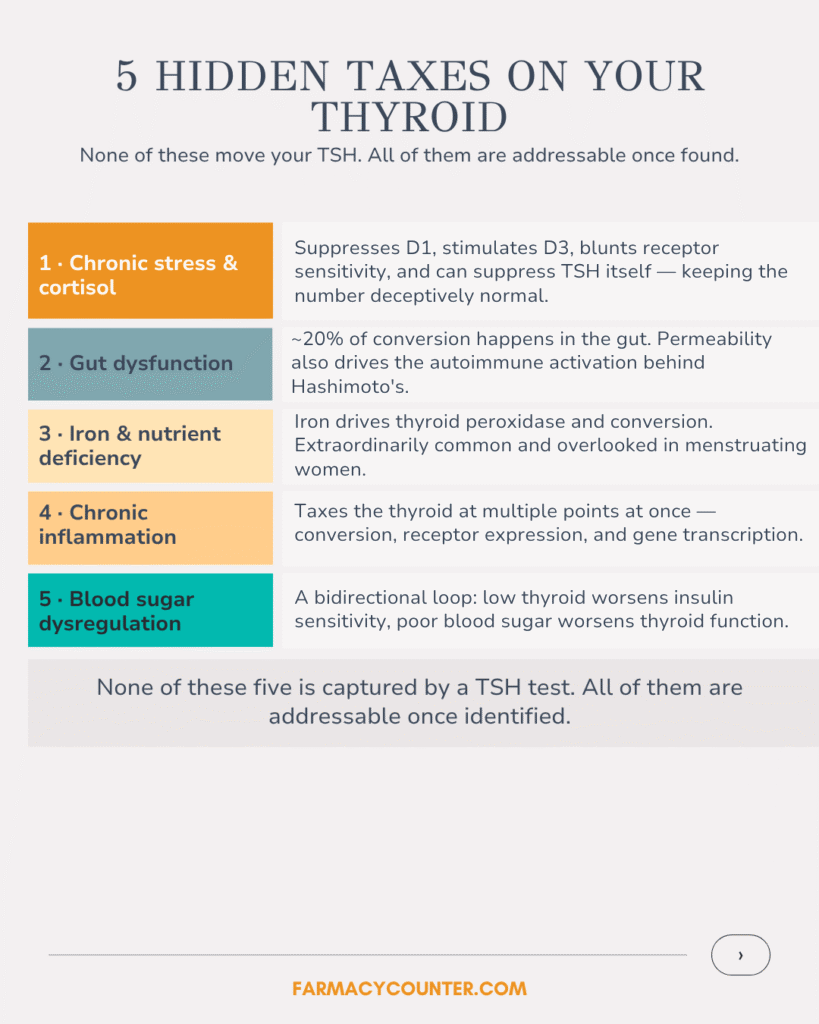
When thyroid-like symptoms keep hanging around despite a clean-looking workup, I’m not looking for one hidden diagnosis to swap in for the one that got ruled out. I’m looking at a set of common contributors that overlap, amplify each other, and sometimes affect how well thyroid treatment itself works. None of these five move your TSH. All of them are addressable once you actually find them.
1. Sleep and Stress Load
Short sleep, sleep apnea, circadian disruption, and sustained stress all affect energy, appetite, cognition, and how the hypothalamic-pituitary-thyroid axis behaves, the very feedback loop that determines what your TSH looks like in the first place.
This is also where a lot of the “deceptively normal” TSH readings come from. Chronic cortisol elevation suppresses the enzyme (D1) responsible for activating conversion, stimulates the enzyme (D3) responsible for producing inactive reverse T3, and blunts receptor sensitivity to the hormone that does arrive (1). In some cases, sustained stress can suppress TSH itself, which means the one number a standard workup relies on can look reassuring precisely because the system upstream of it is under strain.
2. Gut Dysfunction
Roughly 20% of T4-to-T3 conversion happens outside the thyroid gland entirely, in the gut, via bacterial enzymes that activate thyroid hormone as part of its normal recycling process (2). When gut health is compromised, that conversion pathway is compromised along with it.
Gut permeability is also directly implicated in the autoimmune activation behind Hashimoto’s, since a compromised intestinal barrier allows bacterial and dietary proteins to cross into circulation and trigger immune responses that can cross-react with thyroid tissue. Gut dysfunction, in other words, isn’t a separate issue running parallel to thyroid symptoms. It’s frequently upstream of them.
3. Iron and Nutrient Status
Iron deficiency alone can cause fatigue, hair loss, cold intolerance, exercise intolerance, and brain fog, a symptom list nearly indistinguishable from hypothyroidism itself. Iron is also a direct requirement for thyroid peroxidase, the enzyme involved in producing thyroid hormone, and for the deiodinase enzymes responsible for converting T4 into active T3.
This deficiency is extraordinarily common, and extraordinarily overlooked, in menstruating women, often not screened for beyond a basic complete blood count that can look fine even when ferritin is low enough to be symptomatic. B12 and other nutrient deficiencies can add their own overlapping version of the same fatigue-and-fog story, which is part of why nutrient status deserves its own look rather than being assumed adequate just because someone eats reasonably well.
Wondering which of these five is actually driving your symptoms? Download The “Normal Labs, Not Normal Symptoms” Blueprint to see the four places a thyroid problem can hide beyond a single number. Get it here.
4. Chronic Inflammation
Chronic, low-grade inflammation taxes thyroid function at multiple points simultaneously: it impairs T4-to-T3 conversion, it dampens thyroid receptor expression at the cellular level, and it interferes with the gene transcription that thyroid hormone is supposed to trigger once it’s bound to its receptor (3).
This is part of why inflammation from an unrelated source, a food sensitivity, a low-grade infection, ongoing joint or gut inflammation, can produce thyroid-like symptoms even when the thyroid gland itself has nothing structurally wrong with it. The inflammation is taxing the system at several points at once, which makes it easy to miss if you’re only looking for a single cause.
5. Metabolic and Hormonal Factors
Perimenopause, insulin resistance, heavy menstrual bleeding, depression, chronic illness, and under-fueling can each independently contribute to this same symptom cluster, and the relationship between thyroid function and blood sugar in particular runs in both directions. Low thyroid function worsens insulin sensitivity, and poor blood sugar regulation worsens thyroid function, creating a bidirectional loop that can perpetuate itself long after the original trigger has passed (4).
Heavy menstrual bleeding deserves specific mention here because of its direct link to the iron deficiency covered above, and perimenopause deserves it because its symptom overlap with hypothyroidism is significant enough that the two are frequently mistaken for each other, sometimes in both directions.
None of This Moves Your TSH. All of It Is Addressable.
Here’s what ties these five together: not one of them shows up on a standard TSH test, and every one of them is something that can actually be identified and addressed once it’s on the radar. That’s the useful reframe. The goal isn’t to find the one thing that’s “really” wrong. It’s to find the combination of pieces that, together, explains Tuesday afternoon, the shower drain, the cold office, and the jeans that fit differently by lunch than they did in the morning.

What Actually Needs to Be Assessed
When someone’s symptoms don’t match a clean thyroid panel, I’m working through all five of these areas rather than assuming any single one is the answer.
Sleep quality assessment, including screening for sleep apnea when indicated, and a look at cortisol patterns when chronic stress is part of the picture.
Comprehensive stool testing or SIBO breath testing when gut symptoms, bloating, or irregular digestion accompany the thyroid-like symptoms.
Full iron studies including ferritin, not just a basic CBC, along with B12 and other relevant nutrient markers.
Inflammatory markers like high-sensitivity CRP, especially when symptoms suggest a broader inflammatory process rather than an isolated thyroid issue.
Fasting insulin and HOMA-IR to assess insulin resistance, along with a conversation about menstrual bleeding patterns, perimenopausal symptoms, and overall caloric adequacy.
And the full thyroid panel itself, TSH, free T4, free T3, reverse T3, and antibodies, interpreted alongside everything above rather than in isolation.
Let’s Find the Combination That Explains Your Symptoms
If your TSH looks normal and your symptoms haven’t gotten the message, the answer usually isn’t a single hidden diagnosis waiting to be uncovered. It’s more often a combination of these five areas, each contributing a piece, none of them visible on the one test that got run.
On a discovery call, we walk through your full symptom pattern, your history, and any labs you’ve already had, then figure out which of these five areas is actually worth investigating first. Sometimes it’s one clear driver. More often, it’s two or three working together.
If you’re ready to look at the whole picture instead of a single number, you can schedule a discovery call here. We’ll find the combination of pieces that actually explains how you feel.
A normal TSH can be accurate and still leave Tuesday afternoon unexplained. Let’s find what’s actually behind it.
References:
- Chatzitomaris A, Hoermann R, Midgley JE, et al. Thyroid allostasis-adaptive responses of thyrotropic feedback control to conditions of strain, stress, and developmental programming. Front Endocrinol (Lausanne). 2017;8:163.
- Virili C, Centanni M. Does microbiota composition affect thyroid homeostasis? Endocrine. 2015;49(3):583-587.
- Boelen A, Kwakkel J, Fliers E. Beyond low plasma T3: local thyroid hormone metabolism during inflammation and infection. Endocr Rev. 2011;32(5):670-693.
- Duntas LH, Orgiazzi J, Brabant G. The interface between thyroid and diabetes mellitus. Clin Endocrinol (Oxf). 2011;75(1):1-9.