
Your blood work says your thyroid hormone is fine. TSH is normal. Free T4 and free T3 are sitting comfortably in range. And you still feel like your body is running on low power: tired, foggy, cold, stuck.
Here’s a piece of thyroid physiology that rarely makes it into a standard appointment: having enough thyroid hormone circulating in your blood doesn’t guarantee your cells can actually use it. The hormone has to bind a receptor inside the cell, and that receptor has specific structural nutrient requirements. Without them, the signal can arrive perfectly and still not get through.
There are four nutrients in particular your thyroid receptor structurally depends on to do this job: zinc, vitamin A, iron, and the selenium/vitamin D pairing that rounds out the list. Skip any one of them, and the signal can arrive perfectly and still not get through.
The Receptor Isn’t Just a Lock and Key
Thyroid hormone works by entering a cell and binding to a thyroid hormone receptor inside the nucleus, where it influences which genes get turned on or off. This isn’t a simple lock-and-key mechanism. The receptor itself is a complex structural protein, and building and maintaining that structure requires specific nutrients as literal building blocks, not just as general “support.”
This matters clinically because it means thyroid dysfunction doesn’t only look like too little hormone in the blood. It can also look like adequate hormone that never gets properly received, because the receptor doing the receiving isn’t structurally intact. Blood tests measure what’s circulating. They don’t measure what’s happening at the receptor.
1. Zinc: Holding the Receptor’s Shape
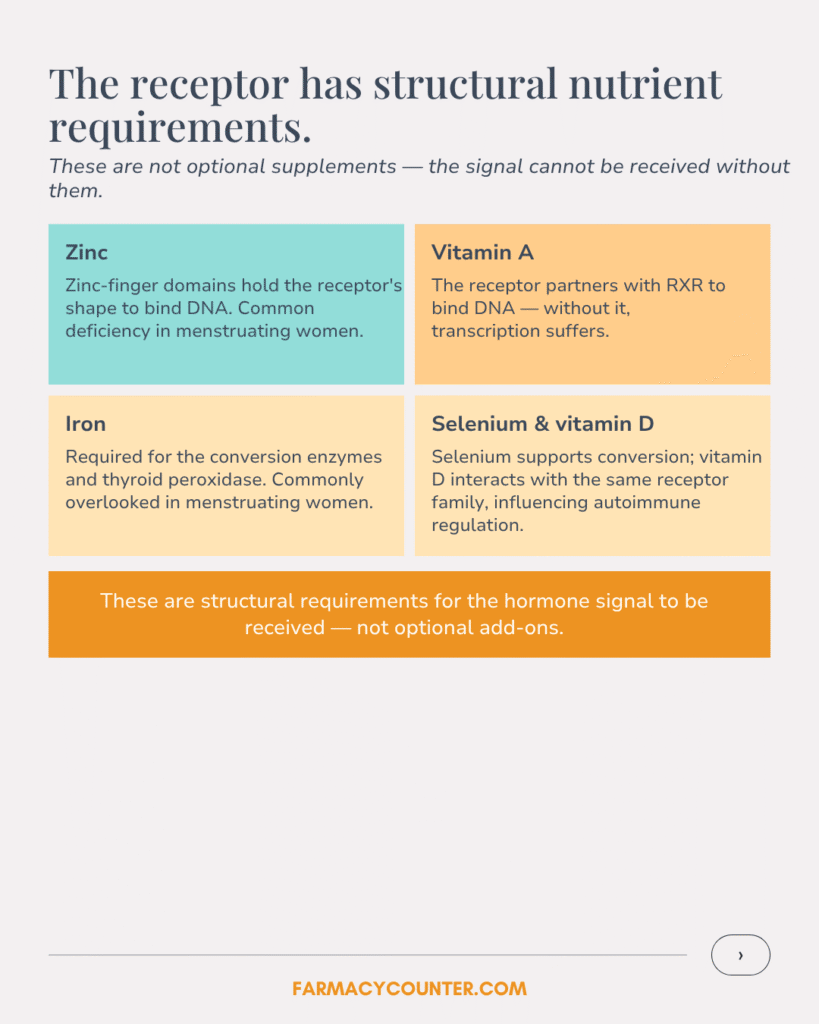
The thyroid hormone receptor relies on structures called zinc-finger domains to hold its shape and bind DNA correctly. These are exactly what they sound like: small, finger-like protein structures stabilized by a zinc ion, without which the receptor can’t fold into the configuration it needs to do its job (1).
This makes zinc a structural requirement, not an optional supplement. And it’s worth flagging that zinc deficiency is a common finding in menstruating women, due to a combination of monthly blood loss and, for many, inadequate dietary intake. Someone can have normal circulating thyroid hormone and still experience receptor-level dysfunction if zinc status is poor.
2. Vitamin A: The Receptor’s Required Partner
The thyroid hormone receptor doesn’t act alone. To bind DNA and influence gene expression, it partners with another receptor called RXR (retinoid X receptor), and RXR’s activity depends on adequate vitamin A status. Without sufficient vitamin A, this partnership is compromised, and transcription, the actual process of the hormone signal translating into cellular action, suffers (2).
This is a good example of why thyroid function can’t be fully understood by looking at the thyroid in isolation. Vitamin A status, something most people would never think to connect to their thyroid, is directly involved in whether the hormone signal actually gets executed once it arrives.
3. Iron: Fueling the Conversion Enzymes
Iron shows up twice in thyroid physiology, and both roles matter here. It’s required for thyroid peroxidase, the enzyme involved in producing thyroid hormone within the gland itself, and it’s also required for the deiodinase enzymes that convert T4 into active T3 (3).
Like zinc, iron deficiency is commonly overlooked in menstruating women, often not screened for beyond a basic complete blood count, and frequently missed until it’s severe enough to show up as anemia. Someone can have iron levels low enough to impair thyroid conversion and receptor function well before it’s low enough to flag as clinically concerning on a standard panel.
Wondering if a nutrient gap is behind the thyroid symptoms your labs can’t explain? Download The “Normal Labs, Not Normal Symptoms” Blueprint to see the four places a thyroid problem can hide beyond a single number. Get it here.
4. Selenium and Vitamin D: Conversion and Immune Regulation
Selenium is required for the deiodinase enzymes responsible for converting T4 into T3, making it directly relevant to whether adequate active hormone is even available to reach the receptor in the first place.
Vitamin D’s connection is a little different, but no less relevant. Vitamin D interacts with the same nuclear receptor family as thyroid hormone, and it plays a meaningful role in immune regulation, including the autoimmune processes involved in conditions like Hashimoto’s. Low vitamin D status is common, and its overlap with this same receptor family makes it worth assessing alongside thyroid-specific nutrients rather than separately from them.
These Are Structural Requirements, Not Add-Ons
It’s worth stating plainly what this framework actually means: zinc, vitamin A, iron, selenium, and vitamin D aren’t wellness extras layered on top of thyroid treatment. They’re structural requirements for the hormone signal to be received at all. A receptor built without adequate zinc, or operating without its RXR partner properly supported by vitamin A, isn’t a fully functional receptor, regardless of how much thyroid hormone is circulating around it.
This reframes what “normal labs, not normal symptoms” often actually means. It’s not always a conversion problem, and it’s not always autoimmune. Sometimes it’s the receptor itself, structurally under-resourced and unable to fully execute a signal that’s arriving exactly as it should.

What Actually Needs to Be Assessed
When someone’s symptoms suggest cellular-level thyroid resistance despite reasonable blood work, nutrient status is where I look closely, alongside the rest of the thyroid picture.
Functional zinc and copper status, since these two minerals compete for absorption and need to be assessed together rather than in isolation.
Ferritin and full iron studies, not just a basic CBC, since ferritin can be low well before anemia develops and still be low enough to impair thyroid conversion and receptor function.
Vitamin A status, particularly in anyone with a restricted diet, malabsorption history, or low intake of animal-source foods, since plant-based beta-carotene conversion to active vitamin A varies significantly between individuals.
Vitamin D levels, both for its role in this same receptor family and for its broader relevance to autoimmune regulation.
Selenium status, especially in anyone with signs of poor conversion (low free T3 relative to free T4) alongside otherwise reasonable thyroid labs.
And the full thyroid panel itself, TSH, free T4, free T3, reverse T3, and antibodies, so nutrient status is being interpreted in context rather than assessed in isolation.
What Happens When the Receptor Is Properly Resourced
When these nutrient gaps are identified and corrected, alongside whatever thyroid hormone management is appropriate, people often notice improvement that thyroid medication adjustment alone hadn’t produced. This makes sense once you understand the mechanism: if the receptor was the bottleneck, increasing circulating hormone without addressing receptor function was never going to fully resolve the symptoms, because more hormone doesn’t help if the receiving end can’t fully use what’s already there.
Energy, cold tolerance, hair, and cognitive clarity often improve as the structural pieces supporting the receptor are restored, not because the thyroid gland itself changed, but because the signal it was already sending finally has what it needs to be received.
Let’s Look at What Your Cells Actually Have Available
If your thyroid labs look reasonable and you still don’t feel like they add up, it’s worth asking not just how much hormone is circulating, but whether your cells have what they need to receive it.
On a discovery call, we go through your full thyroid panel alongside a look at the nutrients this receptor depends on structurally, zinc, iron, vitamin A, selenium, and vitamin D, so we can figure out whether this is a production issue, a conversion issue, or a receptor-level nutrient gap that’s been overlooked.
If you’re ready to look past the circulating number to what’s actually happening at the cellular level, you can schedule a discovery call here. We’ll figure out whether your cells have what they need to hear what your thyroid is already saying.
Enough hormone in your blood doesn’t guarantee enough hormone getting through. Let’s find out what your receptors actually have to work with.
References:
- Yen PM. Physiological and molecular basis of thyroid hormone action. Physiol Rev. 2001;81(3):1097-1142.
- Zhang J, Lazar MA. The mechanism of action of thyroid hormones. Annu Rev Physiol. 2000;62:439-466.
- Zimmermann MB, Köhrle J. The impact of iron and selenium deficiencies on iodine and thyroid metabolism: biochemistry and relevance to public health. Thyroid. 2002;12(10):867-878.