
Low iron, thyroid changes, hormone shifts, nutrients, and medications are common causes of shedding. Here’s what to check and what to ask your provider.
You’ve tried the serums. The shampoos. The gummies. Maybe a scalp massager.
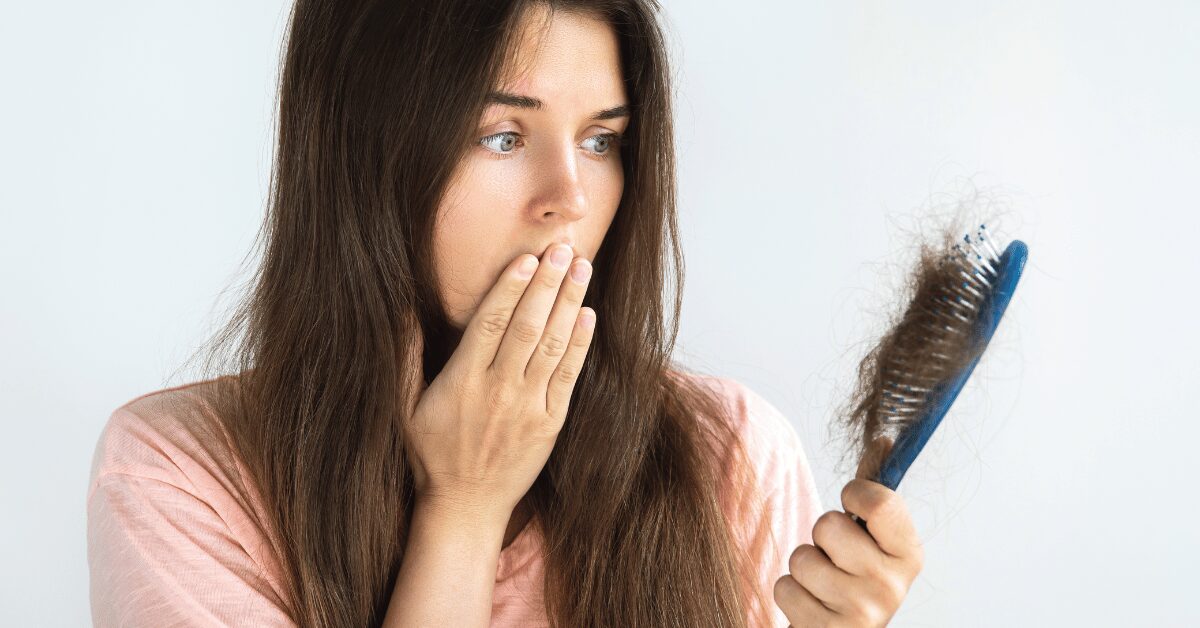
And your hair is still thinning. More in the shower drain. More on your brush. A ponytail that feels thinner than it used to.
If that’s you, I want to say this first: you’re not being vain, and you’re not imagining it. Hair loss can be distressing, and it’s often a sign that something else is going on inside your body.
Most hair products treat where you see the problem. Shedding often starts somewhere else.
This post covers how hair actually grows, the most common root causes I look at from a functional medicine and pharmacist perspective, and what to ask your provider. It focuses mainly on women, though some of it applies to men too. It’s educational and isn’t a substitute for care from your own healthcare team or dermatologist. Numbers in brackets point to the references at the end.
Each hair goes through a cycle. At any time, most of your hair is growing and a small percentage is resting. It’s normal to lose some hair every day.[1]
Most of your hair is here at any time
A short pause as growth stops
Then the hair sheds and a new one starts
Here’s the part that surprises people: when your body goes through a trigger, such as an illness, surgery, childbirth, a crash diet, or a big stressor, more hairs than usual can shift into the resting phase at once. But they don’t fall out right away. Shedding typically shows up about two to three months after the trigger.[1] This is called telogen effluvium, and it’s one of the most common causes of sudden shedding.
By the time your hair is falling out, you may have forgotten what happened three months ago. That delay is why I always start with a timeline.
Lots of hair coming out all over, often suddenly. It’s usually triggered by something, and it often improves once the cause is addressed.[1]
A widening part or less density on top over months or years. In women, this is often female pattern hair loss, which is linked to genetics, hormones, and age.[2]
Both can happen at the same time, and a provider or dermatologist can help sort out which one you have.
Hair is often one of the first places your body shows that something is off. These are the causes I check, and it’s common to find more than one.
Common in women, and often missed.
Iron is needed for hair growth, and low iron stores (ferritin) are common in women, especially with heavy periods, pregnancy, plant-based eating, or digestive problems. The research on iron and hair loss is mixed, and there’s no single agreed ferritin cutoff, but iron deficiency is considered worth checking and correcting.[3]
Ask for your actual ferritin number, not just “normal.” And don’t start iron on your own, because too much is harmful. More on the hidden causes of anemia.
Your body feeds hair last.
Your hair is made of protein, and your body prioritizes other tissues first when intake is low. Crash dieting, very low protein, and restrictive eating can trigger shedding. Deficiencies in nutrients such as zinc, vitamin D, and B12 are also linked to hair loss, though the evidence varies.[4] (Here are protein sources that support hormonal stability.)
Excess vitamin A and selenium can cause hair loss. Test first, and supplement with your provider.[4]
One of the simplest and most important things to check.
Both an underactive and an overactive thyroid can cause hair thinning, along with fatigue, mood changes, and weight changes.[5], [6] Ask for more than TSH alone: free T3, free T4, and thyroid antibodies can add information.
Already on thyroid medication and still shedding? See why thyroid medication works better for some people than others.
This is where functional medicine thinking helps.
Estrogen is high during pregnancy and drops after birth, and many women shed noticeably a few months later.[7] It’s common and usually temporary.
Falling estrogen and progesterone, along with a relatively greater androgen effect, can lead to thinner hair and a widening part.[2] It usually comes with other symptoms like sleep trouble, mood changes, and brain fog. (See perimenopause symptoms that get missed.)
Higher androgens can cause thinning on top of the scalp, often with irregular cycles, acne, and unwanted hair growth. Insulin resistance often plays a role.[8] (See my post on PCOS.)
Starting or stopping hormonal birth control can trigger shedding in some women.[9]
As a pharmacist, I check this layer first.
Many common medicines can cause hair loss, including some anticoagulants (blood thinners), retinoids, certain blood pressure and antidepressant medicines, antithyroid drugs, and others.[9]
Please don’t stop any medication on your own. But if your shedding started a few months after you started or changed something, tell your provider or pharmacist.
Real, but rarely the whole story.
A major stressor can trigger shedding, and chronic stress and poor sleep keep your body in a state where hair isn’t a priority.[1] This is real, but it’s rarely the only cause, which is why I always check the others too. More in Told It’s “Just Stress”? What Else Could Be Going On.
The hormone connection behind thinning.
Blood sugar swings and insulin resistance affect your hormones, especially androgens, which can affect your hair. This is especially true in PCOS.[8] Fasting glucose, fasting insulin, and A1c are worth checking.
If your hair changes come with other symptoms, a good first step is understanding your hormone pattern. My free Hormone Type Assessment is a short quiz that helps you see whether your symptoms point toward one of these, so you know what to ask about next:
You don’t need a diagnosis to start the conversation. Here’s what I’d ask about, depending on your symptoms:
| If You Have… | Ask About… |
|---|---|
| Fatigue, heavy periods, restless legs | Ferritin and a complete blood count |
| Fatigue, cold or heat sensitivity, weight changes | TSH, free T3 and T4, thyroid antibodies |
| Tingling, fatigue, low mood | B12 (and vitamin D if you’re at risk) |
| Irregular cycles, acne, unwanted hair growth | Testosterone with SHBG, DHEA-S, and a review for PCOS |
| Cravings, afternoon crashes, stubborn weight | Fasting glucose, fasting insulin, A1c |
| Night sweats, sleep trouble, cycle changes | A review of your hormones in context |
A normal result isn’t always the end. Reference ranges describe where most people fall, not where you feel your best, so your symptoms and labs belong together.
Biotin is in nearly every “hair, skin, and nails” supplement, but it hasn’t been shown to help hair growth in people who aren’t deficient.[10] It can also interfere with some blood tests, including thyroid tests, and make results look falsely abnormal.[11] If you take biotin, tell your provider and ask whether to pause it before blood work.
When someone tells me their hair is shedding, I look at the whole picture:
When it started, and what happened in the three to six months before: illness, surgery, childbirth, a diet change, a stressful period, or a new medication.
Ferritin with a CBC, thyroid with antibodies, B12, vitamin D, fasting glucose and insulin, A1c, and hormones when the story fits.
Protein, iron-rich foods, and overall intake.
Timing, side effects, and things like biotin.
Postpartum, perimenopause, PCOS, and menopause.
Absorption problems can lead to nutrient deficiencies. (See what a GI-MAP can show.)
Both shape how your body prioritizes repair. (See what happens to your hormones when you don’t sleep.)
I also use my four working patterns to organize what I find:
Hair shedding, fatigue, low iron, low vitamin D or B12
Wired at night, tired by day, high stress, poor sleep
Blood sugar swings, cravings, acne, stubborn weight
Bloating, sluggish digestion, poor absorption
These are clues that organize questions. They don’t diagnose a cause.
Many people see improvement once the cause is found, but hair grows slowly, about half an inch a month, so give it time.[1]
Include a variety of colorful plants too.
It’s a common shedding trigger.
A steady bedtime and wake time, and breaks that actually restore you.
Avoid tight styles and very high heat.
Iron, vitamin D, zinc, and others help only when you’re low. Test first.
For gradual thinning in women, options like topical minoxidil have evidence behind them.[2]
These are the iron and vitamin D products I carry. Iron in particular should only be taken if testing shows you need it. Check with your provider first, especially if you take medications.
Products shown are available through my Fullscript dispensary. Farmacy Counter may earn a commission on purchases.
Talk with your provider or a dermatologist if you have patchy hair loss, a burning, itchy, or painful scalp, scarring, loss of eyebrows or eyelashes, or sudden heavy shedding. Also see them if your hair loss comes with other symptoms like fatigue, a racing heart, cycle changes, or unexplained weight loss.
Hair is often one of the first places your body shows that something is off. The good news is that when you find the cause, many people see their hair start to recover.
If you haven’t yet, start with the free Hormone Type Assessment. And if you’d rather talk through what you’ve been experiencing, I offer a free discovery call. No pressure, just a conversation about whether functional medicine is the right next step for you.
Book Your Free Discovery Call →To your health and vitality, Dr. Ryan
Sudden, all-over shedding is often telogen effluvium, which typically shows up about two to three months after a trigger such as illness, surgery, childbirth, a crash diet, a major stressor, or a medication change. It often improves once the cause is addressed.
Depending on your symptoms, consider ferritin with a complete blood count, a thyroid panel (TSH, free T3, free T4, antibodies), B12, vitamin D if you’re at risk, fasting glucose, fasting insulin, and A1c, plus testosterone with SHBG and DHEA-S if you have signs of PCOS.
Biotin hasn’t been shown to help hair growth in people who aren’t deficient, and it can interfere with some blood tests, including thyroid tests. Tell your provider if you take it, and ask whether to pause it before blood work.
Yes. Falling estrogen and progesterone, along with a relatively greater androgen effect, can lead to thinner hair and a widening part, often along with sleep, mood, and cycle changes.
Hair grows about half an inch a month, so once the cause is addressed it can take several months to see a difference.
For educational purposes only. Not a diagnosis, and not a substitute for care from your healthcare provider, dermatologist, or a licensed mental health professional. Do not start, stop, or change any medication or supplement without talking with your provider.