
Clinical Insights • Stress Response

Why Can’t I Calm Down? 5 Reasons Your Stress Response Stays On

The meeting ended hours ago. So why is your body still acting like it’s in the middle of it? Here are five things that can keep your stress response switched on, and what to look at next.


Your stressful meeting ended at 2 p.m.

So why is your jaw still tight at 9:12? Why are your shoulders up near your ears, and why does your brain decide to open seventeen tabs the second you lie down?

A healthy stress response works like a wave. It rises to meet a demand, then settles back down once the demand is over. You handle the hard conversation, the deadline, or the near-miss in traffic, and an hour later your body has moved on.

The wave rises, but it doesn’t come all the way back down.

Ongoing stress can make that settling harder. That’s what people mean when they say they feel “stuck in fight or flight.”

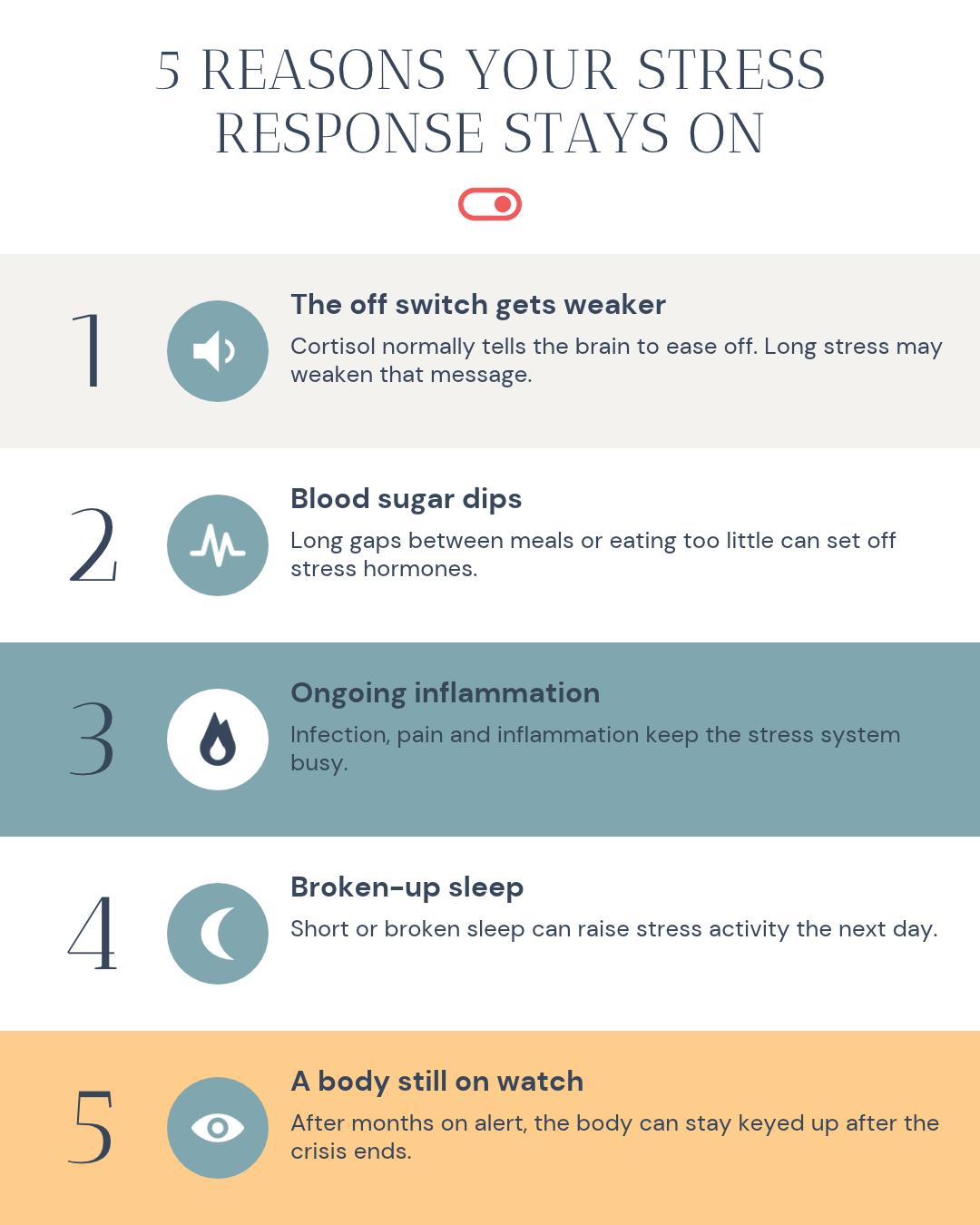
Five reasons the stress response stays switched on: the off switch gets weaker, blood sugar dips, ongoing inflammation, broken-up sleep, and a body still on watch
The Five Contributors

5 Reasons Your Stress Response Stays On

These are the five contributors I look for most when someone tells me they can’t seem to come down.

  1. The off switch gets weaker

    Cortisol does two jobs during stress. It helps you respond, and then it signals your brain to ease off. That built-in feedback loop is part of how the wave comes back down. With long-term stress, that feedback can change in some people. The “ease off” message may not land as clearly, so the system stays more active than it needs to.[1] Some research suggests the body’s tissues can also become less responsive to cortisol’s calming signal over time.[2]

  2. Blood sugar dips

    Long gaps between meals, eating too little, or certain glucose-lowering medications can drop your blood sugar. When that happens, your body releases adrenaline and cortisol to bring it back up.[3] The result can feel a lot like anxiety: shaky, sweaty, heart racing, irritable. One honest note: I don’t blame blood sugar unless the symptoms and the glucose data actually line up. Plenty of people feel shaky for other reasons. More on how to tell in your anxiety might be a blood sugar event.

  3. Ongoing inflammation

    Your immune system and your stress system talk to each other constantly.[4] An infection that won’t quite clear, an inflammatory condition, or daily pain can keep both systems activated, even when nothing stressful is happening in your life. If your labs look normal but you still feel inflamed, this post is for you.

  4. Broken-up sleep

    Short sleep and frequent waking can raise stress activity the next day.[5] That 2:53 a.m. wake-up may show up at 4 p.m. as a headache and a short fuse. And because a keyed-up body sleeps lighter, it can turn into a loop: stress breaks up sleep, and broken sleep keeps stress up.

  5. A body still on watch

    After months of vigilance, like caring for a sick parent, a layoff scare, or a hard season at home, your body can stay keyed up even after the crisis is over.[6] It learned to stay ready, and it hasn’t gotten the message that it can stand down. Worry and replaying the day can also keep the stress response going long after the actual stressor has passed.[7] That’s the seventeen open tabs at bedtime.

Woman lying awake at night unable to wind down after a stressful day
Cover of The Cortisol Rhythm Decoder, a free guide from Farmacy Counter
Free Guide • Find Your Pattern

Is Your Stress Response Stuck On at Night?

Tired all day but wired at bedtime is one of the most common patterns I see, but it’s not the only one. Some people launch hard in the morning and crash by 3 p.m. Others feel flat from start to finish. The Cortisol Rhythm Decoder helps you find your pattern in about five minutes: spiking, flat, running late, or stuck on at night. It also explains why a single morning blood test can’t see it, and which testing actually shows your rhythm.

Rule These Out

What Else I Look For

Feeling keyed up isn’t always about stress. Several other things can look and feel exactly like a stress response that won’t shut off, so I screen for these, too:

What I checkWhy it can feel like stress
Thyroid issuesAn overactive thyroid can cause a racing heart, anxiety, and trouble sleeping. An underactive one can cause fatigue and low mood. See the stress-thyroid pattern.
AnemiaLow iron or low red blood cells can cause a fast heartbeat, breathlessness, and fatigue.
Sleep apneaPauses in breathing at night jolt your body awake and trigger a stress response, often without you knowing. It’s common and often missed.[8]
Medication effectsSome medications can make you feel wired, jittery, or unable to sleep. More on this below.
PerimenopauseShifting hormones can bring night sweats, broken sleep, and anxiety that feels new. Here’s why holiday anxiety can feel harder in perimenopause.
Anxiety and depressionThese are real, treatable conditions, not just “stress,” and they deserve their own care.

For men, this often shows up a little differently: irritability, poor sleep, and low drive more than racing thoughts. I cover that in why men lose energy and drive.

What Helps

What Helps in the Moment (and What Helps Long-Term)

In the moment: slow your exhale

A breathing exercise can help your body shift gears when you’re keyed up. One simple version: breathe in through your nose, take a second small sip of air at the top, then let it out slowly through your mouth. Repeat for a few minutes.

In one study, about five minutes a day of slow, exhale-focused breathing improved mood and lowered signs of physical arousal.[9] It’s a great tool. It just isn’t the whole answer.

Long-term: look at the full pattern

If you’re stuck on most days, a breathing exercise is a bandage. The full pattern deserves a closer look. That means asking:

  • When does it happen? Every evening? After skipped meals? After a bad night?
  • What else is going on? Pain, illness, a new medication, perimenopause?
  • How long has it been this way? Weeks, or since a hard season months ago?

The answers usually point to which of the five reasons is doing the most, and that’s where to start. My evening wind-down routine is a good place to begin if nights are your hardest time. And if the load feels bigger than any one thing, read why you’re so easily overwhelmed lately.

Pharmacist Checklist

A Functional Medicine Pharmacist’s Note

When someone tells me they can’t come down, I always look at their medication and supplement list. A few common culprits:

  • Some diabetes medications can cause blood sugar lows. Medications like glipizide, glyburide, and insulin can drop blood sugar, especially when a meal is late or skipped. That can feel a lot like anxiety.
  • Appetite-lowering medications can lead to under-eating. If you take a GLP-1 medication and find you’re barely eating, long gaps between meals can add to the stress load.
  • Beta blockers can hide the warning signs of a low. They can blunt the racing heart and shakiness that usually tell you your blood sugar is dropping.
  • Some medications can keep you wired. Steroids like prednisone, decongestants like pseudoephedrine, ADHD stimulants taken late in the day, and some asthma inhalers can make it harder to settle.
  • A thyroid dose that’s a little too high can feel like anxiety. Racing heart, jitters, and trouble sleeping are worth mentioning to your prescriber.
  • Caffeine adds up. Coffee, energy drinks, pre-workout, and some pain relievers all contain it.
Pharmacist Note

Please don’t stop or change a medication on your own. But it’s always worth asking your pharmacist or provider, “Could anything I take be keeping me keyed up?”

Targeted Support, With Your Provider

Support for calmer evenings

If you’d like extra support while you work on calming your evenings, these are the options I trust for supporting relaxation and restful sleep. Check with your pharmacist or provider first, especially if you take other medications.

Available through my Fullscript dispensary. Farmacy Counter may earn a commission on purchases.

Know When to Look Closer

When to Get Help

It’s worth checking in with your provider if:

  • You feel keyed up most days for more than a few weeks, even when nothing stressful is happening.
  • You have a racing or pounding heart, unexplained weight loss, or feel shaky and hot much of the time.
  • You snore loudly, wake up gasping, or wake with headaches.
  • You often get shaky, sweaty, or lightheaded between meals, especially if you take a diabetes medication.
  • Worry, low mood, or panic is getting in the way of work, sleep, or relationships.

Get care right away for chest pain, fainting, or a racing heart that won’t settle.

Your Next Step

Let’s Find What’s Keeping You Switched On

A breathing exercise can help in the moment, but the full pattern deserves a closer look. On a free discovery call, we’ll walk through your symptoms, your sleep, your medications, and any labs you’ve had, and figure out which of these five is doing the most. If you haven’t yet, grab the free Cortisol Rhythm Decoder first.

Book Your Free Discovery Call →

To your health and vitality, Dr. Ryan

Common Questions

Frequently Asked Questions

Why can’t I calm down after stress is over?

Ongoing stress can make it harder for your stress response to settle. Changes in cortisol feedback, blood sugar dips, inflammation, broken sleep, and months of vigilance can all keep your body keyed up after the stressful moment has passed.

What does it mean to be stuck in fight or flight?

It’s an informal way to describe a stress response that rises but doesn’t fully come back down. It can show up as a tight jaw, tense shoulders, racing thoughts at bedtime, or trouble sleeping.

Can low blood sugar feel like anxiety?

Yes. When blood sugar drops, your body releases adrenaline and cortisol to bring it back up, which can cause shakiness, sweating, a racing heart, and irritability. The symptoms and glucose data should match before blaming blood sugar.

Can inflammation keep you stressed?

Yes. Your immune system and stress system communicate constantly, so an infection, an inflammatory condition, or daily pain can keep the stress response activated.

Do breathing exercises really help?

They can help in the moment. Slow breathing with a long exhale can help your body shift gears. If you feel stuck most days, it’s worth looking at what’s driving it.

For educational purposes only. Not a diagnosis, and not a substitute for care from your healthcare provider or a licensed mental health professional. Do not start, stop, or change any medication or supplement without talking with your provider or pharmacist.

References
  1. Miller GE, Chen E, Zhou ES. If it goes up, must it come down? Chronic stress and the hypothalamic-pituitary-adrenocortical axis in humans. Psychol Bull. 2007;133(1):25–45.
  2. Cohen S, Janicki-Deverts D, Doyle WJ, et al. Chronic stress, glucocorticoid receptor resistance, inflammation, and disease risk. Proc Natl Acad Sci U S A. 2012;109(16):5995–5999.
  3. Cryer PE, Davis SN, Shamoon H. Hypoglycemia in diabetes. Diabetes Care. 2003;26(6):1902–1912.
  4. Chrousos GP. The hypothalamic-pituitary-adrenal axis and immune-mediated inflammation. N Engl J Med. 1995;332(20):1351–1362.
  5. Leproult R, Copinschi G, Buxton O, Van Cauter E. Sleep loss results in an elevation of cortisol levels the next evening. Sleep. 1997;20(10):865–870.
  6. McEwen BS. Protective and damaging effects of stress mediators. N Engl J Med. 1998;338(3):171–179.
  7. Brosschot JF, Gerin W, Thayer JF. The perseverative cognition hypothesis: a review of worry, prolonged stress-related physiological activation, and health. J Psychosom Res. 2006;60(2):113–124.
  8. Young T, Evans L, Finn L, Palta M. Estimation of the clinically diagnosed proportion of sleep apnea syndrome in middle-aged men and women. Sleep. 1997;20(9):705–706.
  9. Balban MY, Neri E, Kogon MM, et al. Brief structured respiration practices enhance mood and reduce physiological arousal. Cell Rep Med. 2023;4(1):100895.