

Eight hours of sleep is not eight hours of brain detoxification.
That’s the piece of the sleep conversation that almost never gets addressed — and it’s the reason someone can spend a full night in bed and wake up with brain fog, low mood, and anxiety that doesn’t make sense given how long they slept.
The glymphatic system — the brain’s waste clearance network — doesn’t run on sleep duration. It runs on slow-wave sleep specifically. And slow-wave sleep is exactly what gets compressed, suppressed, and eliminated by the most common factors disrupting sleep in people dealing with anxiety, HPA dysregulation, and chronic stress.
Here’s what that means, and why it changes what we actually need to fix.
Why It Has to Be Slow-Wave Sleep
The glymphatic system clears the brain’s metabolic waste — beta-amyloid, tau proteins, inflammatory debris, and the neurotoxic byproducts of neurotransmitter metabolism — by pushing cerebrospinal fluid through channels in the brain’s interstitial space.
For that fluid to flow, the channels have to be open. And the channels open only when the brain’s interstitial cells shrink by approximately 60% — a structural change that creates the physical space the fluid needs to move through.
Here’s the critical detail: that 60% expansion of interstitial space is coupled to delta wave oscillations — the slow electrical rhythms that define deep, slow-wave sleep (stages S3 and S4). Without those oscillations, the channels don’t open. The fluid doesn’t flow. The debris stays.
This means that sleep in stages S1 and S2 — light sleep — is not producing meaningful glymphatic clearance. REM sleep is not producing meaningful glymphatic clearance. The system is active almost exclusively during slow-wave deep sleep, which in a healthy sleep architecture is concentrated in the first half of the night and decreases across the sleep cycle as the night progresses.
This is why total hours of sleep is an incomplete metric. The question that actually matters is: how much of that sleep is slow-wave? And the answer, for a significant subset of people dealing with chronic anxiety, HPA dysregulation, elevated cortisol, or the factors listed below, is: not nearly enough.
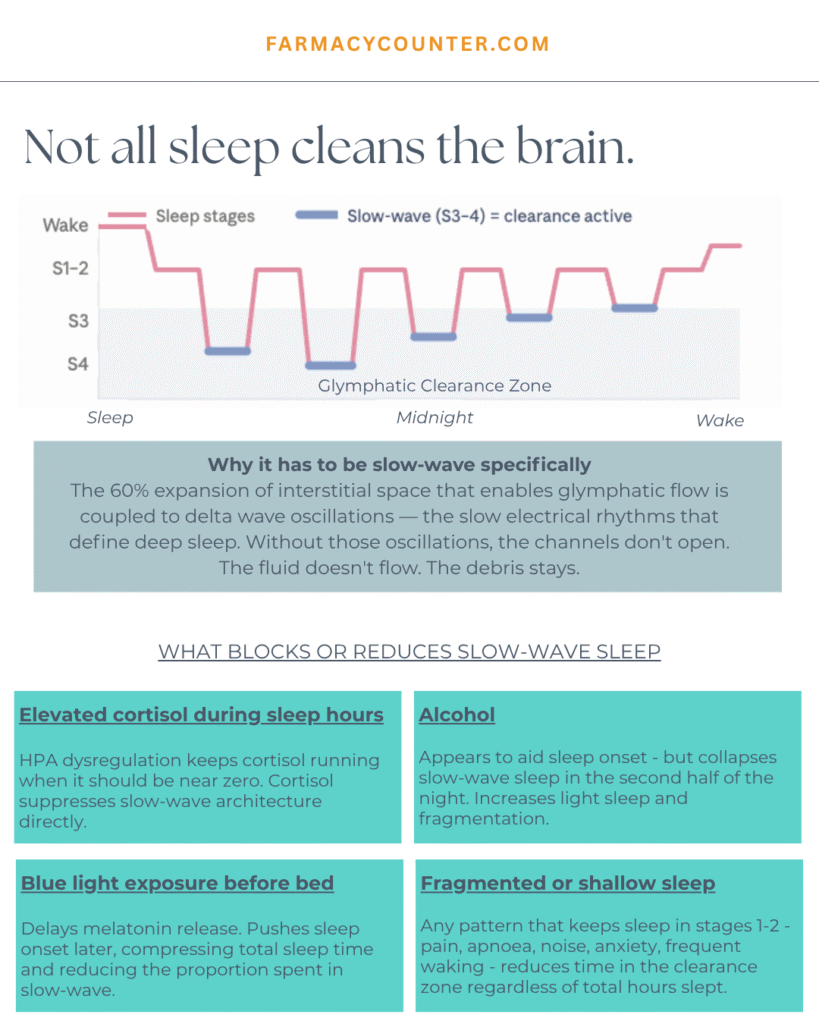
What Blocks or Reduces Slow-Wave Sleep
🔴 Elevated cortisol during sleep hours
The HPA axis has a clear circadian pattern in a healthy, regulated system: cortisol peaks in the early morning, gradually declines through the day, and reaches its lowest point in the late evening and overnight — the point at which slow-wave sleep is most concentrated.
When the HPA axis is dysregulated, this doesn’t happen cleanly. Cortisol remains elevated into the evening and overnight. And cortisol directly suppresses slow-wave sleep architecture — it’s not that elevated cortisol makes sleep feel lighter, it’s that it neurochemically prevents the delta wave activity that slow-wave sleep requires.
This is the mechanism behind the wired-but-tired pattern that’s so common in people with chronic stress and HPA dysregulation. The body is genuinely exhausted. But the cortisol environment overnight is actively suppressing the only stage of sleep that would allow meaningful restoration and brain clearance. They sleep, but they don’t clean.
🔴 Alcohol
Alcohol is widely used as a sleep aid because it genuinely does accelerate sleep onset and produces sedation. What it doesn’t produce is slow-wave sleep.
Alcohol suppresses slow-wave sleep architecture, particularly in the second half of the night. In its place, it increases light sleep stages and sleep fragmentation. The result is sleep that is technically longer in duration but dramatically reduced in its capacity to support glymphatic clearance — which is why the cognitive and mood effects of alcohol-impaired sleep are consistently worse than the number of hours slept would suggest.
This is also relevant to anxiety specifically: alcohol’s initial GABA-mediated sedating effect is followed by a rebound excitatory effect as it’s metabolized, which produces cortisol elevation and sympathetic activation in the second half of the night. The sleep that remains after that rebound is light, fragmented, and glymphatically inactive.
🔴 Blue light exposure before bed
Blue light in the evening suppresses melatonin secretion by signaling the suprachiasmatic nucleus — the brain’s master clock — that it’s still daytime. The result is a delayed melatonin peak, delayed sleep onset, and a compressed total sleep window.
When sleep onset is delayed, the first slow-wave cycle of the night — which is the deepest and longest — is shortened or missed entirely. Because slow-wave sleep is front-loaded in the night, anything that pushes sleep onset later compresses the window during which the brain’s primary clearance mechanism operates.
This is not primarily about being “on screens too late.” It’s about the specific melatonin suppression that blue light produces and the downstream effect on sleep architecture. The behavioral intervention (limiting blue light exposure in the 60-90 minutes before bed) is one of the few sleep hygiene recommendations that actually targets the slow-wave architecture — rather than just total sleep time.
🔴 Fragmented or shallow sleep from any cause
Any pattern that keeps sleep cycling through stages S1 and S2 — pain, sleep apnea, ambient noise, anxiety-driven hyperarousal, frequent waking, histamine-driven middle-of-the-night wakefulness — reduces time in the glymphatic clearance zone regardless of total hours slept.
This is particularly significant for sleep apnea, which fragments sleep through repeated micro-arousals that interrupt slow-wave continuity even when the person has no awareness of waking. Untreated sleep apnea is associated with significantly elevated beta-amyloid accumulation in the brain — a direct consequence of chronically impaired glymphatic clearance — which is part of why it’s now recognized as a significant risk factor for cognitive decline.
It’s also significant for anxiety itself: the hyperarousal that anxiety produces at night — the racing thoughts, the inability to settle, the light sleep that feels easily interrupted — directly impairs slow-wave architecture and thus glymphatic clearance. This creates the cycle where anxiety disrupts the sleep that would reduce the neuroinflammation driving the anxiety.

The Sleep Architecture You Actually Need
A healthy sleep architecture cycles through the sleep stages multiple times across the night, spending meaningful time in slow-wave sleep (S3-S4) particularly in the first half, with REM periods that lengthen in the second half.
Glymphatic clearance is concentrated in those early slow-wave cycles. This is why the first half of the night is disproportionately important for brain health — and why disruptions in the first half of the night (from elevated cortisol, alcohol, late blue light exposure) are particularly costly from a clearance standpoint, while disruptions in the second half (early waking, fragmented light sleep) affect REM more than slow-wave.
Most people don’t know what their sleep architecture actually looks like. They know how long they slept and roughly how rested they feel. A wearable sleep tracker gives a reasonable approximation of sleep stage distribution. For clinical purposes — when sleep disruption is part of a complex picture alongside anxiety and cognitive symptoms — a formal sleep study or a DUTCH test assessing overnight cortisol gives more precise information about what’s actually driving the architecture problem.
What This Means Clinically
When someone comes to me with chronic sleep disruption alongside anxiety, brain fog, or mood symptoms, I’m not starting with blue light glasses and a consistent bedtime. Those recommendations aren’t wrong — but they’re the surface layer of a biological picture that usually runs deeper.
The question I’m asking is: why is slow-wave sleep not happening? And the answer almost always points toward one or more of the four factors above — elevated nocturnal cortisol from HPA dysregulation, histamine-driven hyperarousal from gut dysbiosis or undermethylation, neuroinflammation disrupting sleep staging, or a combination.
That’s what the investigation is for.
DUTCH testing gives me the overnight cortisol picture — whether cortisol is elevated when it should be near zero, how quickly it’s declining in the evening, and whether the pattern points toward a dysregulated HPA setpoint or something more acute.
Whole blood histamine and homocysteine give me the methylation and histamine picture — both directly relevant to the wired-but-tired pattern and the 2-4am waking that’s characteristic of histamine-driven sleep disruption.
Inflammatory markers — hs-CRP, ferritin, and in some cases IL-6 — tell me whether neuroinflammation is part of the architecture disruption, since inflammatory cytokines directly suppress slow-wave sleep staging.
And organic acids testing gives me the neurotransmitter metabolism picture — including whether serotonin, which is the direct precursor to melatonin, is being produced adequately, and whether the kynurenine pathway activation that neuroinflammation drives is affecting the melatonin-producing end of the serotonin pathway.
Sleep disruption is rarely just a sleep problem. It is usually a symptom of a biological driver. And the driver is almost always findable.

The Downstream Consequence of Getting This Right
When slow-wave sleep architecture actually improves — not just sleep duration, but the depth and continuity of the stages that produce glymphatic clearance — the changes that follow are broader than feeling less tired.
The brain fog that had been accepted as a baseline starts to lift. The inflammatory debris that had been accumulating starts to clear. The neuroinflammatory load that was driving anxiety starts to reduce. Emotional regulation improves not because anything psychological changed but because the brain is running the maintenance cycle that allows its neurotransmitter systems to function properly.
Patients who have had disrupted sleep for years — who have adapted their lives around the fatigue, the brain fog, the low mood — often describe the shift when their sleep architecture actually improves as feeling like themselves again. Not just less tired. Cognitively and emotionally more intact.
Because the brain has a cleaning crew. And it had just been waiting for the conditions to do its job.
Where to Start
If your sleep is disrupted — particularly if it’s accompanied by the wired-but-tired pattern, middle-of-the-night waking, anxiety that’s worse in the morning, or cognitive symptoms that track with sleep quality — the investigation worth having is about what’s disrupting your slow-wave architecture, not just about how to sleep longer.
A discovery call is where we start: walking through the full sleep and symptom picture, identifying which biological drivers are most likely involved, and mapping out what the investigation would look like for your specific pattern.
Book a discovery call here.
Or if you want to start by identifying which anxiety type is most likely driving your picture — several of which have sleep disruption as a central feature — the Anxiety Pattern Decoder walks you through the four biological types and helps identify your pattern.
References
- Xie L, Kang H, Xu Q, et al. Sleep drives metabolite clearance from the adult brain. Science. 2013;342(6156):373-377. doi:10.1126/science.1241224
- Hablitz LM, Nedergaard M. The glymphatic system: a novel component of fundamental neurobiology. J Neurosci. 2021;41(37):7698-7711. doi:10.1523/JNEUROSCI.0619-21.2021
- Irwin MR, Olmstead R, Carroll JE. Sleep disturbance, sleep duration, and inflammation: a systematic review and meta-analysis of cohort studies and experimental sleep deprivation. Biol Psychiatry. 2016;80(1):40-52. doi:10.1016/j.biopsych.2015.05.014
- Sharma M, Ragsdale N, Smith J, et al. Alcohol and sleep architecture: a systematic review. Sleep Med Rev. 2014;23:42-52.