

Clinical Insights • Stress & Energy

Not Stressed but Always Exhausted? The Stress You Don’t Count (Your Body Does)

No big crisis, no dramatic life event, and you’re still running on empty. Here’s the everyday stress that flies under the radar, and a simple way to find it.


“My life isn’t even that stressful.”

I hear this all the time, usually right before someone tells me they’re exhausted, foggy, and running on fumes by 3 p.m. And I believe them. There’s no crisis. No divorce, no job loss, nothing dramatic.

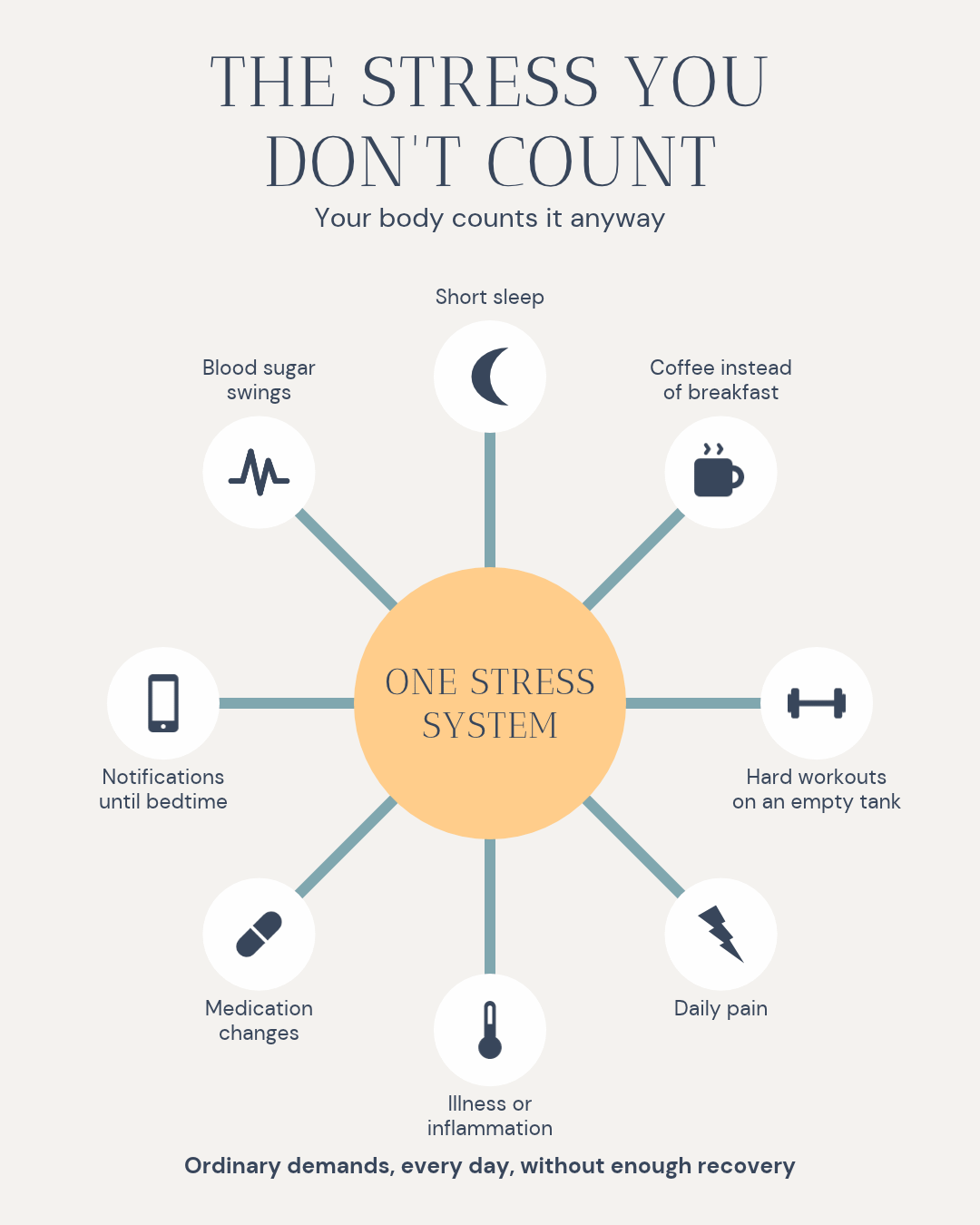
Meanwhile, their body is quietly managing a list like this:

  • Five hours and 46 minutes of sleep
  • Cold brew in place of breakfast
  • A hard workout on an under-fueled body
  • Daily pain they’ve learned to ignore
  • An illness, an inflammatory condition, or a recent medication change
  • Work notifications until the phone lands on the pillow

None of those feel like “stress” in the way we usually use the word. But your body doesn’t sort stress into emotional and physical piles. It runs all of it through the same system.

Tired woman with coffee during an ordinary busy day
Eight everyday demands, including short sleep, coffee instead of breakfast, hard workouts on an empty tank, daily pain, illness or inflammation, medication changes, notifications until bedtime, and blood sugar swings, all connected to one stress system
The Hidden Load

The Stress You Don’t Count (But Your Body Does)

Your stress system responds to physical demands just as much as emotional ones. Here’s what each of those “ordinary” items is actually asking of it.

  1. Short sleep

    A short night does more than make you tired. It can shift when cortisol rises and falls, keeping it higher in the evening when it should be winding down.[1] It also makes it harder for your body to handle blood sugar. In one study, about a week of short sleep left healthy young adults processing sugar noticeably worse.[2]

  2. Coffee instead of breakfast

    Caffeine nudges cortisol up on its own.[3] On an empty stomach, with no food coming in, that adds to the load at the start of the day. If that’s followed by a 3 p.m. crash, you’re not imagining the pattern. More on that in what your caffeine and carb cravings may mean.

  3. Hard workouts on an empty tank

    Exercise is a healthy stress, but it’s still a stress. Your body handles it well when recovery and fuel keep up.[4] When training is hard and food is low for weeks at a time, energy, mood, sleep, and menstrual cycles can all take the hit.[5] Men aren’t immune either. It can show up as low drive, poor recovery, and stalled progress. Sometimes your daily walk does more for you than your HIIT class.

  4. Daily pain, illness, or inflammation

    Pain and illness switch on both your stress response and your immune system.[6] The low-grade backache you’ve stopped noticing, a flare of an inflammatory condition, or the tail end of a cold all count. If your labs look fine but you still feel inflamed, read normal labs but you still feel inflamed.

  5. Medication changes

    Starting, stopping, or changing the dose of a medication can affect sleep, energy, and mood, sometimes weeks later. That’s why the timeline matters so much. More on this in the pharmacist’s note below.

  6. Notifications until bedtime

    Scrolling or answering messages in bed keeps your brain in work mode, and the light from screens can delay your body clock and make it harder to feel alert the next morning.[7] My evening wind-down routine can help.

Why It Adds Up

Any one of these is manageable. The problem is that they don’t come one at a time. They stack, every day, with not much recovery in between.
Cover of The Cortisol Rhythm Decoder, a free guide from Farmacy Counter
Free Guide • Find Your Pattern

What Is All That Stress Doing to Your Day?

Those everyday demands leave a mark on your cortisol rhythm, and it doesn’t look the same for everyone. Some people wake up wired and crash at 3 p.m. Others feel flat all day, or get a second wind right at bedtime. The Cortisol Rhythm Decoder helps you find your pattern in about five minutes: spiking, flat, running late, or stuck on at night. It also explains why a single morning blood test can’t see it, and which testing actually shows your rhythm.

The Functional Medicine Lens

The Clues I Look For

“Tired and stressed” can point in a lot of directions, so I don’t run the same set of tests on everyone. I match the workup to the details. A few examples:

If you noticeI start by asking about
New morning headaches and a dry mouthSleep apnea. It’s common and often missed, especially in women and in people who don’t fit the classic picture.[8]
Heavy periods and getting out of breath on the stairsIron. Heavy periods are one of the most common causes of low iron, and low iron can feel a lot like burnout.[9]
Feeling “off” since a medication was started, stopped, or changedThe timeline. When did it start, and what changed around then?
Wired mornings and a 3 p.m. crashBlood sugar and caffeine timing, then the 3 p.m. crash pattern
Fatigue with feeling cold, hair thinning, or cycle changesThyroid, including the stress-thyroid pattern

The point isn’t to test for everything. It’s to let your actual day tell us where to look first.

Try This Today

Try a 24-Hour Inventory

This is one of the simplest tools I use, and it often tells me more than a lab panel. For one ordinary day, jot down the time next to each of these:

Sleep

when you fell asleep, any wake-ups, and when you got up

Meals

what you ate and when

Caffeine

how much and when

Symptoms

headaches, crashes, shakiness, fog, anxiety

Pain

where, how bad, and when

Movement

workouts, walks, or long stretches of sitting

Medications and supplements

what you took and when

Alcohol

how much and when

Caregiving

kids, parents, pets, anyone who depends on you

Work

start, stop, and the last time you checked messages

Don’t try to be perfect or change anything yet. Just write it down.

Then look at the timestamps. They usually show where to start. Maybe the 3 p.m. crash lines up with a 7 a.m. coffee and no lunch. Maybe the headache shows up every morning after a short, restless night. Maybe the fog started two weeks after a new prescription.

The Takeaway

Stress doesn’t need a dramatic life event. Sometimes it looks like eight ordinary demands arriving every day without enough recovery between them. If that sounds familiar, why you’re so easily overwhelmed lately explains how that load adds up.

Pharmacist Checklist

A Functional Medicine Pharmacist’s Note

The medication line on your inventory is the one people skip most, and it’s often the most useful. Here’s what I look for:

  • Medications that affect sleep or energy. Steroids like prednisone can leave you wired at night. Some blood pressure medications, like beta blockers, can cause fatigue or vivid dreams. Some antidepressants can either energize or sedate, depending on the person and the time of day they’re taken.
  • Recent dose changes. A thyroid medication dose that’s a little too high or too low, a new antidepressant, or stopping something abruptly can all change how you feel, sometimes weeks later.
  • Medications that lower iron. Acid reducers like omeprazole, taken long-term, can make iron harder to absorb.
  • Supplements that interfere with each other. Iron is best taken away from coffee, tea, calcium, and thyroid medication. Taking them together can mean you’re absorbing much less of each.
Pharmacist Note

Please don’t stop or change a medication on your own. But it’s always worth asking your pharmacist or provider, “Could any of my medications be part of why I feel this way?”

Targeted Support, With Your Provider

Support for steady energy and restful sleep

If you’d like extra support while you work on your recovery, these are the options I trust for supporting steady energy and restful sleep. Check with your pharmacist or provider first, especially if you take other medications.

Available through my Fullscript dispensary. Farmacy Counter may earn a commission on purchases.

Know When to Look Closer

When to Get Help

It’s worth checking in with your provider if:

  • You wake up with headaches, a dry mouth, or feeling unrefreshed, or someone has told you that you snore or stop breathing in your sleep.
  • You have heavy periods, get winded easily, or feel dizzy when you stand up.
  • Fatigue started around the time a medication was started, stopped, or changed.
  • Daily pain is going untreated or under-treated.
  • You’ve been exhausted for more than a few weeks, even on days when life feels calm.
Your Next Step

Let’s Look at Your Timeline

You don’t need a dramatic reason to feel this tired. On a free discovery call, we’ll walk through your day, your symptoms, and any labs you’ve had, and figure out which demand is costing you the most and where to start. Bring your 24-hour inventory if you’ve done it. If you haven’t yet, grab the free Cortisol Rhythm Decoder first.

Book Your Free Discovery Call →

To your health and vitality, Dr. Ryan

Common Questions

Frequently Asked Questions

Why am I so tired if I’m not stressed?

Your body counts physical demands as stress, not just emotional ones. Short sleep, skipped meals, hard training on low fuel, pain, illness, and medication changes all draw on the same system, even when life feels calm.

Can lack of sleep raise cortisol?

Yes. Even one short night can keep cortisol higher in the evening, when it should be falling. Over time, short sleep can also make blood sugar harder to regulate.

Is drinking coffee instead of breakfast bad for cortisol?

Caffeine nudges cortisol up on its own. Having it on an empty stomach, with no food until lunch, can add to the morning load and set you up for an afternoon crash. Pairing it with a real breakfast usually helps.

Can over-exercising cause fatigue?

Yes. Exercise is a healthy stress when you’re fueled and recovered. Hard training on too little food for weeks at a time can affect energy, mood, sleep, and menstrual cycles.

What is a 24-hour inventory?

It’s a simple log of one ordinary day: sleep, meals, caffeine, symptoms, pain, movement, medications, alcohol, caregiving, and work, each with a time. The timestamps often show where your energy is going.

For educational purposes only. Not a diagnosis, and not a substitute for care from your healthcare provider. Do not start, stop, or change any medication or supplement without talking with your provider or pharmacist.

References
  1. Leproult R, Copinschi G, Buxton O, Van Cauter E. Sleep loss results in an elevation of cortisol levels the next evening. Sleep. 1997;20(10):865–870.
  2. Spiegel K, Leproult R, Van Cauter E. Impact of sleep debt on metabolic and endocrine function. Lancet. 1999;354(9188):1435–1439.
  3. Lovallo WR, Whitsett TL, al’Absi M, Sung BH, Vincent AS, Wilson MF. Caffeine stimulation of cortisol secretion across the waking hours in relation to caffeine intake levels. Psychosom Med. 2005;67(5):734–739.
  4. Hackney AC. Stress and the neuroendocrine system: the role of exercise as a stressor and modifier of stress. Expert Rev Endocrinol Metab. 2006;1(6):783–792.
  5. Mountjoy M, Ackerman KE, Bailey DM, et al. 2023 International Olympic Committee’s (IOC) consensus statement on Relative Energy Deficiency in Sport (REDs). Br J Sports Med. 2023;57(17):1073–1097.
  6. Chrousos GP. Stress and disorders of the stress system. Nat Rev Endocrinol. 2009;5(7):374–381.
  7. Chang AM, Aeschbach D, Duffy JF, Czeisler CA. Evening use of light-emitting eReaders negatively affects sleep, circadian timing, and next-morning alertness. Proc Natl Acad Sci U S A. 2015;112(4):1232–1237.
  8. Young T, Evans L, Finn L, Palta M. Estimation of the clinically diagnosed proportion of sleep apnea syndrome in middle-aged men and women. Sleep. 1997;20(9):705–706.
  9. Camaschella C. Iron-deficiency anemia. N Engl J Med. 2015;372(19):1832–1843.