
Taking thyroid medication and still tired, foggy, or losing hair? Here’s what to check: vitamin D, absorption, iron, selenium, and more.
You take your thyroid pill every morning. You’ve done it for months, maybe years. Your doctor said your labs look “normal.”
And you’re still exhausted. Still foggy. Still losing hair. Still wondering why the number says you’re fine when your body says otherwise.
A thyroid medication only works as well as the system around it.
If that’s you, you’re not imagining it, and “normal labs” isn’t the end of the conversation. The medication may be doing its job. You may have heard that vitamin D is the missing piece. It’s worth checking, and I’ll tell you exactly what the research does and doesn’t show. But it’s one piece of a bigger puzzle, and the others are often easier to fix.
This post covers what vitamin D really does for your thyroid, the other things that commonly get in the way, and what I look at from a functional medicine perspective. Please don’t change your thyroid medication on your own. Numbers in brackets point to the references at the end.

Vitamin D acts more like a hormone than a traditional vitamin. Your body makes it from sunlight, and it influences your immune system, bones, and mood. It also has a connection to your thyroid. Here’s what’s actually known:
People with autoimmune thyroid disease, including Hashimoto’s, are more likely to have low vitamin D.[1], [2] That’s an association. It doesn’t prove low vitamin D causes the thyroid problem, or the other way around.
In a small randomized trial, vitamin D supplementation lowered thyroid antibody levels in people with autoimmune thyroid disease.[3] That’s encouraging, but it was small, and the evidence overall is still mixed.
You’ll see this claim online, but it isn’t well supported. The enzymes that convert T4 (the storage form of thyroid hormone) into T3 (the active form) depend on other nutrients, especially selenium, and also zinc and iron.[4], [5]
Vitamin D matters, especially if you have Hashimoto’s. But if you stop at vitamin D, you may miss the real issue.
A meaningful number of people on thyroid replacement continue to have symptoms even when their TSH is in range.[6] (A normal TSH isn’t the same as a thyroid that’s fine.) Sometimes it’s the thyroid. Often it isn’t. These are the layers I look at:
Levothyroxine is picky. How and when you take it changes how much gets into your body.
In my experience, this layer is the most common and the most overlooked, and it’s free to fix.
Your thyroid hormone has to be activated to work.
Selenium is needed for the enzymes that activate thyroid hormone, and for protecting the thyroid itself.[4] It also has a narrow safe range, so test and supplement only with your provider.
Zinc and iron play roles too. Low iron can impair thyroid function and also causes fatigue and hair loss on its own.[5] More in my post on the nutrients your thyroid hormone needs to work.
Worth checking, especially with Hashimoto’s.
See the research above, and who benefits most from testing below. My complete guide to vitamin D goes deeper.
Your thyroid isn’t the only reason you’re tired. I rule out:
Ask for your actual number, not just “normal.” (More on iron.)
Particularly with autoimmune disease, low stomach acid, or acid-reducing medicines.
Poor sleep drags down energy no matter what your thyroid is doing.
Swings and high fasting insulin can mimic thyroid fatigue.
Perimenopause in women and low testosterone in men overlap with thyroid symptoms. See the thyroid-testosterone connection.
Real, common, and treatable, and they can look a lot like an underactive thyroid.
This one surprises people.
Biotin, found in many “hair, skin, and nails” supplements, can interfere with thyroid blood tests and make results look falsely abnormal.[10] If you take it, tell your provider and ask whether to pause it before blood work.
For some people, levothyroxine alone isn’t enough.
Guidelines acknowledge that adding T3 is a reasonable discussion in select cases.[11] That’s a conversation for you and your prescriber, after absorption and the other layers have been addressed.
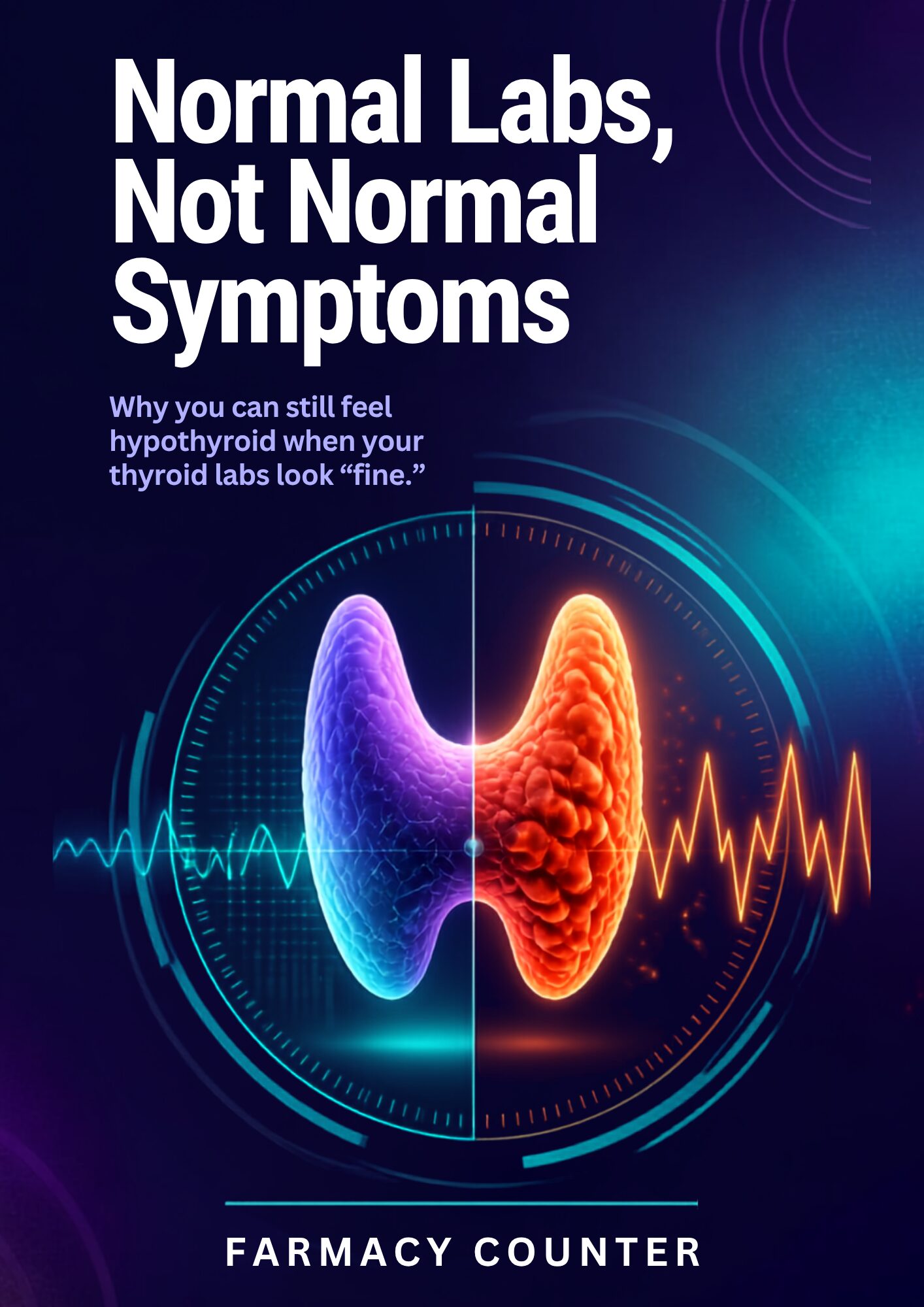
If you’ve been told your labs are normal and you still don’t feel right, start with my free Thyroid Blueprint. It walks you through the full thyroid picture, so you know what to ask and what to check next.
Free instant download. No spam, unsubscribe anytime.
If you’re on thyroid medication and your vitamin D has never been tested, a simple blood test (25-hydroxy vitamin D) shows where you stand. Here’s my honest view of who benefits most from checking:
For healthy adults with no risk factors, the latest Endocrine Society guideline advises against routine testing and high-dose supplementation.[13] So this is about being strategic, not testing everyone.
Work with your provider on a dose. Test first, retest after a few months, and don’t guess. The upper limit for adults is generally 4,000 IU a day unless your provider has directed otherwise,[14] and too much can raise calcium and cause problems. Vitamin D is often paired with magnesium, which your body uses to activate it, and the form you choose matters.
These are the vitamin D and magnesium products I carry. Remember to take magnesium about 4 hours apart from your thyroid medication.
Products shown are available through my Fullscript dispensary. Farmacy Counter may earn a commission on purchases.
When someone says they’re still struggling on thyroid medication, I start with the full picture, not just TSH:
TSH, free T4, free T3, and thyroid antibodies (TPO and thyroglobulin). Many standard panels check TSH alone. Reverse T3 is sometimes used, but its value is debated, so I interpret it cautiously.
Ferritin with a CBC, B12, vitamin D, and selenium status when appropriate.
Fasting glucose, insulin, A1c, and lipids.
A celiac screen if symptoms or autoimmune disease point that way, plus a review of what you take and when.
Timing, interactions, and things like biotin.
Both can lower active thyroid hormone and make symptoms feel worse. (See the hidden stress-thyroid pattern.)
I also use my four working patterns to organize what I find:
Fatigue, hair shedding, low iron, B12, selenium, vitamin D
Wired at night, tired by day, poor sleep, high stress load
Blood sugar swings, cravings, stubborn weight
Bloating, sluggish digestion, puffiness, poor absorption
These are clues that organize questions. They don’t diagnose a cause.
Please call your provider promptly if you have a racing or irregular heartbeat, chest pain, tremor, or sudden anxiety, which can mean your dose is too high, or if you have extreme fatigue, a very slow heartbeat, or confusion.
And if your low mood is heavy or doesn’t lift, talk with your provider or a mental health professional right away. If you’re having thoughts of harming yourself, call or text 988 (the Suicide & Crisis Lifeline in the U.S.).
You’re doing the right thing by taking your medication. The question is whether everything around it is set up to let it work. Vitamin D, absorption, iron, selenium, B12, sleep, and stress are all part of that team.
If you haven’t yet, start with the free Thyroid Blueprint above. And if you’d rather talk through what you’ve been experiencing, I offer a free discovery call. No pressure, just a conversation about whether functional medicine is the right next step for you.
Book Your Free Discovery Call →To your health and vitality, Dr. Ryan
Common reasons include poor absorption of levothyroxine (from coffee, supplements, acid reducers, or gut problems), low iron, B12, selenium, or vitamin D, poor sleep, blood sugar problems, sex hormone changes, and depression. Some people also need a medication adjustment.
People with Hashimoto’s are more likely to have low vitamin D, and a small trial found supplementation lowered thyroid antibodies. The evidence is still mixed, so testing and correcting a deficiency with your provider is a reasonable step.
Coffee, calcium, iron, magnesium, and antacids can reduce absorption. Take levothyroxine on an empty stomach with water, 30 to 60 minutes before breakfast, and separate those supplements by about 4 hours.
Yes. Biotin, common in hair, skin, and nail supplements, can interfere with thyroid blood tests and make results look falsely abnormal. Tell your provider and ask whether to pause it before blood work.
The upper limit for adults is generally 4,000 IU a day unless your provider directs otherwise. Too much can raise calcium levels, so test first and retest after a few months.
For educational purposes only. Not a diagnosis, and not a substitute for care from your healthcare provider. Do not start, stop, or change any medication or supplement without talking with your provider.