
Gut health content online has a nuance problem.
I’ll say it directly: most of what gets shared about gut health isn’t wrong exactly. It’s incomplete. And incomplete advice applied to a complex physiological system doesn’t just fail to help — it can actively make things worse.
The six myths below are things most people have heard, tried, or are currently doing. They’re popular because they contain a kernel of truth. The problem is that the kernel is the whole story being told, when the actual story is significantly more specific.
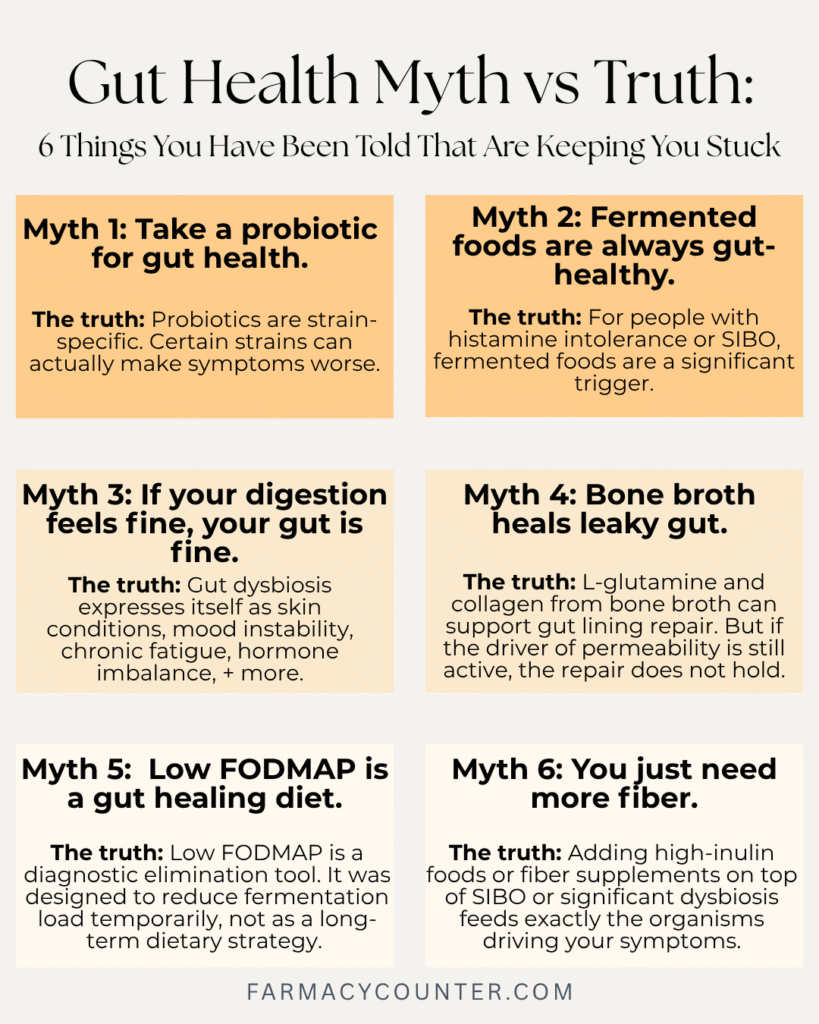
Myth 1: Take a Probiotic for Gut Health
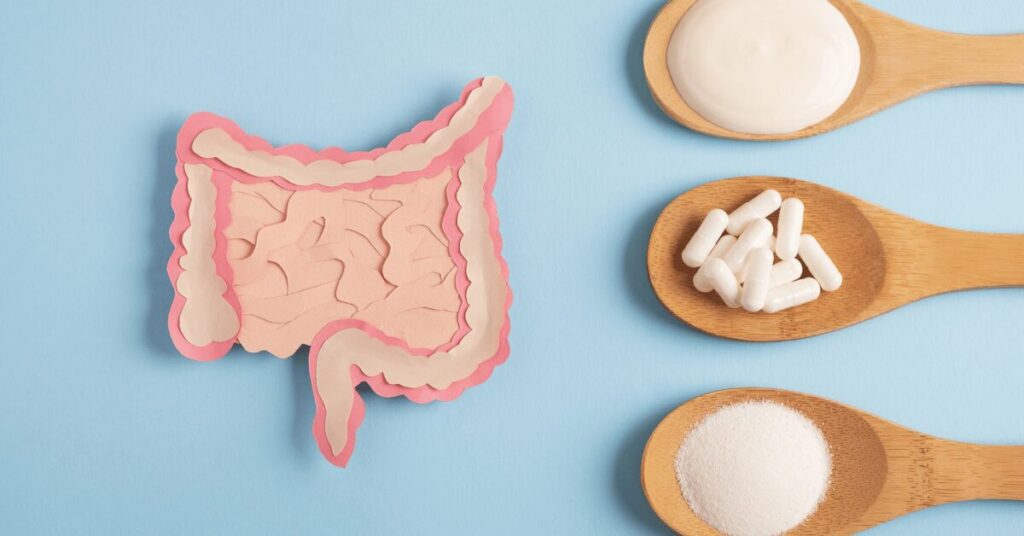
The truth: Probiotics are strain-specific. What strain you take matters more than whether you take one at all — and in certain gut conditions, taking the wrong probiotic makes symptoms significantly worse.
Here’s what gets lost in the generic probiotic conversation: “probiotic” is not a category the way “antibiotic” is. Different strains of the same species do completely different things. Lactobacillus rhamnosus GG has the most robust evidence base for its specific applications — post-antibiotic microbiome restoration, pediatric diarrhea, certain immune applications. Saccharomyces boulardii is a yeast-based probiotic with evidence for C. difficile prevention and traveler’s diarrhea. A generic blend containing neither of those, combined with strains that haven’t been individually studied, isn’t doing what either of those would do.
More importantly: in the context of SIBO — small intestinal bacterial overgrowth — certain Lactobacillus strains actively worsen symptoms. Hydrogen-producing Lactobacillus species fed to a small intestine that already has bacterial overgrowth feeds the overgrowth. People on generic probiotic blends for SIBO often feel worse and attribute it to “die-off” when what’s actually happening is that they’re supplementing the problem.
The right sequence is: test to understand what’s in your gut, then match the probiotic to what the testing shows needs to be addressed. A probiotic without that context is a guess. Sometimes it’s a helpful guess. Sometimes it’s the reason you’re not getting better.
Myth 2: Fermented Foods Are Always Gut-Healthy
The truth: For people with histamine intolerance or SIBO, fermented foods are a significant trigger — and consuming them in the name of gut health can worsen the exact conditions they’re supposed to help.
Fermented foods — kimchi, kefir, sauerkraut, kombucha, aged cheese, miso — are genuinely beneficial for microbiome diversity in people with healthy gut function and adequate histamine clearance capacity. The research supporting fermented food consumption for microbiome health is solid. A 2021 Stanford study found that a high-fermented-food diet increased microbiome diversity and decreased inflammatory markers.
But context determines everything here, and the context that gets left out of the fermented food conversation is histamine.
Many fermented foods are high in histamine — produced during the fermentation process itself. In people with adequate DAO enzyme activity, this dietary histamine is degraded in the gut before it causes problems. In people with histamine intolerance — which, as we covered in the invisible symptoms of gut dysbiosis blog, is driven by dysbiosis-related DAO depletion — adding fermented foods floods a system that can’t clear histamine efficiently. The result is bloating, flushing, headache, racing heart, anxiety, and worsening gut inflammation.
In the context of SIBO, fermented foods can also feed bacterial overgrowth directly. Kombucha, in particular, contains live organisms and fermentable sugars that have been documented to worsen SIBO symptoms. Kefir, depending on the bacterial content, can do the same.
This doesn’t mean fermented foods are bad. It means they’re inappropriate for specific gut conditions — conditions that are extremely common and frequently undiagnosed. Adding fermented foods to someone with untreated SIBO or significant histamine intolerance because “fermented foods are good for the gut” is treating a category without knowing the individual’s pattern.

Myth 3: If Your Digestion Feels Fine, Your Gut Is Fine
The truth: Gut dysbiosis expresses itself as skin conditions, mood instability, chronic fatigue, hormone imbalance, and autoimmune activity. The absence of bloating does not mean a healthy microbiome.
This myth is particularly consequential because it keeps the gut off the investigative radar for a huge category of symptoms that have a gut origin.
When the gut microbiome is dysbiotic — when bacterial balance is disrupted, when inflammatory species are overgrown, when beneficial populations are depleted — the consequences travel. Through LPS-mediated systemic inflammation. Through disrupted neurotransmitter metabolism. Through estrobolome dysfunction. Through impaired short-chain fatty acid production. Through immune dysregulation.
The downstream symptoms look nothing like a digestive problem. As we covered in detail in the invisible symptoms of gut dysbiosis blog, these include morning anxiety that fades by noon, hormonal acne, joint stiffness, blood sugar crashes, flat mood, and low motivation — all with specific gut-bacterial mechanisms driving them.
Someone can have profound gut dysbiosis and never experience significant bloating or digestive discomfort. The gut has other ways of communicating. And as long as the belief persists that a fine-feeling digestive system means a fine gut, those downstream symptoms will continue to be treated in separate departments without anyone identifying the shared origin.

Myth 4: Bone Broth Heals Leaky Gut
The truth: The nutrients in bone broth can support gut lining repair. But if the driver of permeability is still active, those nutrients can’t do their job — and the repair doesn’t hold.
This is a nuance problem rather than a factual error. L-glutamine is the primary fuel source for intestinal epithelial cells and is required for gut lining repair. Collagen provides the structural proteins that intestinal cells use to rebuild tight junction integrity. These are real, documented mechanisms. Bone broth contains both. The claim isn’t wrong.
What the bone broth narrative omits is the concept of the ongoing insult.
Intestinal permeability doesn’t develop in a vacuum. Something is driving it — dysbiosis, SIBO, chronic NSAID use, chronic stress elevating cortisol, a pathogen, a food that’s triggering ongoing immune activation. As long as that driver is present and active, the gut lining is being damaged faster than it can repair.
Applying L-glutamine and collagen to a gut under active assault is like patching a tire that’s still running over nails. The patch can’t hold. You cannot out-supplement an ongoing insult.
This is why people do gut healing protocols — they drink the bone broth, they take the L-glutamine, they feel somewhat better — and then relapse when they stop. The repair agents provided temporary support, but the underlying driver was never identified and addressed.
The correct sequence is: identify what’s driving the permeability, address the driver, then support repair. Not the other way around. For more on the full mechanism of intestinal permeability and what drives it, the leaky gut blog covers this in detail.

Myth 5: Low FODMAP Is a Gut Healing Diet
The truth: Low FODMAP is a diagnostic elimination tool designed to reduce fermentation load temporarily. It was never intended as a long-term dietary strategy — and sustained restriction actively harms the microbiome.
Low FODMAP was developed by researchers at Monash University as a way to identify which fermentable carbohydrates were driving symptoms in IBS patients. The protocol involves a strict elimination phase followed by a systematic reintroduction phase to identify individual triggers. It’s a structured diagnostic tool. It is not a healing protocol.
The confusion happens because people feel significantly better on low FODMAP — which they often do, because it reduces the fermentation load that’s driving their symptoms. That symptom reduction gets interpreted as “this diet is healing my gut” when what’s actually happening is “this diet is reducing the fuel available for fermentation.” The fermentation is being managed. The bacteria causing it aren’t being addressed.
What sustained low FODMAP restriction does to the microbiome is well-documented and concerning. FODMAPs are the primary food source for beneficial gut bacteria — particularly Bifidobacterium species. Long-term low FODMAP restriction consistently reduces Bifidobacterium populations and overall microbial diversity. The very bacteria most associated with gut health, immune regulation, and SCFA production are being starved.
Someone on long-term low FODMAP to manage their symptoms is managing dysbiosis by reducing bacterial activity — at the cost of also reducing the beneficial bacterial populations that would help restore healthy function. They feel better in the short term while their microbiome diversity continues to decline.
The appropriate use of low FODMAP is: short-term reduction of symptom burden, followed by thorough investigation of what’s causing the fermentation that makes FODMAPs symptomatic in the first place, followed by systematic reintroduction as the underlying driver is addressed.
Myth 6: You Just Need More Fiber
The truth: Fiber type matters enormously, and adding the wrong fiber to the wrong gut environment feeds the organisms driving your symptoms rather than the ones that would help.
Fiber is universally promoted for gut health. The research supporting dietary fiber for microbiome diversity and health is robust and consistent. This isn’t a myth about whether fiber matters — it does. It’s a myth about whether more fiber is always the right intervention regardless of gut context.
Here’s the problem: different types of fiber feed different types of bacteria. Inulin and FOS — the high-fiber prebiotic compounds found in garlic, onion, leeks, artichoke, asparagus, and many fiber supplements — selectively feed bacteria that ferment them in the small intestine. In a healthy gut with intact motility and normal bacterial distribution, these compounds feed beneficial bacteria in the colon.
In a gut with SIBO, these same compounds are fermented by overgrown bacteria in the small intestine — exactly where they shouldn’t be. Adding inulin-rich foods or fiber supplements to someone with SIBO increases fermentation in the wrong location, worsening gas, bloating, and distension. The fiber is feeding the problem, not the solution.
The same applies to significant dysbiosis. High-fermentable fibers in a microbiome dominated by gas-producing or inflammatory species feeds those species before it can feed the beneficial ones.
This doesn’t mean fiber is bad or that people with gut issues should avoid it. It means that the type of fiber, and the sequence of introducing it, needs to match the current state of the gut environment. Soluble fiber like psyllium behaves differently than inulin. Resistant starch behaves differently than both. The choice depends on what the gut testing shows is present.
The advice to “eat more fiber” is appropriate for someone with a baseline healthy gut who needs more microbial diversity support. It’s inappropriate — and potentially symptom-worsening — for someone with active SIBO or severe dysbiosis who hasn’t addressed those conditions first.
Why This Pattern Keeps Repeating
All six of these myths share a common structure: they take something that is true in a general sense and apply it without the context that determines whether it’s appropriate for an individual.
Probiotics are beneficial — for the right strains, in the right conditions. Fermented foods support the microbiome — in people who can tolerate histamine and don’t have bacterial overgrowth. Bone broth supports gut lining repair — when the driver of damage has been addressed. Low FODMAP reduces symptoms — as a temporary diagnostic tool, not an indefinite strategy. Fiber supports microbial diversity — when the gut environment can use it appropriately.
The problem isn’t that any of this advice is malicious. It’s that gut health is genuinely complex, and the social media format that most of this advice lives in isn’t designed to carry nuance. The nuance is exactly what determines whether the advice helps you or keeps you stuck.
This is why the starting point for everything in functional gut medicine is identifying what’s actually happening in your gut — not applying popular interventions and hoping one of them matches your pattern.
→ Download the free Bloating Body Map to start identifying which gut pattern your symptoms most likely fall into — before investing more time and money in protocols that may not be designed for your physiology.
Ready to find out what’s actually driving your symptoms? Complete our Digestive Health Assessment and our team will review your full symptom profile to determine your most strategic next step.
→ Start Your Digestive Health Assessment
After reviewing your responses, we’ll recommend the right path forward — whether that includes functional gut testing, a targeted protocol, or a personalized strategy session.
Gut health content has a nuance problem. You deserve the nuance.